
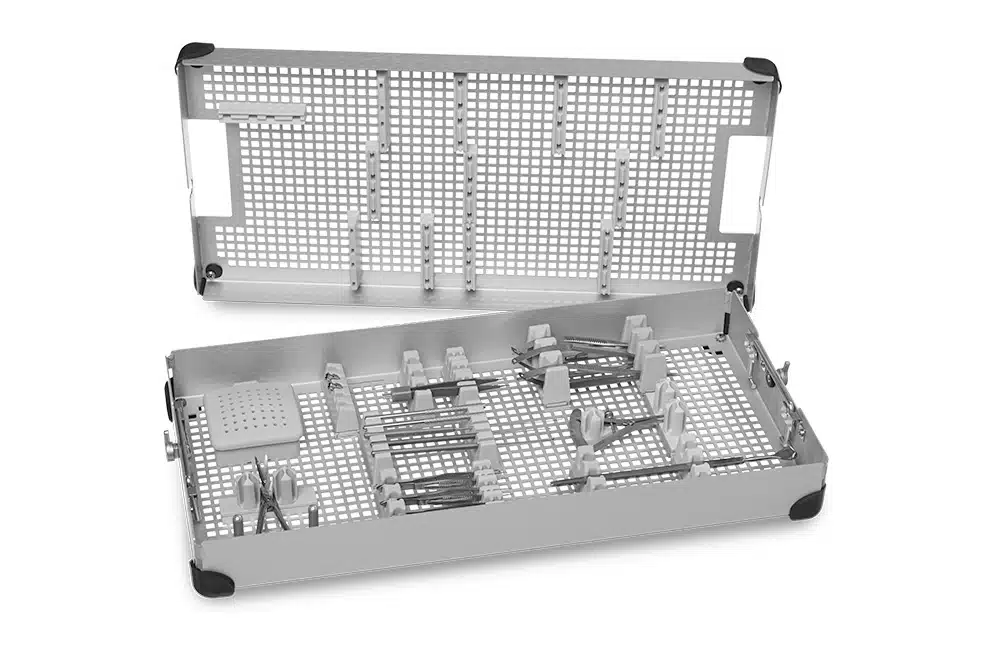
Sterilization boxes are essential in medical, dental, laboratory, and pharmaceutical settings, protecting instruments through sterilization, storage, and transport. This article outlines the precise manufacturing process—from sheet metal selection to final inspection—highlighting key technical considerations.
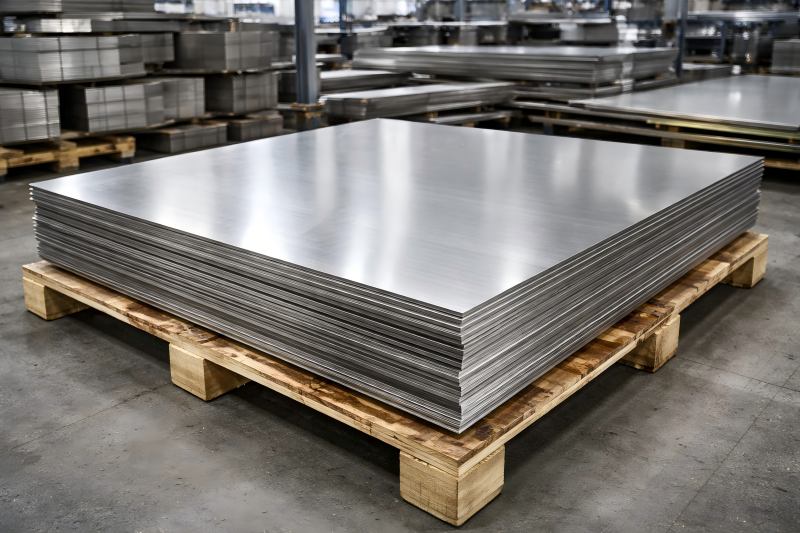
Raw Material Selection: The Foundation of Quality
The manufacturing process begins with selecting suitable sheet metal. Material choice directly affects corrosion resistance, mechanical strength, sterilization compatibility, and product lifespan.
Common Materials Used
| Material Type | Typical Grade | Key Advantages | Typical Applications |
| Stainless Steel | SUS304 / AISI 304 | Excellent corrosion resistance, easy to clean | Medical & dental sterilization |
| Stainless Steel | SUS316 / AISI 316 | Superior chemical resistance, high purity | Surgical & pharmaceutical use |
| Aluminum Alloy | 5052 / 6061 | Lightweight, good formability | Non-critical medical storage |
| Carbon Steel (Coated) | SPCC + coating | Cost-effective, strong | Industrial sterilization boxes |
Material thickness usually ranges from 0.6 mm to 1.5 mm, depending on load requirements and structural design.
Sheet Metal Cutting: Precision Starts Here
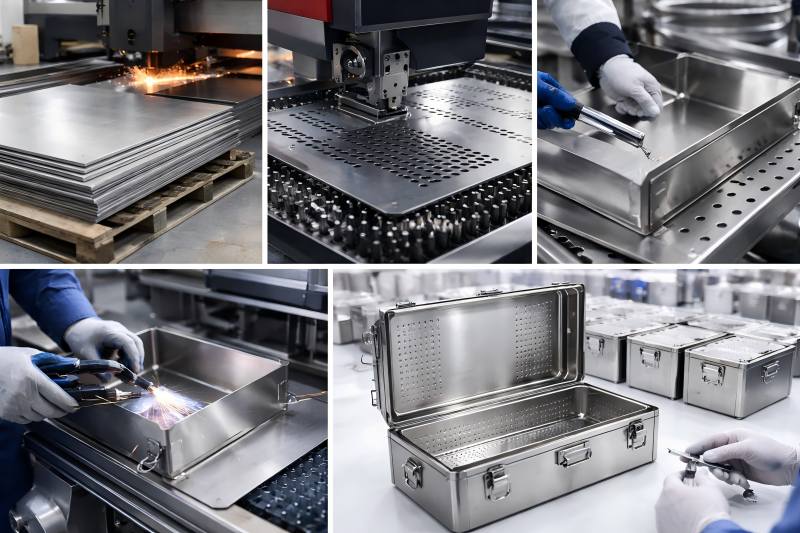
Once the material is selected, large metal sheets are cut into flat blanks based on engineering drawings. Precision at this stage ensures dimensional accuracy throughout the process.
Cutting Methods Comparison
| Cutting Method | Accuracy | Speed | Typical Use |
| Laser Cutting | ±0.05 mm | High | Complex shapes, ventilation slots |
| CNC Punching | ±0.10 mm | Very High | High-volume standardized designs |
| Shearing | ±0.20 mm | Medium | Simple rectangular panels |
| Waterjet Cutting | ±0.10 mm | Medium | Heat-sensitive materials |
Laser cutting is most commonly used for sterilization boxes due to its clean edges and flexibility for intricate perforation patterns.
Punching and Perforation: Functional Design Features
Sterilization boxes require carefully designed holes, slots, and vents to allow steam, gas, or plasma to circulate freely during sterilization cycles.
Typical Perforation Features
- Steam penetration holes
- Drainage slots
- Locking mechanism openings
- Labeling or identification windows
These features are created using CNC punching machines or laser systems, ensuring consistency across batches.
Bending and Forming: Shaping the Structure
After cutting and punching, flat blanks are shaped into three-dimensional components using press brakes.
Key Bending Considerations
- Bend radius to avoid cracking
- Material springback compensation
- Dimensional tolerance control
- Uniform wall thickness
Common Forming Techniques
| Technique | Purpose | Benefit |
| V-Bending | Box sidewalls | High accuracy |
| U-Bending | Lid or tray shapes | Structural strength |
| Hemming | Edge folding | Safety and rigidity |
| Flanging | Lid and base alignment | Improved sealing |
CNC press brakes allow programmable control, ensuring repeatability even for complex multi-bend components.
Welding and Assembly: Building the Box
Once individual panels are formed, they are assembled into a complete sterilization box. Welding quality is critical for strength, hygiene, and appearance.
Common Welding Methods
| Welding Type | Features | Typical Use |
| TIG Welding | Clean seams, precise control | Medical-grade boxes |
| Laser Welding | Minimal distortion | Thin stainless steel |
| Spot Welding | Fast, economical | Internal structural points |
Weld seams are carefully positioned to avoid crevices where bacteria could accumulate.
Grinding and Polishing: Hygiene and Aesthetics
After welding, surfaces are finished to meet hygiene standards. Smooth surfaces reduce contamination risks and improve cleanability.
Surface Finishing Levels
| Finish Type | Roughness (Ra) | Application |
| Brushed Finish | 0.8–1.2 μm | Standard medical use |
| Satin Finish | 0.6–0.8 μm | Surgical instruments |
| Mirror Polish | ≤0.4 μm | High-purity environments |
Edges are rounded and burrs removed to ensure user safety and compliance with medical standards.
Surface Treatment: Safety and Effectiveness
Long-term durability, chemical stability, and corrosion resistance are all improved by surface treatment.
Common Surface Treatments
- Electropolishing – Improves corrosion resistance and surface smoothness
- Passivation – Removes free iron from stainless steel
- Anodizing (for aluminum) – Increases hardness and wear resistance
- Powder Coating (industrial use) – Adds color and surface protection
Electropolishing is especially valued in medical applications for its ability to reduce microbial adhesion.
Component Installation: Functional Assembly
Functional components are installed after surface treatment to avoid damage.
Typical Installed Components
- Hinges and locking mechanisms
- Silicone or PTFE seals
- Identification plates
- Filter holders or vents
Each component must withstand repeated sterilization cycles without degradation.
Dimensional Inspection and Quality Control
Quality control ensures that each sterilization box meets design and regulatory requirements.
Key Inspection Items
| Inspection Type | Purpose |
| Dimensional Measurement | Verify tolerances |
| Weld Integrity Check | Structural safety |
| Surface Roughness Test | Hygiene compliance |
| Fit & Function Test | Lid alignment, locks |
| Load Test | Structural strength |
Inspection is often conducted at multiple stages, including first-article inspection, in-process checks, and final inspection.
Cleaning, Packaging, and Traceability
Sterilization boxes are meticulously cleaned to eliminate manufacturing residues prior to distribution.
Final Preparation Steps
- Ultrasonic or high-pressure cleaning
- Dust-free drying
- Protective film application
- Individual packaging
Each box is typically assigned a batch number or serial code for traceability, supporting medical compliance and after-sales tracking.
Manufacturing Process Overview Table
| Step | Process Stage | Key Equipment |
| 1 | Material Selection | Material inspection tools |
| 2 | Cutting | Laser cutter / CNC punch |
| 3 | Perforation | CNC punching machine |
| 4 | Forming | CNC press brake |
| 5 | Welding | TIG / laser welding |
| 6 | Finishing | Grinding & polishing machines |
| 7 | Surface Treatment | Electropolishing line |
| 8 | Assembly | Manual or semi-automatic |
| 9 | Inspection | CMM, gauges |
| 10 | Packaging | Cleaning & packing station |
Transforming sheet metal into a sterilization box requires precise engineering, strict quality control, and hygiene compliance. Each manufacturing step affects performance, safety, and durability in medical and laboratory environments.