
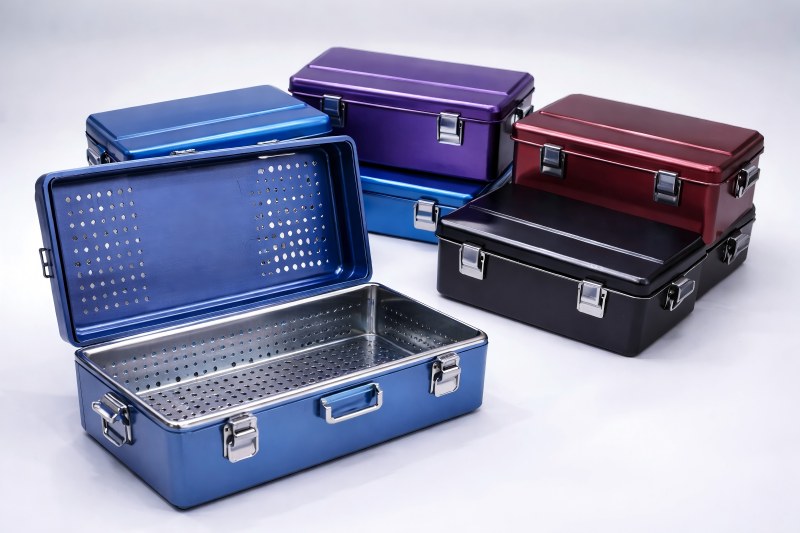
Sterilization boxes are vital in medical, laboratory, pharmaceutical, and industrial settings, protecting instruments during sterilization, storage, and transport while meeting strict hygiene and durability standards. Surface treatment affects corrosion resistance, cleanability, service life, and compliance in addition to material selection.
Why Surface Treatment Matters for Sterilization Boxes
Sterilization containers are repeatedly exposed to:
- High temperatures (steam sterilization up to 134 °C)
- Aggressive chemicals (disinfectants, detergents)
- Moisture and pressure cycles
- Mechanical handling and stacking
- Strict hygiene and contamination-control standards
Without proper surface treatment, even high-quality metal enclosures can suffer from corrosion, discoloration, surface roughening, or microbial adhesion.
Key Performance Goals of Surface Treatment
| Requirement | Importance |
| Corrosion resistance | Prevents rust and material degradation |
| Smooth surface | Reduces bacterial adhesion |
| Chemical stability | Withstands cleaning agents |
| Sterilization compatibility | Endures repeated autoclave cycles |
| Durability | Extends service life |
| Cleanability | Enables fast, effective cleaning |
Surface anodizing and electro-polishing address these goals in different ways.
Overview of Surface Anodizing
What Is Surface Anodizing?
The electrochemical oxidation method known as surface anodizing is mostly applied to aluminum and aluminum alloys. On the metal surface, anodizing produces a thick, stable layer of aluminum oxide (Al2O3).
This oxide layer will not peel or flake since it is an inherent part of the metal, unlike coatings or paints.
How Anodizing Works
- The aluminum part is cleaned and degreased
- The part is submerged in an electrolyte bath (typically sulfuric acid)
- Direct current is applied
- Oxygen ions react with aluminum to form a porous oxide layer
- Pores may be sealed (hot water or nickel acetate)
The result is a hard, corrosion-resistant, electrically insulating surface.
Typical Anodizing Types for Sterilization Boxes
| Anodizing Type | Thickness | Characteristics | Typical Use |
| Sulfuric Anodizing | 5–25 μm | Standard corrosion protection | Medical trays |
| Hard Anodizing | 25–60 μm | High wear resistance | Industrial boxes |
| Sealed Anodizing | Variable | Improved chemical resistance | Sterile environments |
Overview of Electro-Polishing
What Is Electro-Polishing?
Electro-polishing is an electrochemical surface finishing process mainly used for stainless steel. It removes a controlled layer of material from the surface, smoothing microscopic peaks and reducing surface roughness.
Often described as the reverse of electroplating, electro-polishing improves both appearance and hygiene performance.
How Electro-Polishing Works
- The stainless steel part is cleaned
- The part is submerged in an acidic electrolyte
- Part acts as the anode
- High points dissolve faster than low points
- Surface becomes smoother and more uniform
This process also enhances the chromium-rich passive layer, improving corrosion resistance.
Typical Electro-Polishing Outcomes
- Reduced surface roughness (Ra ≤ 0.4 μm)
- Enhanced corrosion resistance
- Mirror-like or satin finish
- Reduced microbial adhesion
- Improved cleanability
Material Compatibility: A Key Difference
One of the most important distinctions between anodizing and electro-polishing is material compatibility.
| Surface Treatment | Compatible Materials |
| Surface Anodizing | Aluminum, aluminum alloys |
| Electro-Polishing | Stainless steel (304, 316, 316L) |
Sterilization boxes made of stainless steel cannot be anodized, while aluminum boxes cannot be electro-polished in the same manner. Therefore, base material selection often determines the surface treatment route.
Surface Roughness and Hygiene Performance
Surface smoothness directly affects microbial retention and cleaning efficiency.
Surface Roughness Comparison
| Treatment | Typical Ra Value | Hygiene Implication |
| Untreated stainless steel | 1.0–1.5 μm | Moderate bacterial adhesion |
| Brushed stainless steel | 0.8–1.2 μm | Acceptable for general use |
| Electro-polished stainless steel | ≤0.4 μm | Excellent hygiene |
| Anodized aluminum | 0.6–1.0 μm (sealed) | Good hygiene |
Electro-polishing delivers superior smoothness, making it ideal for high-risk medical and surgical environments.
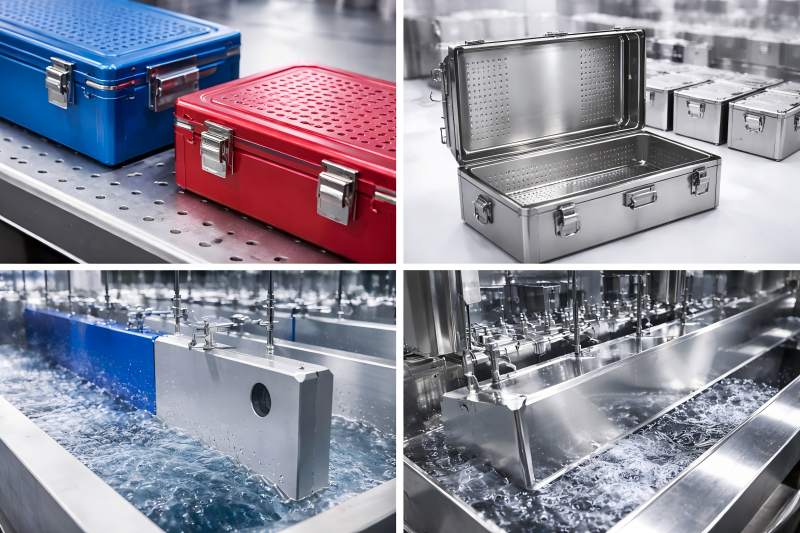
Corrosion Resistance Comparison
Electro-Polishing and Corrosion Resistance
Electro-polishing enhances the chromium oxide passive layer on stainless steel, resulting in:
- Improved resistance to chlorides
- Better performance in steam sterilization
- Reduced pitting and crevice corrosion
Anodizing and Corrosion Resistance
Anodizing creates a thick aluminum oxide barrier that:
- Protects against oxidation
- Performs well in humid environments
- Can degrade under strong alkaline cleaners if not sealed
Corrosion Performance Table
| Condition | Anodized Aluminum | Electro-Polished Stainless Steel |
| Steam sterilization | Good | Excellent |
| Chemical disinfectants | Moderate–Good | Excellent |
| Chloride exposure | Limited | High |
| Long-term moisture | Good | Excellent |
Sterilization Compatibility
Sterilization boxes may undergo hundreds or thousands of cycles.
Compatibility with Sterilization Methods
| Sterilization Method | Anodized Aluminum | Electro-Polished Stainless Steel |
| Steam (Autoclave) | Suitable (sealed) | Ideal |
| Plasma (H₂O₂) | Suitable | Suitable |
| Ethylene Oxide (EtO) | Suitable | Suitable |
| Chemical immersion | Limited | Excellent |
Electro-polished stainless steel shows greater long-term stability across diverse sterilization methods.
Mechanical Durability and Wear Resistance
Anodized Surfaces
- Hard anodizing provides excellent wear resistance
- Surface is hard but brittle
- Deep scratches expose the base aluminum
Electro-Polished Surfaces
- No added thickness
- Retains base material toughness
- Scratches are less likely to propagate corrosion
| Property | Anodizing | Electro-Polishing |
| Surface hardness | High | Same as base metal |
| Scratch resistance | High (hard anodized) | Moderate |
| Damage tolerance | Moderate | High |
Appearance and Aesthetic Considerations
While aesthetics are secondary to hygiene, they still matter in professional environments.
| Feature | Anodizing | Electro-Polishing |
| Color options | Multiple colors | Metallic silver only |
| Finish | Matte to satin | Satin to mirror |
| Long-term appearance | Stable | Very stable |
Anodizing allows color coding, which can be useful for instrument classification, while electro-polishing emphasizes a clean, premium medical look.
Manufacturing Cost and Complexity
Cost Comparison Factors
| Factor | Anodizing | Electro-Polishing |
| Process cost | Lower–Moderate | Moderate–High |
| Energy consumption | Moderate | Higher |
| Process control | Medium | High |
| Batch consistency | High | Very high |
Electro-polishing generally costs more due to tighter process control and chemical management, but delivers higher hygiene performance.
11. Regulatory and Medical Compliance
Electro-polished stainless steel is widely accepted in:
- ISO 13485 medical manufacturing
- FDA-regulated medical devices
- GMP pharmaceutical facilities
- Cleanroom environments
Anodized aluminum is more commonly used in:
- Instrument trays
- Non-critical sterilization containers
- Industrial medical support equipment
12. Typical Application Scenarios
When to Choose Anodizing
- Lightweight sterilization boxes
- Cost-sensitive projects
- Non-surgical instrument storage
- Color-coded workflows
- Industrial or laboratory environments
When to Choose Electro-Polishing
- Surgical instrument sterilization
- Repeated high-temperature autoclave use
- Pharmaceutical cleanrooms
- High hygiene and contamination control
- Long service life requirements
Summary Comparison Table
| Aspect | Surface Anodizing | Electro-Polishing |
| Base material | Aluminum | Stainless steel |
| Surface smoothness | Good | Excellent |
| Corrosion resistance | Good | Excellent |
| Hygiene performance | Good | Excellent |
| Sterilization durability | Good | Excellent |
| Cost | Lower | Higher |
| Medical compliance | Limited | Extensive |
Surface anodizing and electro-polishing are both valuable surface treatments for sterilization boxes, but they serve different performance priorities.
Anodizing offers lightweight construction, cost efficiency, and wear resistance, making it suitable for general medical and industrial sterilization boxes.
Electro-polishing delivers unmatched hygiene, corrosion resistance, and sterilization stability, making it the preferred choice for surgical, pharmaceutical, and high-risk medical applications.
Selecting the right surface treatment requires balancing material choice, hygiene requirements, sterilization methods, cost constraints, and regulatory standards.