
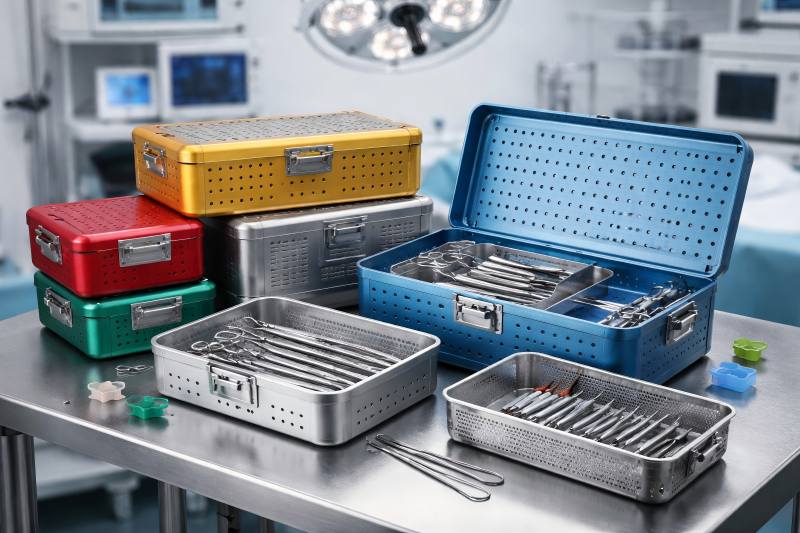
Sterilization boxes are essential in healthcare, laboratory, pharmaceutical, and industrial settings, requiring precise, durable design to protect contents during sterilization, storage, and transport, with customization adding true functional value.
Why Custom Sterilization Boxes Matter
Sterilization boxes are not one-size-fits-all products. Different instruments, workflows, and sterilization methods require tailored solutions that balance:
- Instrument fit and protection
- Sterilant penetration and drainage
- Ease of handling and logistics
- Regulatory compliance
- Durability and cleanability
Custom boxes ensure that instruments are not loose or overcrowded — both of which compromise sterilization effectiveness and damage integrity.
Core Components of Sterilization Box Customization
When designing custom sterilization boxes, manufacturers and buyers should consider the following key parameters:
- Box Size and Volume
- Box Color and Markings
- Internal Configurations and Trays
- Lid Type and Sealing Mechanisms
- Handles and Ergonomics
- Labeling and Identification
- Accessory Options
Each factor influences workflow efficiency, sterilization reliability, and user satisfaction.
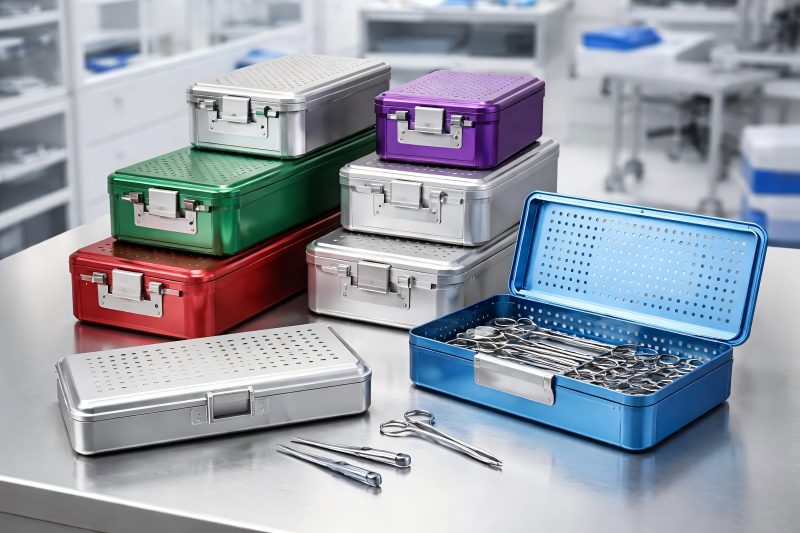
Standard & Custom Box Sizes
Sterilization boxes are typically defined by interior dimensions (length × width × height), which determine the usable space for instruments and trays. Sizes range from compact units designed for small tool sets to large capacity boxes for extensive sets or instruments.
Standard Size Chart
| Size Code | Interior Dimensions (mm) | Exterior Dimensions (mm) | Typical Use Case |
| S-100 | 200 × 150 × 75 | 230 × 180 × 90 | Small hand instruments |
| M-200 | 300 × 200 × 100 | 330 × 230 × 115 | Medium instrument sets |
| L-300 | 400 × 250 × 150 | 430 × 280 × 165 | Larger instrument kits |
| XL-400 | 500 × 350 × 200 | 530 × 380 × 220 | High-capacity trays |
Custom Size Considerations
Custom sizes are often needed when:
- Instruments exceed standard dimensions
- Multiple tray levels are required
- Workflow constraints demand non-standard sizing (e.g., narrower cabinets, specialized sterilizers)
- Volume optimization is needed for specific sterilization equipment
Custom sizing benefits:
- Maximizes usable space
- Reduces wasted chamber volume
- Improves sterilant circulation
- Enhances ergonomic handling
Colors & Visual Identification
Color is more than aesthetic; it serves functional purposes in workflow differentiation, contamination control, and departmental organization.
Standard Color Options
| Color | Common Meaning in Healthcare | Advantages |
| Silver / Metallic | Standard sterilization | Neutral, professional |
| Blue | Clean/Ready for use | Easy visual cue |
| Green | Sterile/Approved | Universally associated with sterile status |
| Red | High-risk/Quarantine | Alerts handlers to caution |
| Yellow | Reprocessing / Dirty | Indicates need for cleaning/processing |
Custom Color Coding Systems
Organizations often adopt custom color schemes tied to:
- Department (e.g., OR vs. ICU vs. Dental)
- Sterilization method (e.g., steam vs. EO vs. plasma)
- Instrument type or specialty
These systems improve efficiency and reduce error rates in busy environments.
Internal Configuration Options
Internal configurations are critical. They determine instrument separation, sterilant accessibility, drainage, and protection.
Tray & Basket Configurations
| Configuration | Description | Best For |
| Single Tray | One removable tray | Simple instrument sets |
| Multi-Tier Trays | Two or more stacked trays | Maximizes volume |
| Mesh Basket | Perforated basket | Enhanced sterilant flow |
| Custom Inserts | Foam or fitted slots | Delicate instrument protection |
| Divider Grid | Fixed partitions | Organized placement |
Tray Material Options
| Material | Advantages |
| Stainless Steel | Corrosion resistance, durability |
| Aluminum | Light weight, cost-efficient |
| High-Grade Polymer | Light, non-corroding, quieter |
Lid & Sealing Mechanisms
Lids can be simple hinged covers or advanced designs incorporating sealing and locking features.
Lid Types
| Type | Description | Use Case |
| Removable Lid | Fully detachable | Easy access |
| Hinged Lid | Attached with a hinge | Frequent use |
| Locking Lid | Includes a locking mechanism | Transit or secure storage |
| Gasketed Lid | Rubber/silicone gasket | Enhanced moisture control |
While most sterilization boxes rely on perforated surfaces for sterilant penetration rather than full seals, gasketed and locking lids are valuable where cross-contamination and transport integrity are concerns.
Handles & Ergonomics
Ergonomic design reduces strain, improves safety, and accelerates workflow throughput.
Handle Styles
| Handle Type | Advantages |
| Fixed Side Handles | Durable, rugged |
| Fold-Down Handles | Compact storage |
| Soft Grip Handles | Comfortable, reduces hand fatigue |
| Telescoping Handles | Adjustable reach for tall users |
Handles are typically coated with polymer sleeves for comfort and slip resistance. Their positioning should also balance weight distribution when the box is fully loaded.
Labeling, Markings, and Identification
Labeling ensures traceability and compliance with sterilization and documentation protocols.
Permanent vs. Temporary Labels
| Label Type | Best Use Case |
| Laser-etched Marking | Serial numbers, permanent ID |
| Color-coded Labels | Workflow status |
| Barcodes / RFID Tags | Inventory tracking |
| Writable Panels | Custom notes or dates |
Integration of labels with sterilization record systems enables digital traceability and regulatory compliance.
Sterilization Compatibility & Material Selection
Custom manufacturing must consider sterilization compatibility. The most common sterilization methods include:
- Steam (Autoclave)
- Ethylene Oxide (EtO)
- Hydrogen Peroxide Plasma
- Dry Heat
- Gamma Irradiation
Material Compatibility Chart
| Material | Steam | EtO | Plasma | Dry Heat | Gamma |
| 304 SS | ✓ | ✓ | ✓ | ✓ | ✓ |
| 316L SS | ✓ | ✓ | ✓ | ✓ | ✓ |
| Anodized Aluminum | ✓ | ✓ | ✔ | ✔ | ✗ |
| Polymer (PTFE/HDPE) | ✗ | ✓ | ✗ | ✗ | ✗ |
Legend:
✓ – Highly compatible
✔ – Moderately compatible
✗ – Not recommended
Custom Configurations by Application
Different workflows demand tailored solutions. Here are common configurations by industry:
Healthcare & Hospitals
- Multi-tier trays for surgical instruments
- Color coding by department
- Barcode/RFID for inventory control
- Secure locking for inter-department transport
Dental Clinics
- Compact, single-tier boxes
- Removable mesh baskets
- Writable panels for chairside identification
Laboratories
- Custom inserts for delicate tools
- Modular tray systems
- Polymer instrument holders for temperature protection
Surface Treatment & Finish Options
Surface finishes impact sterilization effectiveness and longevity.
Typical Finishes
| Finish Type | Benefits |
| Electropolished | Smooth surface, easier cleaning, improved corrosion resistance |
| Passivated | Enhanced oxidation resistance |
| Anodized (Aluminum) | Hard, protective layer |
| Bead Blasted | Matte finish minimizes glare |
Electropolishing is especially beneficial for stainless steel boxes because it reduces surface roughness — critical for preventing biofilm formation and enhancing cleanability.
Compliance & Regulatory Standards
Custom sterilization boxes must align with international and industry standards, including:
- ISO 13485 – Medical devices quality management systems
- ANSI/AAMI ST79 – Comprehensive sterilization guidance
- FDA 21 CFR – Device manufacturing controls (where applicable)
- CE Marking – EU compliance for medical devices
Documentation and traceability are key components in compliance. Customized serial numbers and barcode tracking ensure that each box can be traced for sterilization records and audit trails.
Manufacturing Best Practices
When selecting a custom sterilization box manufacturer, consider:
- Precision fabrication capabilities
- Experience with medical/Lab standards
- Material traceability
- Quality control procedures
- Customization flexibility
- After-sales support
Quality Inspection Checklist
- Dimensional accuracy
- Surface finish conformity (Ra measurements)
- Handle and hardware torque testing
- Sterilant penetration verification
- Labeling readability and durability
Cost Considerations
Pricing is influenced by:
- Material (304 vs. 316L stainless steel)
- Size and complexity
- Surface finish
- Custom trays and inserts
- Quantity ordered
- Regulatory documentation package
14.1 Cost Comparison Snapshot (Illustrative)
| Feature | Standard Box | Custom Box |
| Size | Predefined | Tailored |
| Surface Finish | Standard (Bead Blast) | Electropolished/Anodized |
| Internal Trays | Optional | Custom Insert Included |
| Labeling | Basic | Barcode/RFID + Etched ID |
| Average Cost | $120–$250 | $250–$700+ |
(Note: Actual prices vary by region, manufacturer capabilities, and order volume.)
Choosing the Right Configuration: A Step-by-Step Guide
Step 1: Define Application Needs
- Instrument type, weight, and geometry
- Workflow sterilization method
- Frequency of use
Step 2: Select Appropriate Size
- Ensure instrument fit with buffer space
- Consider stackability and sterilizer chamber limits
Step 3: Choose Color & Labeling Scheme
Department mapping
Workflow status indicators
Barcode/RFID integration
Step 4: Determine Internal Configuration
- Tray count
- Mesh or perforation needs
- Custom inserts for precision fit
Step 5: Confirm Material & Finish
- Corrosion resistance requirements
- Cycle frequency
- Regulatory standards
Step 6: Validate Ergonomic Features
- Handle type
- Weight distribution
- Stackability
Case Studies: Custom Solutions in Action
Surgical Instrument Sets
- Need: Mixed instrument set for cardiac surgery
- Solution: Multi-tier trays with custom dividers and electropolished finish
- Benefits: Perfect fit, better sterilant flow, reduced cycle time
Dental Clinic Packs
- Need: Compact sterilization boxes for chairside reuse
- Solution: Small footprint box with color coding and RFID
- Benefits: Traceability, rapid identification, ergonomic handling
Emerging Trends in Sterilization Box Design
- Smart labeling and IoT tracking
- Lightweight composite trays for ergonomic efficiency
- Color-coded visual management systems
- Modular stackable designs
- Sustainable material options
Custom sterilization box manufacturing balances materials, design, and ergonomics to ensure safety, compliance, and sterilization efficiency. Well-engineered solutions improve workflows, reduce errors, and extend instrument lifecycles.