
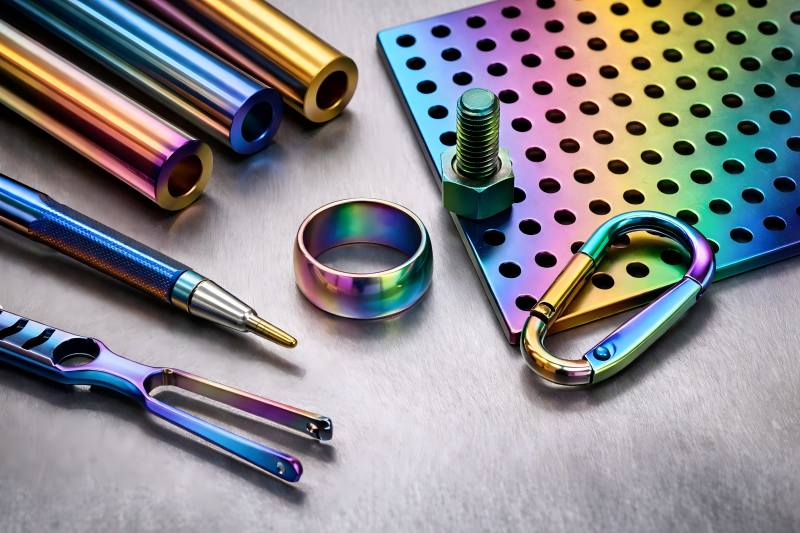
Titanium is already well-known for its remarkable biocompatibility, corrosion resistance, and strength-to-weight ratio. When anodized, it gains an additional advantage: vibrant, durable colors created without paints or dyes. Anodized titanium combines engineering performance with aesthetic versatility, making it highly desirable in aerospace, medical, industrial, architectural, and consumer applications.
This definitive guide explores what anodized titanium is, how the anodizing process works, the science behind its colors, key benefits, technical considerations, and real-world applications.
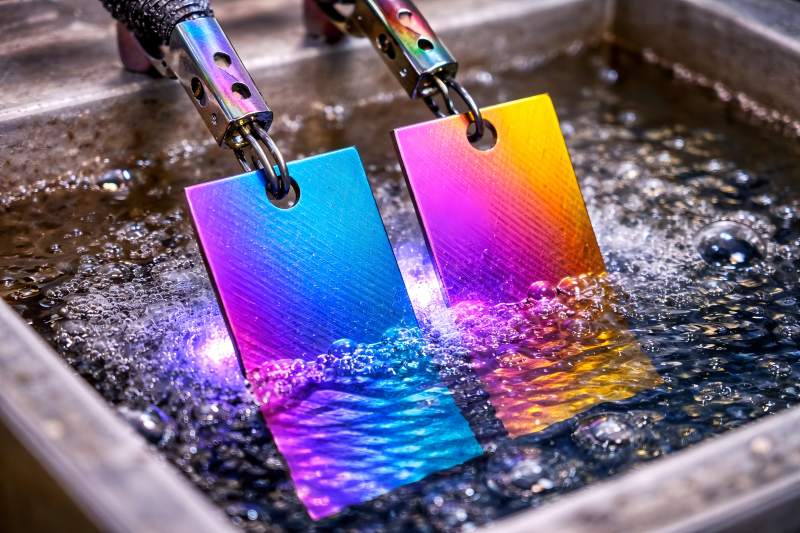
How Does Anodized Titanium Work?
Anodized titanium is titanium that has had its natural oxide layer thickened by an electrochemical surface treatment. Unlike anodized aluminum, titanium anodizing does not rely on dyes. Instead, it produces color through light interference caused by varying oxide thickness.
Titanium naturally forms a thin oxide layer (TiO₂) when exposed to oxygen. This oxide layer is carefully thickened by anodizing. The resulting surface:
- Becomes more corrosion-resistant
- Gains electrical insulation properties
- Displays permanent interference colors
- Maintains dimensional integrity
Importantly, the color is not a coating or pigment. It is a physical optical effect produced by the oxide thickness.
How the Titanium Anodizing Process Works
Titanium anodizing is an electrolytic process. In an electrochemical cell, the titanium component acts as the anode, or positive electrode.
Step-by-Step Process
Surface Preparation
Cleaning removes oils, contaminants, and oxides. Mechanical polishing or bead blasting may be used depending on the desired finish.
Bath of Electrolytes
An electrolyte solution is used to immerse the titanium component. Common electrolytes include phosphoric acid, sulfuric acid, or alkaline solutions.
Voltage Application
Direct current is applied. Voltage determines oxide thickness and, therefore, color.
Oxide Layer Growth
The oxide film thickens in proportion to voltage.
Rinsing and Drying
The part is cleaned and dried. No sealing step is required, unlike aluminum anodizing.
The process is clean, precise, and highly repeatable when voltage control is accurate.
The Science Behind Titanium Anodizing Colors
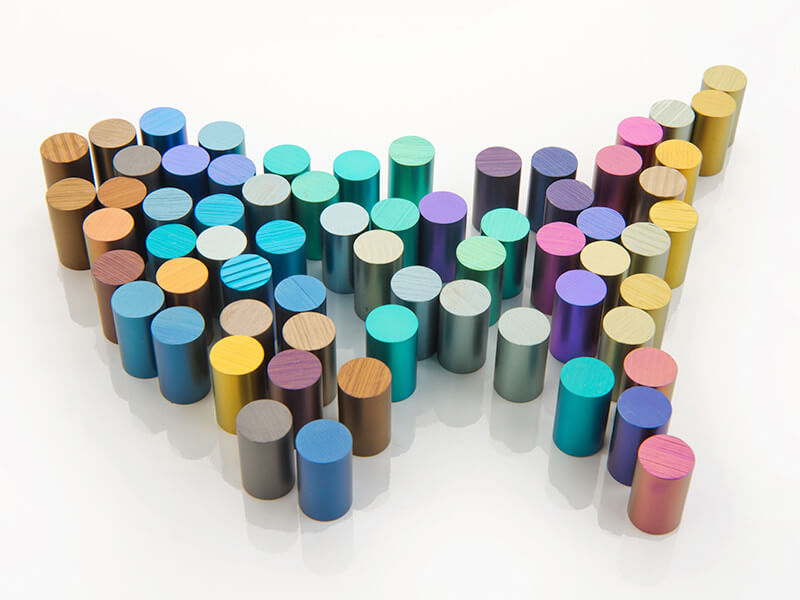
The striking colors of anodized titanium result from thin-film interference.
When light strikes the oxide layer:
- Some light reflects from the outer oxide surface.
- Some light passes through and reflects from the metal-oxide interface.
- The two reflected waves are interfering with one another.
Certain wavelengths cancel out while others reinforce, creating visible hues, depending on the thickness of the oxide.
Voltage vs. Color Relationship
| Voltage Range (Approx.) | Oxide Thickness (nm) | Typical Color |
| 10–20 V | 20–40 nm | Light gold / bronze |
| 25–35 V | 40–55 nm | Purple |
| 40–55 V | 55–80 nm | Blue |
| 60–75 V | 80–100 nm | Teal / green |
| 80–100 V | 100–120 nm | Yellow / pink |
| 100+ V | 120–150+ nm | Green / multi-tone |
Color consistency depends on:
- Surface finish
- Alloy composition
- Voltage precision
- Electrolyte purity
Unlike painted finishes, anodized colors do not chip because they are part of the oxide structure itself.
Types of Titanium Anodizing
Titanium anodizing can be categorized based on its purpose.
1. Type I – Decorative / Color Anodizing
- Low voltage
- Produces interference colors
- Used in jewelry, consumer products, and medical tools
2. Type II – Functional Anodizing
- Higher voltage
- Improves wear and corrosion resistance
- May not prioritize color
3. Type III – Hard Anodizing / Plasma Electrolytic Oxidation (PEO)
- Very high voltage
- Creates thicker, ceramic-like oxide
- Enhances wear resistance and hardness
Each type serves different engineering and aesthetic goals.
Key Benefits of Anodized Titanium
1. Exceptional Corrosion Resistance
Titanium already resists seawater, chlorides, and body fluids. Anodizing further strengthens its protective oxide layer.
2. Biocompatibility
The oxide layer is perfect for implants and surgical tools because it is non-toxic and compatible with human flesh.
3. Lightweight Strength
Anodizing does not add significant thickness or weight.
4. Permanent Color Without Dyes
Colors cannot peel or flake because they are not applied coatings.
5. Electrical Insulation
The oxide layer increases electrical resistance, beneficial in electronics.
6. Low Maintenance
No additional sealing or painting required.
Common Applications of Anodized Titanium
Aerospace Industry
- Fasteners
- Structural components
- Engine parts
- Identification color coding
Anodizing assists with part identification and enhances corrosion protection in harsh environments.
Medical Field
- Orthopedic implants
- Dental implants
- Surgical instruments
- Color-coded medical tools
Surgeons often use color anodizing for instrument differentiation without introducing contaminants.
Consumer Goods
- Watches
- Eyewear frames
- Jewelry
- Smartphones and accessories
Titanium jewelry benefits particularly from vibrant colors without plating.
Industrial Equipment
- Chemical processing components
- Marine hardware
- Precision tools
- Fasteners
Anodized titanium performs exceptionally well in aggressive environments.
Surface Finish and Preparation Considerations
The final appearance of anodized titanium depends heavily on surface preparation.
Polished Surface
- High reflectivity
- More vivid color appearance
Matte / Bead-Blasted Finish
- Softer color tone
- Reduced glare
Brushed Finish
- Directional aesthetic
- Industrial appearance
Surface contamination (oil, fingerprints, oxide inconsistencies) can cause uneven coloring. Strict cleaning protocols are essential.
Titanium Alloys and Anodizing Compatibility
Most commercially pure titanium grades and common alloys can be anodized.
Common Grades
| Alloy | Anodizing Behavior | Typical Uses |
| Grade 2 (CP Titanium) | Excellent color consistency | Medical, marine |
| Grade 5 (Ti-6Al-4V) | Good, slightly varied tone | Aerospace, high strength parts |
| Grade 7 | Superior corrosion resistance | Chemical processing |
Different alloy compositions slightly affect oxide growth and final color.
Limitations and Technical Challenges
Despite its advantages, anodized titanium has certain limitations:
Color Control Sensitivity
Small voltage changes can significantly alter color. Precision power supply is critical.
Wear Resistance (Decorative Types)
Thin decorative anodizing may scratch under heavy abrasion.
Limited Dark Colors
True black cannot be achieved through standard interference anodizing.
Surface Uniformity
Complex geometries may produce minor shade variation.
Understanding these limitations ensures appropriate application selection.
Hard Anodizing and Plasma Electrolytic Oxidation (PEO)
Plasma Electrolytic Oxidation (PEO) is an advanced anodizing technique that creates:
- Thicker oxide layers
- Ceramic-like surfaces
- Higher hardness
- Superior wear resistance
- Applications include:
- Engine components
- Aerospace structural parts
- Biomedical implants requiring improved osseointegration
PEO coatings are typically gray, white, or ceramic in appearance rather than brightly colored.
Maintenance and Care
Anodized titanium requires minimal maintenance:
- Clean with mild soap and water
- Avoid harsh abrasives for decorative finishes
- No repainting or recoating needed
The oxide layer is stable and self-healing if lightly damaged.
Environmental Considerations
Titanium anodizing is relatively environmentally friendly compared to plating processes because:
- No heavy metal deposition
- No paint solvents
- Minimal hazardous waste
Electrolytes must still be handled responsibly according to environmental regulations.
Cost Factors
The cost of anodized titanium depends on:
- Part size and complexity
- Surface preparation requirements
- Voltage precision needs
- Alloy grade
- Production volume
Decorative anodizing is generally cost-effective, while advanced PEO treatments are more expensive due to equipment and energy requirements.
Anodized Titanium vs. Coated Titanium
| Feature | Anodized Titanium | Painted / Coated Titanium |
| Color Source | Oxide interference | Applied pigment |
| Durability | High | Moderate |
| Chipping Risk | None | Possible |
| Thickness Added | Minimal | Moderate |
| Maintenance | Low | Moderate |
Anodizing integrates color into the metal surface, making it more durable than coatings.
Future Trends in Titanium Anodizing
Emerging developments include:
- Precision voltage-controlled robotic anodizing
- Gradient color techniques
- Biomedical surface engineering
- Integration with additive manufacturing (3D-printed titanium parts)
- Nano-structured oxide layers for improved bioactivity
As industries demand lightweight, durable, and corrosion-resistant materials with aesthetic flexibility, anodized titanium will continue to grow in popularity.
Anodized titanium represents a powerful combination of performance and aesthetics. By controlling oxide thickness through voltage, manufacturers can create durable, corrosion-resistant surfaces in a spectrum of vibrant colors without dyes or coatings. Beyond decoration, functional anodizing and advanced techniques like PEO enhance hardness, wear resistance, and electrical properties.
Whether used in aerospace, medical implants, marine systems, industrial equipment, or high-end consumer products, anodized titanium offers a unique balance of strength, longevity, and visual appeal. Optimal outcomes and long-term performance are ensured by comprehending the science, process parameters, and application factors.