
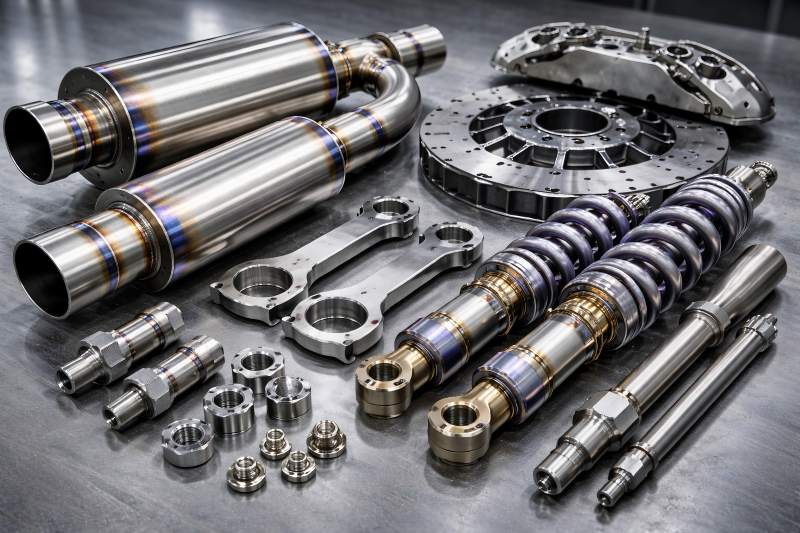
From performance supercars to aerospace-inspired vehicles, titanium car parts are increasingly integrated into engines, suspension systems, exhausts, and fasteners. However, using titanium requires understanding its grades, manufacturing techniques, and design principles. This guide explores these aspects to help engineers, manufacturers, and automotive enthusiasts make informed decisions.
Why Titanium in Automotive Applications?
Titanium provides several advantages over conventional metals such as steel and aluminum:
- High Strength-to-Weight Ratio: Titanium alloys maintain structural strength at significantly lower weight, improving vehicle performance and fuel efficiency.
- Temperature Stability: Titanium retains mechanical properties at high temperatures, making it ideal for exhaust systems, turbocharger components, and engine parts.
- Fatigue Resistance: The high fatigue strength lowers the chance of failure in crucial automotive components by ensuring long-term endurance under cyclic loading.
- Example: Titanium exhaust systems reduce weight by 40–50% compared to stainless steel while improving heat resistance.
Titanium Grades Used in Automotive Components
Titanium alloys are classified into commercially pure (CP) grades and alloyed grades. Each grade offers a unique balance of strength, ductility, and corrosion resistance.
Common Titanium Grades in Automotive Applications
| Grade | Type | Composition (wt%) | Yield Strength (MPa) | Applications |
| Grade 1 | CP Titanium | >99% Ti | 170 | Exhausts, corrosion-resistant panels |
| Grade 2 | CP Titanium | >99% Ti | 275 | Body components, heat shields |
| Grade 5 | Ti-6Al-4V | 6% Al, 4% V | 880 | Engine valves, suspension, fasteners |
| Grade 9 | Ti-3Al-2.5V | 3% Al, 2.5% V | 620 | Springs, structural brackets |
| Grade 23 | Ti-6Al-4V ELI | 6% Al, 4% V, Extra Low Interstitials | 830 | Critical engine and aerospace parts |
Design Considerations:
- CP titanium (Grades 1–4) is highly ductile and corrosion-resistant, suitable for non-structural components.
- Alloyed grades (Ti-6Al-4V, Ti-3Al-2.5V) are stronger but less ductile, preferred for load-bearing parts like suspension links and engine valves.
Manufacturing Techniques for Titanium Car Parts
Titanium’s unique properties also pose manufacturing challenges. Specialized procedures are necessary due to its high reactivity, low heat conductivity, and propensity to gall or work-harden.
CNC Machining
CNC machining is commonly used for precise titanium parts like fasteners, brackets, and engine components.
- Cutting Tools: Polycrystalline diamond (PCD) or carbide tools minimize tool wear.
- Coolants: Flood cooling or inert gases prevent oxidation and work hardening.
- Machining Parameters: Lower feed rates and higher spindle speeds reduce heat generation.
Example: Titanium engine valves are precision CNC-machined to maintain tight tolerances and optimal weight.
Forging
Forging improves mechanical properties by aligning the metal’s grain structure:
- Open-Die Forging: Used for large suspension components and structural brackets.
- Closed-Die Forging: Produces high-strength, complex shapes such as connecting rods or rocker arms.
Mechanical Properties of Forged Titanium vs. Machined Titanium
| Process | Yield Strength (MPa) | Ultimate Tensile Strength (MPa) | Fatigue Life (cycles) |
| CNC Machined | 830 | 900 | 250,000 |
| Forged | 880 | 950 | 400,000 |
Casting
Titanium casting allows near-net-shape parts but is less common due to high cost and oxidation risk:
- Investment Casting: Ideal for exhaust manifolds and turbocharger housings.
- Vacuum Casting: Prevents contamination and preserves mechanical properties.
Additive Manufacturing (3D Printing)
3D printing is gaining traction for titanium car parts, especially in limited production or performance applications:
- Powder Bed Fusion (PBF): Creates complex geometries with minimal material waste.
- Directed Energy Deposition (DED): Repairs or builds large titanium components.
- Applications: Lightweight brackets, custom suspension links, and complex exhaust manifolds.
Design Considerations for Titanium Car Parts
Weight Optimization
Reducing weight while maintaining strength is a primary goal:
- Hollow sections or thin walls reduce mass without compromising stiffness.
- Lattice structures via additive manufacturing provide strength and weight efficiency.
Example: Hollow titanium driveshafts reduce rotational inertia while maintaining torsional rigidity.
Stress Distribution
Titanium’s fatigue strength makes it suitable for cyclic loading, but stress concentrations must be minimized:
- Fillets and Chamfers: Avoid sharp corners in high-load areas.
- Ribbing: Strengthens thin-walled components without significant weight addition.
Thermal Management
Titanium has low thermal conductivity, affecting heat dissipation:
- Exhaust components may require heat shields or ceramic coatings.
- Engine parts may need specialized cooling designs or surface treatments.
Joining and Assembly
Titanium requires careful joining methods due to reactivity:
- Welding: Gas tungsten arc welding (GTAW) with inert gas shielding.
- Fasteners: Titanium bolts and nuts are common for corrosion resistance.
- Adhesives: High-temperature adhesives can bond titanium to aluminum or composites.
Joining Methods for Titanium Car Parts
| Method | Strength | Applications | Notes |
| Welding | High | Exhausts, brackets | Requires inert atmosphere, skilled operator |
| Bolting | Moderate | Engine assembly, suspension | Titanium fasteners avoid galvanic corrosion |
| Adhesives | Low | Composite-titanium hybrid parts | Temperature and curing constraints |
Common Titanium Car Components
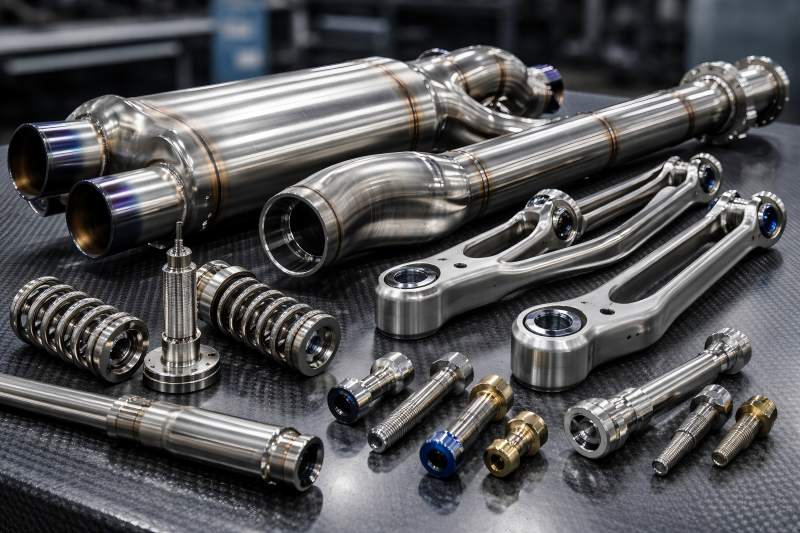
Exhaust Systems
Titanium reduces weight, improves heat resistance, and enhances sound quality in high-performance exhausts.
Engine Valves and Springs
Ti-6Al-4V is commonly used for valves and valve springs, offering low weight and excellent fatigue resistance.
Suspension Components
Suspension links, brackets, and fasteners benefit from titanium’s strength-to-weight ratio, improving handling and responsiveness.
Fasteners
Bolts, nuts, and studs made from titanium resist corrosion and maintain high clamping force under temperature variations.
Cost Considerations
Titanium is more expensive than steel or aluminum. Key cost factors:
- Material Cost: Titanium raw materials are expensive due to extraction and refining processes.
- Machining Cost: Hardness and reactivity increase CNC tool wear and machining time.
- Finishing and Coatings: Surface treatments may be necessary to improve wear resistance.
Relative Cost Comparison of Common Automotive Materials
| Material | Relative Cost Index | Machining Difficulty |
| Steel | 1 | Low |
| Aluminum Alloy | 1.5 | Medium |
| Titanium Alloy | 5–7 | High |
Design Tip: Use titanium selectively in critical or performance parts to balance cost and benefit.
Upkeep and Sturdiness
Because titanium car parts are resistant to corrosion, they often require little maintenance. However, high-stress components like suspension links and drive shafts require fatigue monitoring.
- Routine checks for deformation or surface fractures.
- Use of non-destructive testing (NDT), such as ultrasonic inspection or dye penetrant.
- Avoid overloading or exceeding design torque limits to prevent early fatigue.
Future Trends
Hybrid Components: For hybrid structures, titanium is combined with aluminum or carbon fiber.
- Additive Manufacturing: Custom, lightweight, complex geometries for high-performance vehicles.
- Surface Coatings: Ceramic or DLC coatings for wear resistance in high-temperature applications.
- Electric Vehicles: Titanium is used in suspension, battery housings, and motors to boost efficiency and save weight.
Conclusion
Titanium car parts provide unparalleled advantages in performance, weight reduction, and corrosion resistance. Understanding titanium grades, manufacturing methods, and design principles is essential for engineers and automotive manufacturers. While costs are higher than traditional materials, selective use in critical components can enhance vehicle performance, durability, and efficiency. Advances in CNC machining, forging, and additive manufacturing continue to expand titanium’s applications in modern automotive design.