
Custom sheet metal card cage fabrication provides reliable PCB mounting, electronic protection, airflow control, grounding support, and enclosure integration. A well-designed card cage improves assembly, maintenance, EMI control, and system reliability. This guide covers key design points, materials, processes, finishes, quality checks, and supplier selection tips.
What Is a Sheet Metal Card Cage?
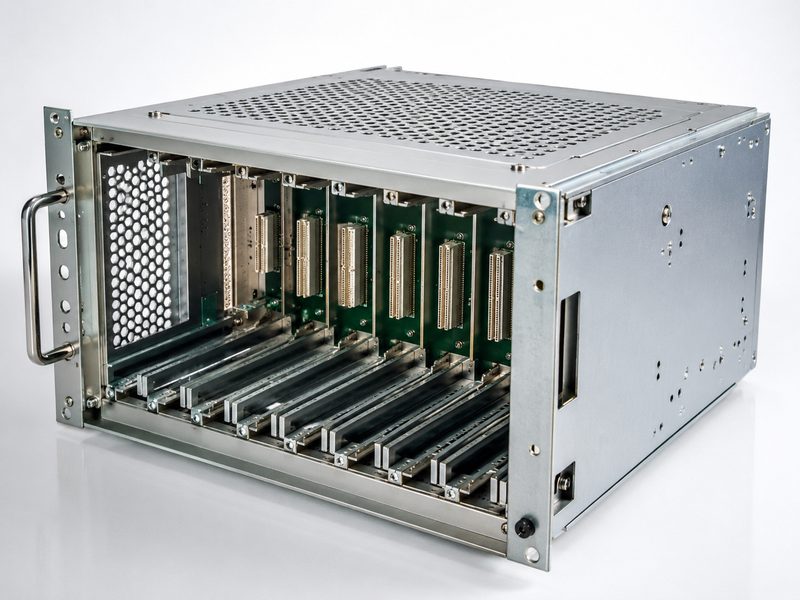
A sheet metal card cage is a metal framework or enclosure that helps you mount and organize electronic cards or PCB assemblies. It usually includes side panels, guide rails, mounting brackets, front panels, rear panels, ventilation holes, covers, handles, fasteners, and sometimes backplane mounting structures.
Unlike a standard metal enclosure, your card cage must support accurate board alignment, smooth card insertion, secure positioning, proper grounding, thermal management, and easy service access. In many applications, you may install the card cage inside a larger rack, control cabinet, electronic enclosure, or machine housing.
You may need a sheet metal card cage for:
- Communication and networking equipment
- Industrial control systems
- Power supply modules
- Embedded computer systems
- Test and measurement equipment
- Medical electronic devices
- Railway and transportation control units
- Military and aerospace electronics
- Automation and machine control panels
Why Should You Choose Custom Sheet Metal Card Cage Fabrication?
Standard card cages may work for simple projects, but your equipment may have special requirements for size, board spacing, airflow, mounting points, cable routing, surface finish, or EMI protection. Custom sheet metal fabrication allows you to design the card cage around your actual product needs.
With a custom sheet metal card cage, you can improve:
- Your PCB positioning accuracy
- Your product assembly efficiency
- Your heat dissipation performance
- Your EMI shielding and grounding protection
- Your mechanical strength
- Your cable management
- Your maintenance convenience
- Your product appearance
- Your compatibility with special modules or backplanes
For OEM projects, custom fabrication also helps you create a more compact layout, improve product reliability, and match the card cage with your complete equipment design.
Key Design Factors You Should Consider
Before you place an order, you should clearly define how your card cage will be used. A clear design plan can help you reduce engineering changes, avoid production delays, and control your total project cost.
1. Your PCB Size and Board Spacing
The first thing you need to confirm is the size of your circuit boards or plug-in cards. Your card cage must provide enough space for components, connectors, heat sinks, wiring, and smooth insertion or removal.
You should check:
- Your PCB length, width, and thickness
- Your number of cards
- Your required board spacing
- Your component height on both sides
- Your connector position
- Your guide rail size
- Your front panel clearance
- Your backplane interface requirements
If your board spacing is too narrow, airflow may be poor and components may interfere with each other. If the spacing is too wide, your final equipment may become larger than necessary.
2. Your Mechanical Strength Requirements
Your card cage may need to carry several PCBs, modules, connectors, and cables. It must stay stable during assembly, transportation, vibration, and long-term operation.
Mechanical strength depends on:
- Your material thickness
- Your bending structure
- Your reinforced flanges
- Your welding or riveting points
- Your mounting bracket design
- Your frame rigidity
- Your fastener selection
If your card cage will be used in heavy-duty or vibration-sensitive applications, you may need thicker sheet metal, reinforced ribs, stiffeners, or welded frame sections.
3. Your Thermal Management Needs
Electronic modules generate heat during operation. Your card cage should support proper cooling through ventilation holes, fan openings, airflow paths, and heat dissipation space.
You can improve thermal performance with:
- Perforated panels
- Louvered ventilation
- Fan mounting areas
- Airflow channels
- Heat sink clearance
- Open-frame design
- Aluminum material for better heat transfer
Before production, you should provide your supplier with information such as heat load, operating temperature, fan layout, and airflow direction if available.
4. Your EMI Shielding and Grounding Requirements
If your equipment is used in communication, medical, industrial, or defense applications, EMI protection may be very important. A metal card cage naturally offers better shielding than plastic structures, but your design still needs proper grounding and conductive contact areas.
You may need:
- Conductive surface treatment
- Grounding tabs
- EMI gaskets
- Tight panel joints
- Shielded covers
- Conductive fasteners
- Masked areas without paint
- Zinc plating or chromate treatment
If EMI shielding is critical for your project, you should discuss it with your fabrication supplier at the beginning of the design stage.
Common Materials You Can Choose
Your material choice will affect strength, weight, corrosion resistance, conductivity, cost, and appearance.
| Material | Advantages | Suitable Applications |
| Aluminum | Lightweight, corrosion-resistant, good heat dissipation | Communication equipment, rack systems, portable electronics |
| Stainless Steel | Strong, durable, corrosion-resistant | Medical, outdoor, marine, harsh industrial environments |
| Cold Rolled Steel | Strong, cost-effective, easy to form | Industrial equipment, control cabinets, general electronics |
| Galvanized Steel | Economical and corrosion-resistant | Power equipment, electrical cabinets, indoor/outdoor systems |
| Copper or Brass | Excellent conductivity | EMI shielding parts, grounding components |
If you need a lightweight card cage, aluminum may be a good choice. If you need higher strength at a lower cost, cold rolled steel may be more suitable. If your equipment will be used in a corrosive or harsh environment, stainless steel can give you better durability.
Custom Sheet Metal Card Cage Fabrication Process
A professional manufacturer usually follows a complete process from design review to final inspection.
1. Design Review
Your supplier should review your drawings, 3D models, material requirements, tolerances, surface finishes, assembly details, and production quantity. This step helps you find possible problems before manufacturing begins.
During design review, your supplier may check:
- Bend feasibility
- Hole position accuracy
- Material thickness
- Assembly sequence
- Tolerance stack-up
- Welding accessibility
- Surface treatment limits
- Fastener compatibility
2. Laser Cutting or CNC Punching
Your flat sheet metal parts are cut by laser cutting or CNC punching. Laser cutting is suitable for flexible designs, complex shapes, and low-to-medium production volumes. CNC punching can be more efficient when your design has repeated hole patterns or larger production quantities.
3. Bending and Forming
After cutting, your parts are bent into side panels, brackets, covers, frames, and support structures. Accurate bending is very important because small angle errors can affect PCB alignment and final assembly fit.
4. Welding, Riveting, or Fastening
Your card cage parts may be joined by welding, riveting, clinching, PEM fasteners, screws, or other mechanical methods. Some card cages use a modular screw-assembled structure, while others need welded frames for better strength.
5. Surface Treatment
Surface finishing helps improve corrosion resistance, appearance, conductivity, and long-term durability. Your supplier may offer powder coating, anodizing, plating, passivation, brushing, or painting.
6. Assembly and Inspection
Your supplier may install guide rails, handles, threaded inserts, grounding points, fasteners, covers, and other accessories. Final inspection should check dimensions, surface quality, assembly fit, and functional requirements.
Surface Finishing Options for Your Card Cage
The right finish depends on your application environment, appearance requirements, and electrical performance needs.
| Finish | Best For | Notes |
| Powder Coating | Durable appearance and corrosion resistance | Common for industrial and electronic enclosures |
| Anodizing | Aluminum card cages | Good appearance and corrosion protection |
| Zinc Plating | Steel parts | Improves corrosion resistance and conductivity |
| Passivation | Stainless steel | Enhances corrosion resistance |
| Brushed Finish | Visible metal appearance | Suitable for premium panels |
| Conductive Coating | EMI-sensitive applications | Useful for grounding and shielding |
If your card cage needs electrical contact or grounding, you should clearly mark the areas that must remain unpainted or conductive.
Tolerance Requirements You Should Check
Your card cage may need higher precision than a simple sheet metal box because PCB insertion, connector alignment, and guide rail positioning all depend on accurate dimensions.
You should pay attention to:
- Board slot spacing
- Guide rail position
- Backplane mounting holes
- Connector openings
- Front panel alignment
- Mounting hole locations
- Cover fit
- Frame squareness
For high-precision projects, you should provide detailed tolerances instead of only basic dimensions. You may also request a prototype before mass production to confirm the fit and function.
Prototype vs Mass Production
For a new card cage project, you should consider making a prototype first. A prototype helps you test board fit, structure, airflow, cable routing, assembly method, and appearance before you move into larger production.
| Stage | Purpose | What You Should Check |
| Prototype | Verify design feasibility | Fit, function, dimensions, assembly |
| Pilot Run | Test production stability | Process control, finish consistency, packaging |
| Mass Production | Scale manufacturing | Cost, lead time, quality consistency |
If you skip the prototype stage, you may save time at the beginning, but you may also increase the risk of expensive design changes later.
What Affects Your Card Cage Fabrication Cost?
Your custom card cage cost depends on design complexity, material, thickness, tolerance, finish, order quantity, and assembly requirements.
Main cost factors include:
- Your material type and thickness
- Your number of sheet metal parts
- Your laser cutting or punching time
- Your bending complexity
- Your welding or assembly requirements
- Your surface finishing process
- Your precision tolerance level
- Your fasteners and accessories
- Your prototype or tooling cost
- Your packaging and shipping requirements
A simple open-frame card cage is usually more economical. A fully enclosed structure with EMI protection, special finishes, tight tolerances, and multiple accessories will usually cost more.
How to Choose the Right Custom Card Cage Manufacturer
When you choose a supplier, you should not only compare prices. You should also evaluate engineering support, fabrication capability, quality control, communication, and delivery reliability.
You should check whether your supplier has:
- Experience with electronic enclosures and card cages
- Ability to read 2D drawings and 3D CAD files
- Laser cutting, punching, bending, welding, and assembly capability
- Multiple surface finishing options
- Precision tolerance control
- Prototype and mass production support
- Quality inspection process
- Material traceability
- Safe packaging experience
- Stable communication and project management
A good supplier should help you review your drawings, improve manufacturability, identify risk points, and suggest cost-saving solutions.
Questions You Should Ask Before Ordering
Before you confirm your order, you should ask clear technical and commercial questions.
Some helpful inquiries are:
- For my project, what kind of material and thickness would you suggest?
- Are you able to support both mass manufacturing and prototypes?
- What tolerances can you control for guide rails and mounting holes?
- Can you provide surface finishing and assembly service?
- How do you protect grounding areas during coating?
- Can you install PEM nuts, standoffs, handles, and guide rails?
- What inspection reports can you provide?
- What is your expected lead time?
- How do you package finished card cages?
- Can you suggest design changes to reduce cost?
These questions help you avoid misunderstandings and confirm whether the supplier has real experience with custom sheet metal card cage fabrication.
Common Mistakes You Should Avoid
Many card cage problems happen because design requirements are unclear at the beginning.
You should avoid:
- Ignoring PCB component height
- Leaving too little cable routing space
- Choosing the wrong material thickness
- Overlooking airflow and ventilation
- Forgetting grounding or EMI requirements
- Painting areas that need conductivity
- Ignoring tolerance stack-up
- Starting mass production without prototype testing
- Choosing a supplier only because of a low price
- Providing incomplete drawings
The majority of these issues may be avoided with clear drawings, comprehensive requirements, and early supplier communication.
Custom sheet metal card cage fabrication protects electronic assemblies, secures PCBs, improves airflow, supports grounding, and simplifies maintenance. By defining requirements, choosing suitable materials and finishes, confirming tolerances, and working with an experienced supplier, you can reduce risks, control costs, and build a reliable card cage for your electronic system.