
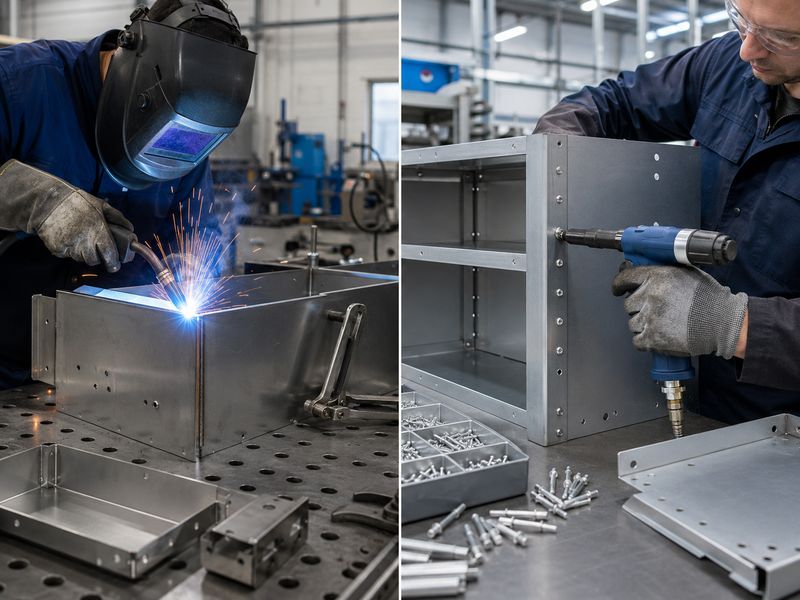
Sheet metal assembly is widely used in automotive parts, enclosures, machinery covers, HVAC systems, cabinets, brackets, aerospace structures, and custom metal products. The joining method affects strength, appearance, cost, durability, maintenance, and performance.
Welding fuses metal parts together, while riveting joins parts with fasteners. The right choice depends on material, structure, load, corrosion resistance, appearance, repair needs, cost, and production environment.
What Is Welding in Sheet Metal Assembly?
Welding is a joining method that uses pressure, heat, or both to fuse two or more metal components together. TIG, MIG, spot, laser, and resistance welding are popular welding techniques used in sheet metal manufacturing.
Welding is often used when the assembly requires high strength, sealed joints, smooth appearance, or a permanent connection. It is common in machinery frames, stainless steel enclosures, automotive parts, tanks, cabinets, brackets, and structural sheet metal components.
| Welding Method | Common Use in Sheet Metal Assembly |
| TIG welding | Thin stainless steel, aluminum parts, visible welds |
| MIG welding | Carbon steel frames, brackets, industrial assemblies |
| Spot welding | Automotive panels, cabinets, thin sheet connections |
| Laser welding | Precision parts, clean seams, high-speed production |
| Resistance welding | Overlapping sheet metal joints |
Welding can create a strong and continuous joint, but it requires skilled workers, proper equipment, heat control, and quality inspection.
What Is Riveting in Sheet Metal Assembly?
Riveting is a mechanical fastening process that joins sheet metal parts using rivets. To keep the materials together, a rivet is put through holes in the components and either deformed or secured.
Riveting does not require melting the base metal. This makes it useful for thin sheets, coated metals, dissimilar materials, heat-sensitive parts, and assemblies that may need stable mechanical fastening without welding distortion.
Common rivet types include solid rivets, blind rivets, semi-tubular rivets, self-piercing rivets, and structural rivets.
| Rivet Type | Common Application |
| Blind rivets | One-side access assembly, enclosures, cabinets |
| Solid rivets | Aerospace, heavy-duty mechanical joining |
| Semi-tubular rivets | Hinges, brackets, light sheet metal parts |
| Self-piercing rivets | Automotive sheet metal and aluminum panels |
| Structural rivets | High-strength industrial assemblies |
Riveting is valued for easy operation, low heat impact, consistent fastening, and good repairability.
Basic Comparison: Welding vs Riveting
| Comparison Item | Welding | Riveting |
| Joining principle | Melts and fuses metal parts | Uses mechanical fasteners |
| Joint type | Permanent fused joint | Mechanical locked joint |
| Heat input | High | None or very low |
| Strength | High when properly welded | Good, depends on rivet type and quantity |
| Appearance | Smooth after finishing | Rivet heads remain visible |
| Material limitation | Requires weldable materials | Works with many metals and mixed materials |
| Distortion risk | Possible due to heat | Low |
| Repairability | Difficult to disassemble | Easier to drill out and replace |
| Production speed | Fast with automation | Fast for simple assemblies |
| Sealing ability | Good for continuous welds | Needs sealant if leak-proofing is required |
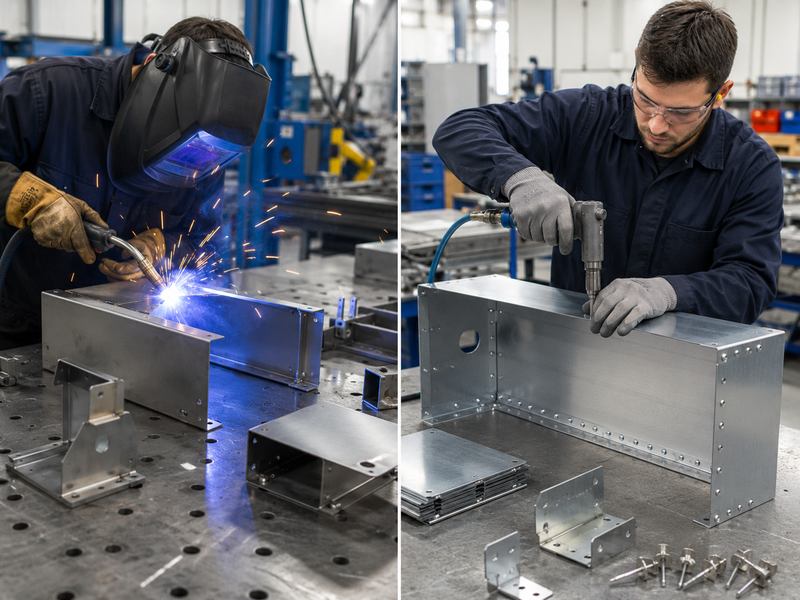
Both welding and riveting can produce strong assemblies. Welding is usually better for permanent, sealed, and high-strength metal joints. Riveting is often better for heat-sensitive, coated, dissimilar, or serviceable assemblies.
Strength and Load-Bearing Performance
Strength is one of the most important factors when choosing between welding and riveting. Welding can create a continuous joint that becomes part of the metal structure. A properly welded junction can be extremely sturdy and appropriate for load-bearing applications.
Riveting creates strength through mechanical clamping and shear resistance. The final strength depends on rivet material, rivet diameter, hole quality, sheet thickness, spacing, edge distance, and joint design.
| Strength Factor | Welding | Riveting |
| Tensile strength | High with proper weld penetration | Depends on rivet size and material |
| Shear strength | High for continuous welds | Good with correct rivet layout |
| Fatigue resistance | Good if weld quality is controlled | Good in some vibration applications |
| Load distribution | Continuous along weld seam | Distributed through rivet points |
| Structural integrity | Strong and rigid | Strong but more flexible |
For heavy-duty frames, brackets, tanks, and structural parts, welding is often preferred. For panels, covers, aircraft structures, and assemblies exposed to vibration, riveting can also perform very well when designed correctly.
Heat Distortion and Sheet Metal Deformation
Sheet metal is sensitive to heat. Welding introduces heat into the material, which can cause warping, shrinkage, burn-through, discoloration, and dimensional changes. This is especially important for thin panels, large flat surfaces, stainless steel parts, aluminum parts, and products with tight tolerances.
Riveting does not melt the material, so it causes much less thermal distortion. This makes riveting useful for sheet metal parts where flatness, coating quality, or dimensional accuracy must be maintained.
| Issue | Welding | Riveting |
| Warping risk | Higher | Low |
| Burn-through risk | Possible on thin sheets | None |
| Surface discoloration | Possible | Minimal |
| Coating damage | Common near weld area | Limited to hole area |
| Dimensional change | Possible | Low |
If the sheet metal part has a large flat surface or a pre-finished coating, riveting may reduce the risk of deformation. If welding is required, manufacturers should use proper fixtures, welding sequence, heat control, and post-weld inspection.
Material Compatibility
Welding works best when the materials are compatible and weldable. Carbon steel, stainless steel, and aluminum are commonly welded, but different metals require different welding methods, filler materials, shielding gases, and process control.
For joining various materials, riveting offers greater flexibility. It can connect aluminum to steel, coated steel to stainless steel, metal to plastic, or thin sheet metal to composite panels. This is one reason riveting is widely used in aircraft, vehicles, appliances, and equipment covers.
| Material Combination | Better Joining Method | Reason |
| Carbon steel to carbon steel | Welding or riveting | Depends on strength and design |
| Stainless steel to stainless steel | Welding | Clean and strong joint |
| Aluminum to aluminum | Welding or riveting | Riveting reduces heat distortion |
| Aluminum to steel | Riveting | Dissimilar metals are harder to weld |
| Coated sheet metal | Riveting | Less coating damage |
| Metal to plastic/composite | Riveting | Welding is not suitable |
| Thin decorative panels | Riveting | Lower heat risk |
For mixed-material assemblies, riveting is often more practical than welding.
Appearance and Surface Finish
Appearance requirements can strongly affect the choice between welding and riveting. Welding can create a clean, smooth joint after grinding, polishing, or surface finishing. For premium stainless steel products, visible enclosures, display fixtures, and custom metal products, welding may provide a more integrated appearance.
Visible rivet heads are left on the surface after riveting. This can be acceptable or even desirable in some industrial designs, but it may not be suitable for products requiring a seamless appearance.
| Appearance Requirement | Better Choice |
| Smooth seamless surface | Welding |
| Industrial fastened look | Riveting |
| Hidden internal joint | Either method |
| Visible premium stainless steel product | TIG welding |
| Coated panel with minimal heat marks | Riveting |
| Product requiring no grinding | Riveting |
If the product needs a smooth outside surface, welding is usually better. If visible fasteners are acceptable, riveting can simplify production.
Sealing and Leak Resistance
For tanks, ducts, containers, cabinets, and some HVAC components, sealing performance may be important. Welding can create a continuous seam that is suitable for air-tight or liquid-tight applications when properly done.
Riveted joints are not naturally sealed because there are holes and gaps between sheets. If sealing is required, manufacturers need to add sealants, gaskets, adhesives, or special rivet designs.
| Requirement | Welding | Riveting |
| Air-tight seam | Very suitable | Needs sealant |
| Water-tight joint | Suitable | Needs gasket or sealant |
| Structural enclosure | Suitable | Suitable |
| Decorative cover | Suitable | Suitable |
| Removable access panel | Not ideal | Better |
For leak-proof applications, welding is often preferred. For covers and panels that do not require sealing, riveting is a practical option.
Production Efficiency and Cost
Cost depends on design complexity, labor skill, equipment, production volume, material, finishing, and inspection requirements.
Welding may require higher skill, more expensive equipment, fixtures, shielding gas, and post-weld finishing. However, welding can be efficient in automated production, especially with spot welding, robotic welding, or laser welding.
Riveting is often faster and easier for simple sheet metal assemblies. Operators can install rivets with pneumatic, hydraulic, or automatic riveting equipment. It usually requires less heat protection and less post-processing.
| Cost Factor | Welding | Riveting |
| Labor skill | Higher | Lower to medium |
| Equipment cost | Medium to high | Low to medium |
| Setup requirement | Fixtures may be needed | Hole alignment is important |
| Post-processing | Grinding or polishing may be needed | Usually less |
| Automation potential | High | High |
| Cost for simple panels | Medium | Low |
| Cost for sealed structures | Better value | Extra sealing cost needed |
For simple panels and covers, riveting may reduce cost. For strong sealed assemblies, welding may be more cost-effective in the long term.
Maintenance and Repairability
Welded joints are permanent. If a welded part fails or needs modification, repair usually requires cutting, grinding, re-welding, and refinishing. This can be time-consuming and may affect appearance or dimensions.
Riveted joints are easier to repair. A rivet can be drilled out and replaced without melting the material. This is useful for equipment covers, access panels, aircraft structures, vehicle panels, and products that may need maintenance.
| Maintenance Factor | Welding | Riveting |
| Disassembly | Difficult | Easier |
| Field repair | More difficult | Easier |
| Replacement of damaged joint | Requires welding tools | Drill and replace rivet |
| Design modification | More complex | More flexible |
| Long-term serviceability | Lower | Higher |
If future repair or replacement is important, riveting may be the better choice.
Common Applications
| Application | Recommended Method | Reason |
| Machinery frames | Welding | High strength and rigidity |
| Stainless steel enclosures | Welding | Clean appearance and sealed joints |
| Electrical cabinets | Welding or riveting | Depends on structure and finish |
| HVAC ducts | Welding or riveting | Depends on sealing requirements |
| Automotive body panels | Spot welding or riveting | Depends on material and design |
| Aircraft panels | Riveting | Lightweight and repairable |
| Aluminum sheet assemblies | Riveting or TIG welding | Riveting reduces heat distortion |
| Industrial brackets | Welding | Strong and permanent |
| Access panels | Riveting | Easier replacement |
| Decorative covers | Riveting or welding | Depends on appearance target |
In many sheet metal factories, welding and riveting are both used depending on the part design.
When to Choose Welding
Choose welding when the assembly needs:
- High structural strength
- Permanent connection
- Smooth appearance
- Continuous sealed seams
- Strong load-bearing performance
- No visible fasteners
- Rigid structure
- Metal-to-metal fusion
- Leak-proof or air-tight joints
Welding is suitable for frames, tanks, brackets, stainless steel housings, machine guards, support structures, and industrial sheet metal assemblies.
When to Choose Riveting
Choose riveting when the assembly needs:
- Low heat distortion
- Easy repair or replacement
- Joining of dissimilar materials
- Fast mechanical assembly
- Connection of coated or painted sheets
- Consistent fastening
- One-side access with blind rivets
- Reduced surface discoloration
- Serviceable panels or covers
Riveting is suitable for panels, covers, cabinets, aircraft parts, aluminum sheet assemblies, coated metal parts, and light-to-medium-duty structures.
Welding vs Riveting Decision Guide
| Project Requirement | Better Choice |
| Highest joint strength | Welding |
| Lowest heat distortion | Riveting |
| Smooth seamless appearance | Welding |
| Easy repair | Riveting |
| Dissimilar material joining | Riveting |
| Leak-proof seam | Welding |
| Coated sheet metal assembly | Riveting |
| Heavy structural frame | Welding |
| Thin panel assembly | Riveting |
| Premium stainless steel product | Welding |
Can Welding and Riveting Be Used Together?
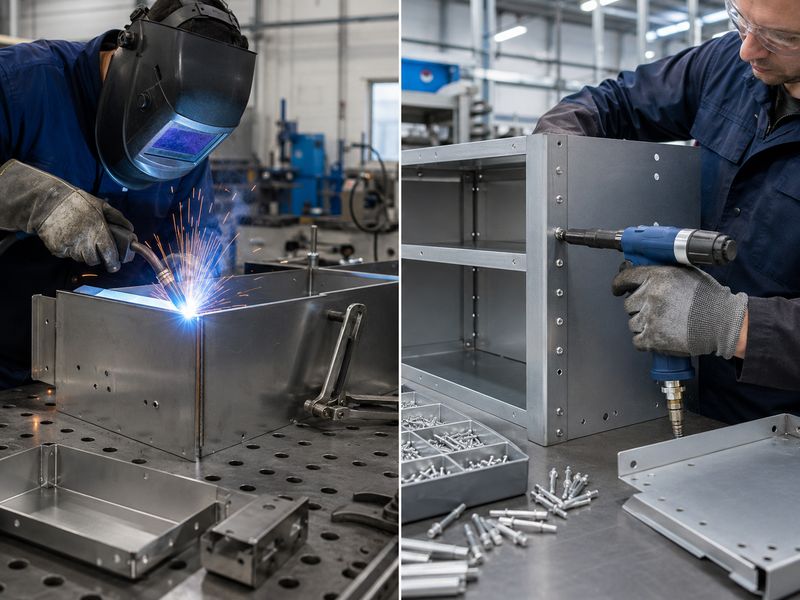
Yes. Many sheet metal assemblies use both welding and riveting. For example, a manufacturer may weld the main frame for strength and use rivets to attach panels, covers, brackets, or service doors.
This hybrid approach can improve product performance by combining the strength of welding with the flexibility of riveting.
| Assembly Area | Possible Joining Method |
| Main structural frame | Welding |
| External cover panels | Riveting |
| Access doors | Riveting |
| Reinforcement brackets | Welding |
| Decorative panels | Riveting |
| Sealed seams | Welding |
| Replaceable parts | Riveting |
Using both methods can help balance strength, cost, appearance, repairability, and production efficiency.
Welding and riveting are both common sheet metal assembly methods. Welding creates strong, permanent, and seamless joints, making it suitable for structural parts, sealed seams, brackets, frames, and applications requiring high strength or appearance.
Riveting uses fasteners to join parts and is ideal for thin sheet metal, coated or dissimilar materials, serviceable panels, and low-heat assembly. It can reduce distortion and simplify maintenance.
The best choice depends on material, thickness, strength, finish, sealing needs, production volume, maintenance, and cost. In many projects, welding and riveting can be combined for better performance.