
Machine covers and guards protect operators, shield moving parts, reduce dust exposure, improve equipment appearance, and support safer production. They are widely used on CNC machines, packaging equipment, automation lines, conveyors, motors, and custom systems.
Because sheet metal production is strong, flexible, long-lasting, and economical, it is frequently utilised. With proper material, design, cutting, bending, joining, and surface treatment, sheet metal covers can meet both functional and appearance needs.
What Are Machine Covers and Guards?
Machine covers and guards are protective structures installed around machines, moving parts, electrical systems, cutting areas, motors, belts, gears, chains, and other components. Their primary goals are to safeguard the equipment and increase safety.
Machine covers may be removable, hinged, fixed, transparent, ventilated, or fully enclosed. Guards may be designed to prevent operator contact with dangerous areas, contain chips or sparks, or separate production zones.
| Product Type | Main Function | Common Application |
| Machine cover | Protects equipment and improves appearance | CNC machines, automation equipment |
| Safety guard | Protects operators from moving parts | Conveyors, presses, rotating machinery |
| Belt guard | Covers belts and pulleys | Motors, pumps, compressors |
| Gear guard | Covers gears and transmission parts | Industrial machinery |
| Electrical enclosure cover | Protects control systems | Electrical cabinets, control panels |
| Chip guard | Prevents chips from flying out | CNC machining equipment |
| Transparent guard | Allows visibility while protecting operators | Laser machines, cutting equipment |
A well-designed cover or guard should not only look good but also support safety, maintenance, cooling, cleaning, and long-term use.
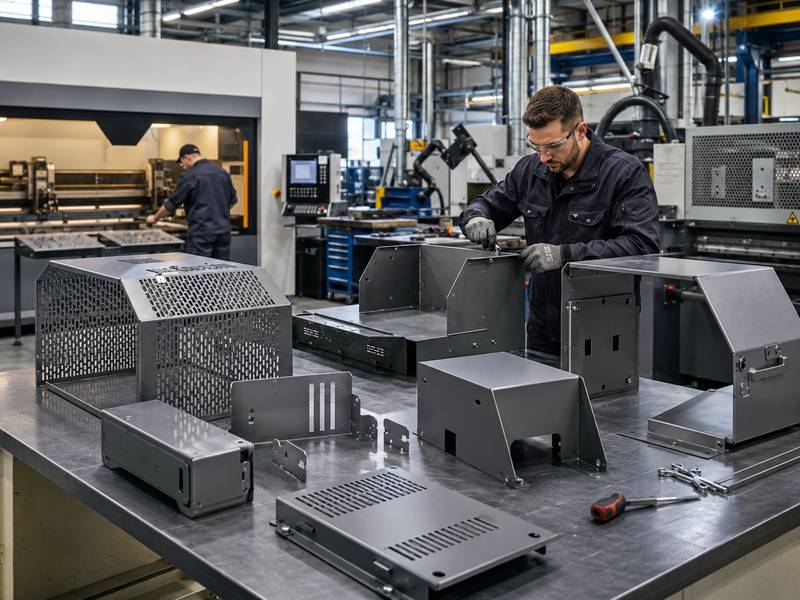
Why Sheet Metal Is Used for Machine Covers and Guards
Sheet metal is widely used because it offers a good balance between strength, weight, cost, and manufacturability. Compared with castings or plastic covers, sheet metal parts can be customized more easily for different machine sizes, structures, and production requirements.
Sheet metal can be cut, bent, punched, welded, riveted, assembled, and finished into many shapes. Both high-volume manufacturing and small-batch custom covers can use it.
Main advantages include:
- Good mechanical strength
- Flexible custom design
- Suitable for small and large parts
- Cost-effective production
- Easy surface finishing
- Good protection performance
- Suitable for ventilation holes and access doors
- Can be combined with transparent panels, handles, locks, hinges, and seals
For industrial equipment manufacturers, sheet metal fabrication makes it possible to create machine covers that match the machine structure, brand appearance, and safety requirements.
Common Materials for Machine Covers and Guards
Choosing the right material is one of the first steps in sheet metal fabrication. Strength, corrosion resistance, weight, appearance, cost, and service life are all impacted by the material.
| Material | Advantages | Common Use |
| Carbon steel | Strong, cost-effective, easy to fabricate | General machinery covers and guards |
| Stainless steel | Corrosion-resistant, clean appearance, durable | Food, medical, chemical, outdoor equipment |
| Aluminum | Lightweight, corrosion-resistant, easy to machine | Automation equipment, electronics, lightweight guards |
| Galvanized steel | Better corrosion resistance than carbon steel | HVAC, outdoor covers, industrial guards |
| Perforated metal | Ventilation and visibility | Motor guards, fan covers, heat dissipation panels |
| Aluminum composite panel | Lightweight and smooth surface | Decorative machine covers |
| Transparent polycarbonate panel | Visibility and impact resistance | Safety windows and machine observation guards |
When strength and cost control are crucial, carbon steel is frequently utilised. For settings that need to be hygienic or resistant to corrosion, stainless steel is recommended. When it’s vital to reduce weight, aluminium works well. In many projects, a machine cover may use a metal frame with transparent plastic windows or perforated panels.
Key Design Requirements for Machine Covers and Guards
A machine cover is not just a metal shell. It must be designed according to the machine’s function, working environment, safety risk, maintenance needs, and assembly structure.
Safety Protection
Safety is the most important requirement. Guards should prevent operators from touching moving parts, sharp tools, high-temperature areas, electrical components, or rotating mechanisms. The structure should be stable and difficult to remove accidentally.
For safety guards, designers should consider distance from danger zones, opening size, material thickness, impact resistance, and fastening method.
Structural Strength
Machine covers and guards must be strong enough to resist vibration, impact, bending, and daily operation. Thin sheet metal may need stiffening ribs, folded edges, welded frames, or reinforced brackets to improve rigidity.
Easy Maintenance
Machines need regular maintenance. A good cover design should allow easy access to lubrication points, motors, belts, sensors, control panels, and replaceable components. Hinged doors, removable panels, handles, latches, and quick-release fasteners can improve maintenance efficiency.
Ventilation and Heat Dissipation
Some machines generate heat during operation. Covers should include ventilation holes, louvers, perforated areas, fans, or air flow channels if needed. Poor ventilation may reduce equipment life or cause overheating.
Noise and Dust Control
Covers can help reduce noise, contain dust, block chips, and protect internal systems. In CNC machining or cutting equipment, covers should prevent chips, coolant, sparks, and debris from spreading outside the working area.
Common Fabrication Processes
Sheet metal machine covers and guards are usually made through several fabrication steps. The exact process depends on part size, material, tolerance, quantity, and design complexity.
| Process | Purpose | Importance |
| Laser cutting | Cuts sheet metal into accurate shapes | Good for complex outlines and holes |
| CNC punching | Creates holes, slots, and repeated patterns | Efficient for batch production |
| Bending | Forms panels, edges, covers, and brackets | Creates final structure |
| Welding | Joins parts permanently | Improves strength and sealed structure |
| Riveting | Mechanical fastening | Useful for panels and mixed materials |
| Grinding and polishing | Removes sharp edges and weld marks | Improves safety and appearance |
| Surface treatment | Protects against rust and wear | Extends service life |
| Assembly | Adds hinges, locks, windows, handles, seals | Completes functional design |
Laser cutting is commonly used because it provides clean edges and high flexibility. Bending gives the cover its shape. Welding and riveting are used to assemble different parts. Surface finishing improves durability and appearance.
Welding, Riveting, and Fastening Options
Different joining methods are used depending on the cover design.
Welding is suitable for strong and permanent structures. It is often used for frames, heavy-duty guards, stainless steel covers, and sealed enclosures. However, welding may cause heat distortion if not controlled properly.
Riveting is useful for thin panels, removable covers, and assemblies where heat should be avoided. It is also good for joining different materials, such as metal panels and transparent windows.
Screws and bolts are used when parts need to be removed for maintenance. Hinges and latches are often used for access doors.
| Joining Method | Best For | Main Advantage |
| Welding | Strong fixed structures | High strength and clean appearance |
| Riveting | Thin panels and mixed materials | Low heat distortion and fast assembly |
| Screws and bolts | Removable panels | Easy maintenance and replacement |
| Hinges | Access doors | Convenient opening and closing |
| Latches and locks | Safety covers | Secure operation |
| Adhesive bonding | Decorative panels or seals | Smooth surface and no visible fasteners |
Many machine covers use a combination of methods. For example, the frame may be welded, while side panels are bolted or riveted for easier maintenance.
Surface Treatment Options
Machine covers and guards are often exposed to oil, coolant, dust, moisture, vibration, and scratches. Surface treatment helps improve corrosion resistance, appearance, and durability.
| Surface Treatment | Suitable Material | Benefits |
| Powder coating | Carbon steel, galvanized steel, aluminum | Durable, colorful, corrosion-resistant |
| Painting | Steel and aluminum | Flexible color options |
| Brushing | Stainless steel, aluminum | Clean industrial appearance |
| Polishing | Stainless steel | Smooth and premium surface |
| Anodizing | Aluminum | Corrosion resistance and decorative finish |
| Galvanizing | Steel | Strong rust protection |
| Passivation | Stainless steel | Improves corrosion resistance |
| Sandblasting | Steel, stainless steel, aluminum | Matte texture and better coating adhesion |
Powder coating is widely used for machine covers because it provides a durable and attractive finish. Stainless steel covers may be brushed or polished. Aluminum covers may use anodizing for a clean and corrosion-resistant surface.
Design Features That Improve Performance
A good sheet metal cover should be designed for real industrial use. Small design details can greatly improve safety, durability, and user experience.
Important design features include:
- Folded edges to reduce sharp corners
- Reinforced ribs to increase stiffness
- Ventilation holes for heat dissipation
- Louvers to protect against dust and liquid entry
- Transparent windows for observation
- Handles for easy operation
- Hinges for access doors
- Rubber seals to reduce vibration and dust
- Locking systems for safety
- Removable panels for maintenance
- Cable holes for electrical connections
- Drainage holes for wet environments
These details help make the cover more functional and reliable.
Applications of Sheet Metal Machine Covers and Guards
Sheet metal covers and guards are used across many industries.
| Industry | Common Covers and Guards |
| CNC machining | Machine enclosures, chip guards, tool area covers |
| Packaging machinery | Conveyor guards, motor covers, safety shields |
| Food processing | Stainless steel covers, hygienic guards, splash covers |
| Automation equipment | Robot covers, sensor guards, machine frames |
| Electrical equipment | Control cabinet covers, panel guards |
| HVAC equipment | Fan guards, duct covers, access panels |
| Agricultural machinery | Belt guards, chain guards, engine covers |
| Laser equipment | Protective covers, safety doors, observation windows |
| Medical equipment | Stainless steel covers and clean machine guards |
Different finishes and materials are needed for different industries. For instance, conventional machinery may utilise powder-coated carbon steel for cost effectiveness, but food processing equipment frequently employs stainless steel for hygienic reasons and corrosion resistance.
Quality Control for Machine Covers and Guards
Quality control is important because machine covers must fit correctly, protect safely, and work reliably. Poor fabrication may cause assembly problems, gaps, sharp edges, weak joints, or poor surface finish.
Key inspection items include:
| Inspection Item | Why It Matters |
| Dimensions | Ensures the cover fits the machine correctly |
| Hole position | Supports accurate assembly and fastening |
| Bending angle | Affects part shape and installation |
| Flatness | Prevents gaps and misalignment |
| Weld quality | Ensures strength and appearance |
| Surface finish | Improves corrosion resistance and product image |
| Edge treatment | Prevents injury from sharp edges |
| Assembly test | Confirms final function |
| Packaging inspection | Prevents scratches and damage during shipping |
For custom projects, manufacturers should check the first sample before batch production. This helps reduce risk and ensures that all parts meet drawing requirements.
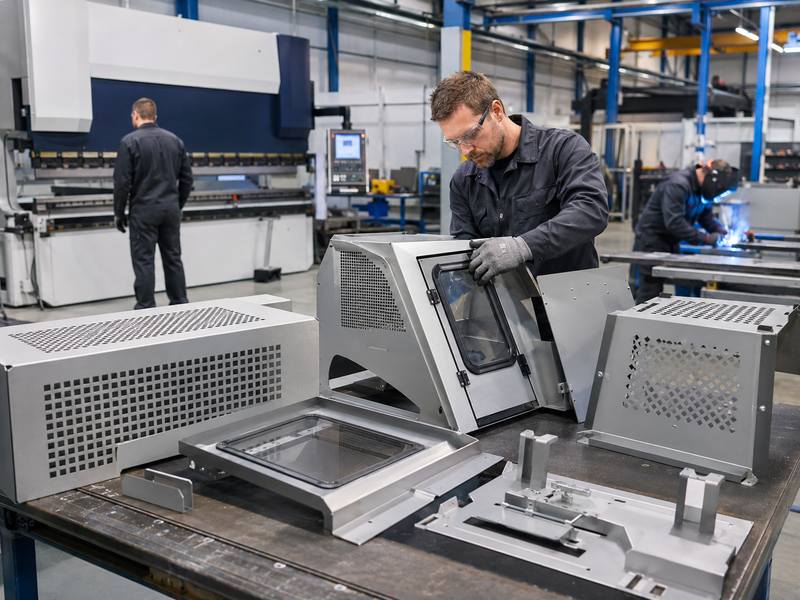
How to Choose a Sheet Metal Fabrication Manufacturer
Choosing the right manufacturer is important for machine cover and guard quality. A reliable supplier should understand both sheet metal fabrication and equipment protection requirements.
Buyers should check:
- Material processing capability
- Laser cutting and bending equipment
- Welding and assembly experience
- Surface treatment options
- Ability to produce custom designs
- Quality inspection process
- Experience with industrial equipment parts
- Support for prototypes and batch production
- Packaging and delivery reliability
A professional manufacturer should also provide design feedback. For instance, they might recommend more appropriate surface treatments, quicker assembly techniques, stronger reinforcement, or better bending structures.
Cost Factors in Machine Cover Fabrication
The cost of sheet metal covers depends on several factors.
| Cost Factor | Impact on Price |
| Material type | Stainless steel and aluminum usually cost more than carbon steel |
| Sheet thickness | Thicker material increases cost and processing difficulty |
| Part size | Larger covers require more material and handling |
| Design complexity | More bends, holes, and welded parts increase cost |
| Surface treatment | Powder coating, polishing, and anodizing add cost |
| Quantity | Larger orders usually reduce unit cost |
| Assembly parts | Hinges, locks, handles, seals, and windows add cost |
| Tolerance requirements | Higher precision increases inspection and processing time |
The best design should balance protection performance, manufacturing cost, appearance, and maintenance needs.
Sheet metal fabrication is a reliable solution for machine covers and guards, offering strength, durability, customization, and a clean appearance. Properly designed covers can protect operators, shield components, reduce dust, support ventilation, and improve equipment safety.
Successful covers require the right material, design, access, ventilation, finish, and assembly method. Carbon steel, stainless steel, aluminium, galvanised steel, perforated metal, and transparent panels are examples of common materials.
Working with an experienced sheet metal fabrication supplier helps create safe, durable, and easy-to-use machine covers and guards.