
While both die casting and sand casting are significant metal casting techniques, their applications in production are distinct. Die casting uses reusable steel molds and high-pressure injection, making it ideal for mass production of aluminum, zinc, and magnesium parts with good accuracy and surface finish. Sand casting uses sand molds and gravity pouring, making it more flexible for large parts, small batches, prototypes, and a wider range of metals.
What Is Die Casting?
Die casting is a method of casting metal that creates metal parts using a steel mould, often known as a die. High pressure is used to inject melted metal into the mould cavity. Once the casting has cooled and set, the mould opens, releasing the finished product.
Die casting is frequently utilised for non-ferrous metals, particularly alloys of magnesium, zinc, and aluminium. It is extensively utilised in consumer goods, mechanical parts, lighting components, electronic housings, hardware, and automobile parts.
Main Steps of Die Casting
- Prepare and lubricate the steel mold
- Cool and solidify the casting
- Open the mold and eject the part
- Trim excess material such as flash or gates
- Perform machining, polishing, coating, or inspection if needed
Die casting is suitable for high-volume production because one mold can produce thousands or even millions of parts.
What Is Sand Casting?
Sand casting is a casting technique that forms metal components using a sand mould. A mould cavity is made by putting a pattern in the sand. The hollow is filled with molten metal, which is then let to cool.
It can be used for small parts, large parts, simple shapes, and complex industrial components. It is suitable for iron, steel, aluminum, bronze, brass, and many other metals.
Main Steps of Sand Casting
- Make a pattern of the part
- Pack sand around the pattern to form the mold
- Remove the pattern and prepare the mold cavity
- Fill the sand mould with molten metal.
- Let the metal cool and harden.
- Remove the casting by shattering the sand mould.
- Clean, grind, machine, and inspect the finished part
Unlike die casting, the sand mold is usually used only once.
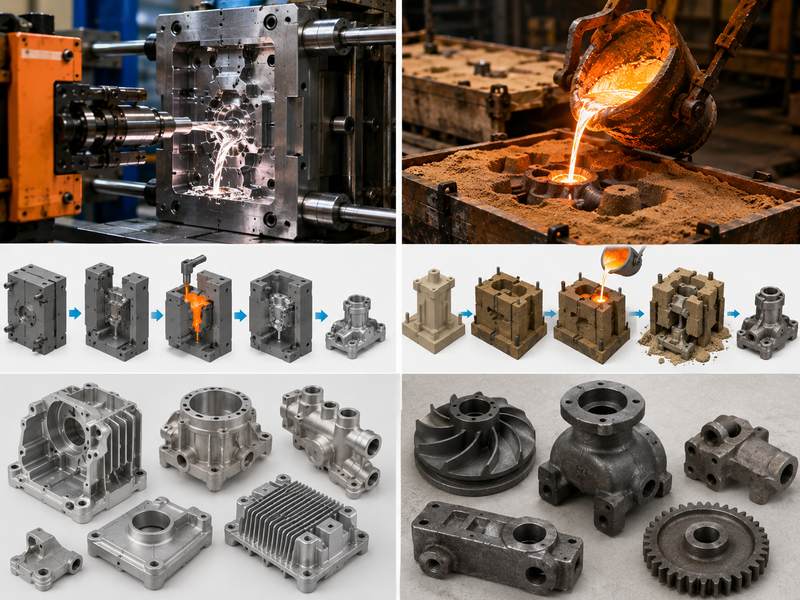
Die Casting vs Sand Casting: Quick Comparison
| Item | Die Casting | Sand Casting |
| Mold material | Steel mold | Sand mold |
| Mold life | Long mold life | Usually one-time mold |
| Production volume | Best for medium to high volume | Best for low to medium volume |
| Initial tooling cost | High | Low to moderate |
| Unit cost | Low for mass production | Higher for large quantity |
| Surface finish | Smooth and fine | Rougher surface |
| Dimensional accuracy | High | Lower than die casting |
| Part size | Small to medium parts | Small to very large parts |
| Metal options | Mostly aluminum, zinc, magnesium | Iron, steel, aluminum, bronze, brass, etc. |
| Production speed | Fast | Slower |
| Design detail | Good for thin walls and fine details | Good for large and heavy shapes |
Key Difference 1: Mold Type
The biggest difference between die casting and sand casting is the mold.
Die casting uses a permanent steel mold. The mold is expensive to make, but it can be reused many times. Because of this, die casting is cost-effective when making huge quantities of the same product.
A sand mould is used in sand casting, and it is typically destroyed after each casting. The tooling cost is lower, but each part requires mold preparation. This makes sand casting more flexible for small batches, prototypes, and large parts.
Mold Comparison
| Mold Factor | Die Casting | Sand Casting |
| Mold cost | High | Lower |
| Mold durability | Very high | Low |
| Mold reuse | Reusable | Usually not reusable |
| Best for | Repeat production | Custom or low-volume parts |
| Design modification | More expensive | Easier and cheaper |
Key Difference 2: Production Volume
Die casting is more suitable for mass production. Production is quick and steady once the die is created. The cost per part is lowered as a result.
Sand casting is better for small batches, prototypes, and customized parts. It does not require expensive steel tooling, so it is often more cost-effective when the order quantity is low.
For example, if you need 50 large machine bases, sand casting may be the better choice. If you need 50,000 aluminum housings, die casting is usually more economical.
Key Difference 3: Surface Finish
Because molten metal is pumped into a precise steel mould, die casting typically results in a smoother surface. The finished parts often require less polishing or machining.
Sand casting has a rougher surface because the mold is made from sand. The surface quality depends on sand grain size, mold quality, pouring conditions, and post-processing.
| Surface Requirement | Recommended Process |
| Smooth surface | Die casting |
| Fine details | Die casting |
| Decorative appearance | Die casting |
| Rough industrial surface acceptable | Sand casting |
| Heavy machining after casting | Sand casting |
If the final product needs painting, powder coating, plating, or decorative finishing, die casting often has an advantage.
Key Difference 4: Dimensional Accuracy
Die casting offers better dimensional accuracy and repeatability. This is crucial for components that need precise assembly, tight tolerances, and constant quality.
Sand casting has lower dimensional accuracy because sand molds can expand, shift, or deform slightly during pouring and cooling. Sand castings often require additional machining to reach final dimensions.
Accuracy Comparison
| Requirement | Die Casting | Sand Casting |
| Tight tolerance | Better | More difficult |
| Repeatability | High | Medium |
| Thin wall design | Suitable | Limited |
| Post-machining need | Lower | Higher |
| Complex small details | Better | Possible but less precise |
Key Difference 5: Material Options
Die casting is mainly used for non-ferrous metals. Common die casting materials include:
- Aluminum alloys
- Zinc alloys
- Magnesium alloys
- Copper-based alloys in some special cases
Sand casting supports a wider range of metals, including:
- Cast iron
- Carbon steel
- Stainless steel
- Aluminum
- Bronze
- Brass
- Ductile iron
This makes sand casting more suitable for heavy-duty industrial parts, pump bodies, valve bodies, machinery bases, and large structural components.
Key Difference 6: Part Size and Weight
Die casting is usually used for small to medium-sized parts. The size is limited by die casting machine capacity, mold size, clamping force, and injection pressure.
Sand casting is much more flexible for large and heavy parts. Parts weighing a few kilograms to several tonnes can be produced by it.
| Part Type | Better Choice |
| Small aluminum housing | Die casting |
| Zinc hardware component | Die casting |
| Automotive gearbox housing | Die casting |
| Large pump casing | Sand casting |
| Heavy machine base | Sand casting |
| Cast iron valve body | Sand casting |
Key Difference 7: Cost Structure
The cost structure of die casting and sand casting is very different.
Die casting has a high initial tooling cost because the steel mold requires precision machining. However, the unit cost becomes low when production volume is high.
Although labour and mould preparation expenses are higher for each part, sand casting has a cheaper tooling cost. For large production quantities, sand casting may become less economical than die casting.
Cost Comparison
| Cost Factor | Die Casting | Sand Casting |
| Tooling cost | High | Low to medium |
| Unit cost at low volume | High | Lower |
| Unit cost at high volume | Lower | Higher |
| Labor cost | Lower after tooling | Higher per casting |
| Machining cost | Usually lower | Usually higher |
| Best cost advantage | Mass production | Low-volume production |
Advantages of Die Casting
Die casting has many advantages for industrial production:
- High production efficiency
- Excellent dimensional accuracy
- Smooth surface finish
- Good repeatability
- Suitable for thin-wall parts
- Lower unit cost in large quantities
- Good strength-to-weight ratio with aluminum alloys
- Less machining required after casting
Die casting is often chosen when the product needs consistent appearance, stable dimensions, and high-volume output.
Disadvantages of Die Casting
Die casting also has limitations:
- High mold cost
- Longer mold development time
- Not ideal for very low-volume orders
- Limited to certain metals
- Not suitable for very large parts
- Design changes after mold making can be expensive
For buyers, die casting is usually a better investment when the product design is stable and the demand quantity is large.
Advantages of Sand Casting
Sand casting is popular because it is flexible and widely applicable.
Main advantages include:
- Lower tooling cost
- Suitable for small batches and prototypes
- Can produce very large parts
- Supports many metals, including iron and steel
- Easier to modify designs
- Suitable for complex internal cavities
- Good for heavy-duty industrial components
Sand casting is often used in machinery, mining equipment, pumps, valves, construction machinery, and heavy industrial parts.
Disadvantages of Sand Casting
Sand casting also has some disadvantages:
- Rougher surface finish
- Lower dimensional accuracy
- Slower production speed
- More machining may be required
- Sand mold is usually single-use
- Higher chance of casting defects if process control is poor
Common sand casting defects include sand inclusion, shrinkage, porosity, rough surface, and dimensional variation.
When Should You Choose Die Casting?
You should consider die casting if your project requires:
- Medium to high-volume production
- Aluminum, zinc, or magnesium parts
- Smooth surface finish
- Thin walls or fine details
- Tight dimensional control
- Lower unit cost after tooling investment
- Stable product design with few changes
Typical die casting products include:
- Automotive aluminum housings
- LED lighting housings
- Electric motor parts
- Electronic enclosures
- Handles and brackets
- Hardware accessories
- Small parts of machinery
When Is Sand Casting the Best Option?
You should consider sand casting if your project requires:
- Low-volume or custom production
- Large or heavy metal parts
- Cast iron, steel, bronze, or brass
- Lower initial tooling cost
- Flexible design changes
- Industrial parts with machining allowance
- Prototypes before mass production
Typical sand casting products include:
- Pump bodies
- Valve bodies
- Engine blocks
- Machine bases
- Agricultural machinery parts
- Construction equipment parts
- Large industrial housings
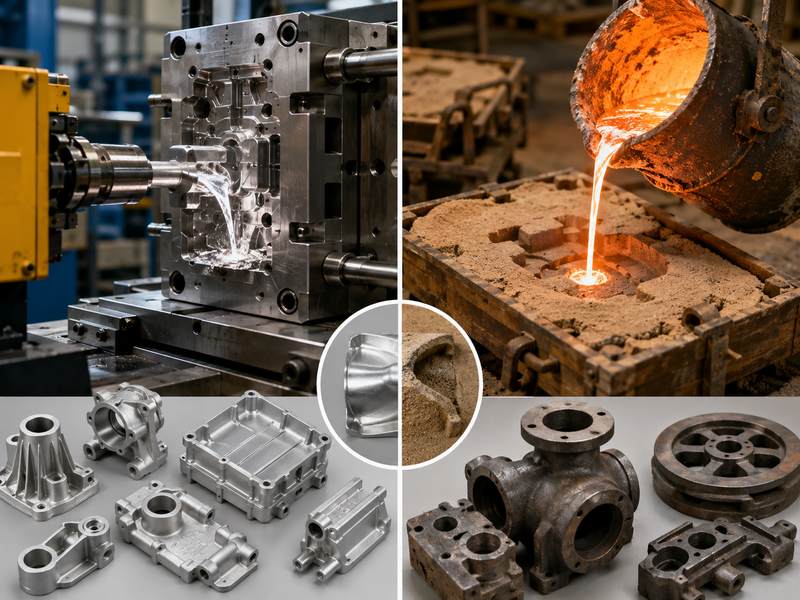
Die Casting vs Sand Casting: Application Table
| Industry | Die Casting Applications | Sand Casting Applications |
| Automotive | Gearbox housings, brackets, engine covers | Engine blocks, heavy housings |
| Electronics | Aluminum enclosures, heat sinks | Large protective housings |
| Machinery | Small precision parts | Machine bases, pump casings |
| Construction | Hardware, connectors | Heavy structural castings |
| Lighting | LED housings, lamp bodies | Large decorative cast parts |
| Agriculture | Small aluminum parts | Heavy equipment components |
Design Considerations Before Choosing a Process
Before choosing between die casting and sand casting, buyers should evaluate several factors.
Important questions include:
- What metal material is required?
- What is the expected annual production quantity?
- How large and heavy is the part?
- What surface finish is required?
- Are tight tolerances needed?
- How much machining is acceptable?
- Is the design final or likely to change?
- What is the target unit cost?
- What is the budget for tooling?
- How fast does the product need to enter production?
For example, if your part is aluminum, small, detailed, and required in large quantities, die casting is often the best choice. If your part is large, made of cast iron, and required in small quantities, sand casting is usually more suitable.
Which Method Is Superior?
There isn’t just one solution. Die casting is not always better than sand casting, and sand casting is not always better than die casting. The best process depends on your product design, material, quantity, budget, and quality requirements.
For smooth-surfaced, high-volume, high-precision products, die casting works well. Large, heavy, low-volume, or highly customised products are better suited for sand casting.
For buyers, the right choice should not be based only on price. It should consider production volume, material, size, tolerance, surface finish, machining needs, and long-term cost. By understanding the differences between die casting and sand casting, you can choose the most suitable process and improve product quality, manufacturing efficiency, and overall project value.