
Magnesium die casting is widely used to produce lightweight, strong, and dimensionally stable metal parts. As the lightest common structural metal, magnesium offers excellent weight reduction, good castability, high stiffness-to-weight ratio, and strong vibration damping, making it suitable for automotive, electronics, aerospace, medical, and consumer products. Since pure magnesium has limited strength and corrosion resistance, it is usually alloyed with elements such as aluminum, zinc, manganese, silicon, calcium, and rare earth elements to improve casting and performance.
What Are Die Casting Alloys Made of Magnesium?
These alloys are formulated to flow well into steel molds, fill thin-wall sections, resist cracking, and provide stable mechanical properties after solidification.
Common magnesium die casting alloys include:
- AZ91D
- AM60B
- AM50A
- AM20
- AS41B
- AE42
- AE44
- AJ62
- MRI series alloys
Each alloy has different strengths. Some alloys are better for general-purpose housings, while others are designed for impact resistance, ductility, elevated-temperature performance, or improved creep resistance.
Why Magnesium Is Used in Die Casting
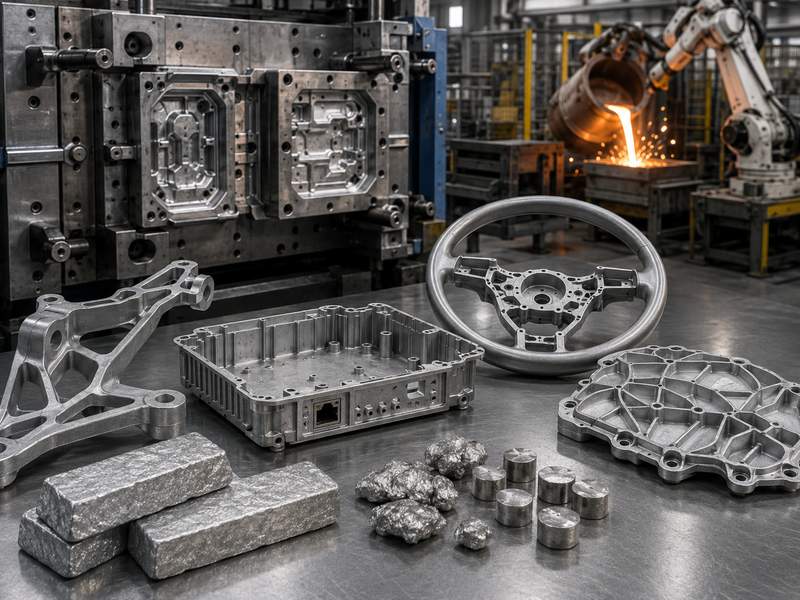
Magnesium is especially suitable for die casting because it has good fluidity, fast solidification, and low density. These features allow manufacturers to produce thin-wall parts with complex shapes.
The primary advantages of magnesium die casting are as follows:
- Lightweight structure
Magnesium helps reduce part weight in vehicles, electronic devices, tools, and portable equipment.
- Good castability
Many magnesium alloys can fill complex die cavities and thin walls.
- High strength-to-weight ratio
Magnesium parts can provide useful strength while remaining light.
- Good vibration damping
Magnesium can reduce vibration and noise in mechanical applications.
- Excellent machinability
Magnesium is generally easier to machine than many other metals.
- Good electromagnetic shielding
Magnesium housings are often used for electronic and communication products.
- Recyclability
Magnesium scrap and runners can often be recycled under proper process control.
Common Magnesium Die Casting Alloys
The most widely used magnesium die casting alloys belong to the AZ, AM, AS, AE, and AJ alloy families. The alloy letters usually indicate the main alloying elements. For example, AZ means aluminum and zinc, while AM means aluminum and manganese.
| Alloy Family | Main Alloying Elements | Main Advantage | Common Applications |
| AZ series | Aluminum + Zinc | Strength, castability, corrosion resistance | Housings, brackets, covers |
| AM series | Aluminum + Manganese | Ductility, impact resistance | Automotive safety parts, steering wheels |
| AS series | Aluminum + Silicon | Improved creep resistance | Engine and transmission parts |
| AE series | Aluminum + Rare earth elements | Better high-temperature performance | Powertrain and heat-exposed parts |
| AJ series | Aluminum + Strontium | Creep resistance, thermal stability | Automotive powertrain parts |
AZ91D Magnesium Alloy
AZ91D is the most common magnesium die casting alloy. It is often considered the general-purpose choice for magnesium die cast parts. AZ91D is the most often used magnesium die casting alloy, according to NADCA alloy data, and AZ91D and AZ81 are two of the strongest commercial magnesium die casting alloys.
About 1% zinc and 9% aluminium are included in AZ91D. It offers a good balance of strength, castability, corrosion resistance, and cost. Because of this balance, it is widely used in automotive parts, electronic housings, communication equipment, power tool housings, and general industrial components.
Advantages of AZ91D
- Excellent castability
- Good strength
- Good corrosion resistance when impurity levels are controlled
- Suitable for thin-wall die casting
- Commonly available and cost-effective
- Good surface finish after casting
Limitations of AZ91D
- Limited ductility compared with AM alloys
- Not the best choice for high-impact safety parts
- Limited high-temperature creep resistance
- Requires proper surface treatment in corrosive environments
AZ91D is usually a good choice when the part needs a strong, lightweight structure but does not require very high ductility or long-term high-temperature performance.
AM60B Magnesium Alloy
Another common magnesium die casting alloy is AM60B. It is often selected when better ductility and impact resistance are needed. Dynacast describes AM60B as a popular magnesium die casting alloy for applications requiring strength, ductility, and lightweight design.
Compared with AZ91D, AM60B contains less aluminum and no significant zinc addition. This gives it better elongation and impact performance, although its strength may be slightly lower than AZ91D.
Common Applications of AM60B
- Automotive steering wheels
- Seat frames
- Instrument panel supports
- Safety-related brackets
- Structural housings
- Impact-resistant components
AM60B is often used in automotive applications where parts need to absorb energy during impact.
AM50A Magnesium Alloy
AM50A is similar to AM60B but contains slightly less aluminum. This gives AM50A better ductility and toughness, making it suitable for parts that require deformation resistance and energy absorption.
AM50A is often used in automotive structural parts, seat components, brackets, and safety-related parts. When ductility is more crucial than maximum strength, it is a good choice.
| Alloy | Strength | Ductility | Castability | Typical Use |
| AZ91D | High | Medium | Excellent | General die cast parts |
| AM60B | Medium-high | Good | Good | Impact-resistant parts |
| AM50A | Medium | Very good | Good | Safety and structural parts |
AM20 Magnesium Alloy
AM20 contains lower aluminum than AM50A and AM60B. It provides higher ductility but lower strength. It is not as common as AZ91D or AM60B, but it can be useful for parts where formability, toughness, and impact behavior are important.
AM20 may be selected for special automotive or structural applications where the casting must resist cracking under load.
AS41B Magnesium Alloy
AS41B is an aluminum-silicon magnesium alloy. The silicon addition helps improve creep resistance compared with common AZ and AM alloys. Creep resistance is important when a part must hold its shape under long-term stress at elevated temperatures.
AS41B can be used for engine-related parts, transmission components, and other applications exposed to moderate heat. However, its corrosion resistance and castability may not always match AZ91D in general applications.
AE42 and AE44 Magnesium Alloys
AE series alloys contain aluminum and rare earth elements. These alloys are designed for improved elevated-temperature performance. AE44, for example, is often used where higher heat resistance is required.
A recent review of high-pressure die-cast magnesium alloys notes that AZ91D is used where high strength at moderate temperature is needed, AM50A and AM60B are used where high ductility is needed, and AE44 is used for elevated-temperature applications.
AE alloys are more expensive than general-purpose magnesium alloys, but they can provide better creep resistance and thermal stability.
Typical Chemical Composition of Common Magnesium Die Casting Alloys
The following table shows common composition ranges for several magnesium die casting alloys. In accordance with the necessary standard, supplier certificate, and client specification, exact quantities should always be verified.
| Alloy | Aluminum % | Zinc % | Manganese % | Other Key Elements | Main Feature |
| AZ91D | 8.3–9.7 | 0.35–1.0 | 0.15–0.50 | Low Fe, Cu, Ni control | General-purpose strength and castability |
| AM60B | 5.5–6.5 | ≤0.22 | 0.24–0.60 | Low impurity control | Strength and ductility balance |
| AM50A | 4.4–5.4 | ≤0.22 | 0.26–0.60 | Low impurity control | Better ductility |
| AM20 | 1.7–2.2 | ≤0.10 | ≥0.50 | Low impurity control | High ductility |
| AS41B | 3.5–5.0 | ≤0.12 | 0.35–0.70 | Silicon 0.5–1.5 | Better creep resistance |
| AE42 | 3.4–4.6 | ≤0.22 | Around 0.25 | Rare earth elements | Elevated-temperature performance |
Composition ranges above are based on published magnesium die casting alloy data tables for commercial alloys such as AZ91D, AM60B, AM50A, AM20, AE42, and AS41B.
Typical Mechanical Properties
Mechanical properties depend on alloy composition, casting design, die temperature, injection parameters, porosity level, wall thickness, and testing method. The values below are typical references, not guaranteed values for every casting.
| Alloy | Tensile Strength | Yield Strength | Elongation | Density | General Comment |
| AZ91D | About 240 MPa | About 160 MPa | About 3% | About 1.81 g/cm³ | Strong general-purpose alloy |
| AM50A | About 210 MPa | About 125 MPa | About 10% | About 1.77 g/cm³ | Good ductility |
| AM60B | About 225 MPa | About 130 MPa | About 8% | About 1.80 g/cm³ | Good impact resistance |
| AM20 | About 190 MPa | About 90 MPa | About 12% | About 1.75 g/cm³ | High ductility, lower strength |
| AE42 | About 230 MPa | About 145 MPa | About 10% | About 1.79 g/cm³ | Better heat resistance |
| AE44 | About 245 MPa | About 142 MPa | About 10% | About 1.82 g/cm³ | Elevated-temperature applications |
These typical property values are reported in magnesium alloy material property data for die cast alloys, but actual production properties should be verified by testing and supplier documentation.
How Alloying Elements Affect Magnesium Die Casting
Different alloying elements are added to magnesium to improve specific performance.
Aluminum
Aluminum improves strength, hardness, and castability. AZ91D, AM60B, and AM50A all contain aluminum. Higher aluminum content usually improves strength but may reduce ductility.
Zinc
Zinc helps improve strength in AZ alloys. However, too much zinc can increase hot cracking risk, so it must be controlled.
Manganese
Manganese helps improve corrosion resistance by reducing the harmful effect of iron impurities. It is important in many die casting magnesium alloys.
Silicon
Silicon improves creep resistance in AS alloys. It is useful for parts exposed to elevated temperatures.
Rare Earth Elements
Rare earth additions improve high-temperature strength and creep resistance. AE alloys use rare earth elements for better thermal stability.
Calcium and Strontium
Calcium and strontium may improve creep resistance and flame resistance in some advanced magnesium alloys. These elements are often used in special high-temperature or automotive applications.
Choosing the Right Magnesium Die Casting Alloy
Selecting the right alloy depends on the product’s function, environment, loading condition, and cost target.
Choose AZ91D When You Need:
- General-purpose magnesium die casting
- Good strength
- Good castability
- Smooth surface finish
- Cost-effective production
- Housings, covers, brackets, and consumer product parts
Choose AM60B When You Need:
- Better ductility than AZ91D
- Impact resistance
- Automotive structural performance
- Energy absorption
- Safety-related parts
Choose AM50A When You Need:
- Higher ductility
- Better toughness
- Structural automotive parts
- Parts exposed to impact or bending
Choose AE or AS Alloys When You Need:
- Better high-temperature performance
- Improved creep resistance
- Powertrain or engine-area components
- Long-term dimensional stability under heat
Application Guide for Magnesium Die Casting Alloys
| Application | Recommended Alloy | Reason |
| Electronic housing | AZ91D | Good castability and surface finish |
| Laptop or camera frame | AZ91D / AM60B | Lightweight and rigid |
| Automotive steering wheel | AM60B | Ductility and impact resistance |
| Seat frame component | AM50A / AM60B | Toughness and energy absorption |
| Power tool housing | AZ91D | Strength and machinability |
| Engine-area bracket | AS41B / AE44 | Better heat resistance |
| Transmission component | AE42 / AE44 / AJ alloys | Creep resistance |
| General industrial cover | AZ91D | Cost-effective and stable |
Surface Treatment for Magnesium Die Castings
Magnesium has good lightweight performance, but it requires proper protection in corrosive environments. Surface treatment is often necessary, especially for automotive, outdoor, marine, or electronic applications.
Common surface treatments include:
- Chromate conversion coating
- Phosphate treatment
- Micro-arc oxidation
- Anodizing
- Electrophoretic coating
- Powder coating
- Painting
- Plating after proper pretreatment
Surface treatment improves corrosion resistance, appearance, wear resistance, and coating adhesion.
Important Design Tips for Magnesium Die Casting
Good alloy selection alone is not enough. Product design also affects casting quality.
Recommended design practices include:
- Keep wall thickness uniform where possible
- Avoid sharp internal corners
- Add proper draft angles
- Use ribs instead of thick solid sections
- Avoid isolated heavy areas
- Design proper bosses and mounting features
- Consider gate location and flow direction
- Allow enough machining stock only where necessary
- Plan surface treatment early
- Confirm tolerance requirements before mold design
Magnesium die casting can produce complex shapes, but poor design may lead to porosity, shrinkage, deformation, cracks, or high machining cost.
Common Defects in Magnesium Die Casting
Magnesium die casting defects are often related to alloy selection, melt handling, mold design, and process control.
Common defects include:
- Porosity
- Cold shuts
- Flow marks
- Shrinkage
- Hot cracking
- Flash
- Oxidation inclusions
- Surface corrosion
- Dimensional deformation
To reduce defects, manufacturers should control melt cleanliness, injection speed, die temperature, venting, vacuum assistance, cooling balance, and trimming process.
Magnesium vs Aluminum Die Casting Materials
Magnesium and aluminum are both popular lightweight die casting materials. Magnesium is lighter and easier to machine, while aluminum usually offers better high-temperature strength and broader corrosion resistance.
| Factor | Magnesium Die Casting | Aluminum Die Casting |
| Density | Lower | Higher than magnesium |
| Weight reduction | Excellent | Good |
| Castability | Very good | Very good |
| Machinability | Excellent | Good |
| Strength | Good | Good to high |
| High-temperature performance | Depends on alloy | Generally better |
| Corrosion resistance | Needs surface protection | Usually better |
| Cost | Often higher material cost | Often lower material cost |
| Best use | Lightweight precision parts | General structural parts |
Magnesium die casting alloys are selected based on strength, ductility, temperature resistance, corrosion performance, part design, production volume, and cost. AZ91D is the most common general-purpose alloy, while AM60B and AM50A offer better ductility and impact resistance. AS, AE, and rare-earth magnesium alloys are suitable for higher-temperature applications. With the right alloy, mold design, and process control, magnesium die casting can produce lightweight, high-quality parts for automotive, electronics, aerospace, medical, and industrial uses.