
For mechanical parts to be designed, manufactured, and inspected, geometric tolerance is essential. It is a critical concept in ensuring that parts fit together properly, function effectively, and meet quality standards. However, despite its importance, many engineers, designers, and manufacturers still find geometric tolerance a challenging subject. This article will break down what geometric tolerance is, why it’s important, and how to use it effectively in your design and manufacturing processes.
What is Geometric Tolerance?
The permitted variance in a part or feature’s shape, orientation, or position with respect to the ideal geometry specified in the design is known as geometric tolerance. Unlike dimensional tolerances, which focus solely on linear measurements, geometric tolerances ensure that a part’s features conform to a specified form, location, or orientation in three-dimensional space.
These tolerances control the permissible deviations in geometric characteristics such as:
- Form: Straightness, flatness, circularity, and cylindricity.
- Orientation: Angularity, parallelism, and perpendicularity.
- Location: Symmetry, concentricity, and position.
- Runout: Circular and total runout.
Form Tolerances
Form tolerances describe the shape of an individual feature. They ensure that the surface of a part conforms to the ideal shape specified in the drawing.
| Form Tolerance | Description | Application |
| Straightness | Limits the variation in the straightness of a line | Ensures edges or lines on a surface are as straight as possible |
| Flatness | Limits the variation in the flatness of a surface | Ensures surfaces are as flat as required |
| Circularity | Limits the variation in the roundness of a feature | Ensures holes or circles are within tolerance for proper fitting |
| Cylindricity | Limits the variation in the roundness of a cylindrical part | Ensures shafts or cylindrical parts maintain consistent diameter |
Orientation Tolerances
Orientation tolerances control the alignment of one feature with respect to another. These tolerances guarantee that components fit together and perform as intended.
| Orientation Tolerance | Description | Application |
| Angularity | Limits the angular deviation between two surfaces or axes | Ensures surfaces or features are at the correct angle |
| Parallelism | Limits the deviation of one surface or line from being parallel to another | Ensures parts align correctly for assembly |
| Perpendicularity | Limits the deviation of a surface or axis from being at a right angle to another | Ensures proper alignment for mounting or assembly |
Location Tolerances
Position tolerances govern a feature’s position on a part. In order to guarantee that parts fit together during assembly, certain tolerances are essential.
| Location Tolerance | Description | Application |
| Position | Controls the location of a feature relative to a reference | Ensures holes, slots, or other features are positioned accurately |
| Concentricity | Controls the alignment of two or more circular features with a common axis | Ensures that holes, shafts, or pins align properly |
| Symmetry | Ensures that the left and right sides of a part or feature are symmetrical | Ensures consistent balance and functionality in parts |
Runout Tolerances
Runout tolerances control the amount of variation in a part’s rotational motion. These tolerances are critical in applications where the rotational accuracy of a part is vital, such as in bearings, shafts, and wheels.
| Runout Tolerance | Description | Application |
| Circular Runout | Controls the variation in a circular feature’s radial position as it rotates | Ensures that the part rotates concentrically |
| Total Runout | Controls the variation in a part’s entire surface as it rotates | Ensures that the part is centered, both radially and axially |
Why Geometric Tolerances Are Important
Geometric tolerances are essential because they provide a clear and standardized way to communicate design intent, functionality, and quality expectations. They offer several key benefits:
1. Improved Part Fit and Function
By controlling how parts are manufactured and assembled, geometric tolerances ensure that parts fit and function as intended, even with manufacturing variability. This is particularly important for complex assemblies that require precise interactions between multiple components.
2. Enhanced Quality Control
Geometric tolerances give quality control personnel a defined set of parameters for inspecting parts. They help in setting up measurement systems and processes to verify that parts meet the design specifications, ensuring that only high-quality parts are produced.
3. Cost Efficiency
Using geometric tolerances allows manufacturers to achieve a balance between tight tolerances and cost-effective production. By specifying only the tolerances that are necessary for part function, unnecessary costs can be avoided.
4. Interaction Among Teams
For engineers, designers, and manufacturers, geometric tolerances establish a common language. This common language helps ensure that everyone involved in the production process, from design to final assembly, understands the specific requirements for each part.
How to Use Geometric Tolerance
Effectively using geometric tolerances requires understanding the right time and place for each tolerance. Geometric tolerances should be applied based on part function, cost considerations, and assembly requirements.
1. Understand the Functional Requirements of the Part
The first step in applying geometric tolerance is to understand the part’s function. If a part requires precise alignment, features such as position or perpendicularity should be considered. If the part needs to maintain a certain form, such as a cylindrical shaft, circularity or cylindricity tolerances should be applied.
2. Apply the Right Tolerance to the Right Feature
For each part feature (such as a hole, edge, or surface), the appropriate geometric tolerance should be applied based on the function of that feature. For example, flatness should be applied to surfaces that need to stay level, while position should be applied to holes that must align precisely.
3. Select the Appropriate Tolerance Value
Once the right tolerance type is chosen, the next step is selecting the appropriate value. This is determined by factors such as:
Functional requirements: How tightly should the part fit?
Manufacturing capabilities: What can the factory achieve within budget?
Cost considerations: Tight tolerances increase production costs.
4. Use of Reference Frames
Geometric tolerances often reference a datum, or reference point, that all other features are aligned to. This is essential for consistency in the manufacturing process, ensuring that all parts conform to the same reference system.
5. Use of Tolerance Zones
Each tolerance is defined within a tolerance zone. The size and shape of this zone dictate how much variation is allowed. For example:
Position tolerance defines a tolerance zone around the ideal position, typically in the form of a circular or rectangular area.
Straightness tolerance defines a tolerance zone that the part must remain within along a straight line.
6. Combine Geometric Tolerances for Complex Parts
In many cases, multiple geometric tolerances will be applied to a single part. For example, a part may need to be both flat and straight, and its holes may need to be in precise positions. This requires stacking tolerances while ensuring that the combined tolerances do not compromise functionality.
Best Practices for Geometric Tolerance
1. Use Simpler Tolerances When Possible
While geometric tolerances are essential, simpler tolerances (e.g., linear dimensions) should be used when possible to keep manufacturing costs low. Only apply geometric tolerances when they directly impact part function.
2. Make Use of Feature Control Frames
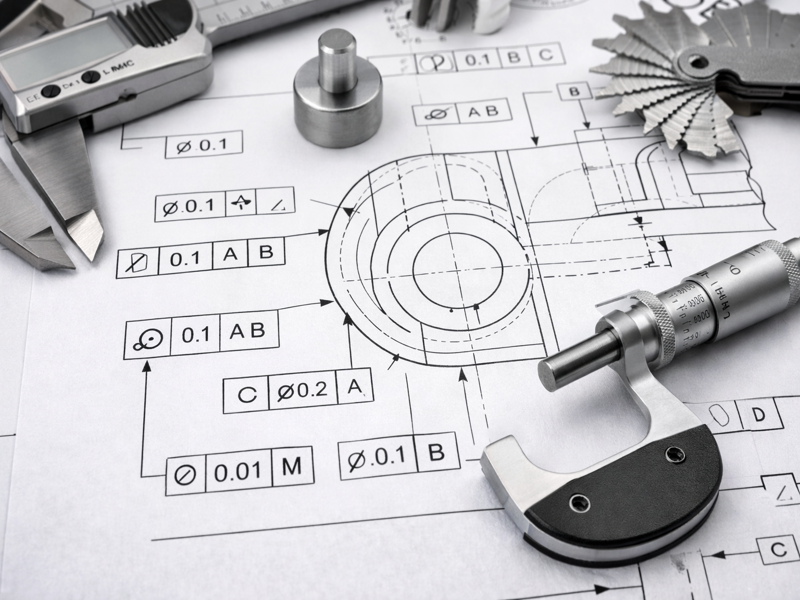
Geometric tolerances are often presented in feature control frames, which specify the type, value, datum references, and modifiers for the tolerance. Learning how to read and apply these frames is critical for the correct use of geometric tolerances.
3. Consider Manufacturing and Measurement Capabilities
When setting geometric tolerances, consider both manufacturing and measurement capabilities. Specialized equipment, tools, and procedures may be needed to achieve tight tolerances, which could lengthen manufacturing times and raise expenses.
Geometric tolerance is an essential concept for controlling the form, orientation, location, and runout of parts in the manufacturing process. By using geometric tolerances effectively, engineers and manufacturers can ensure part functionality, reduce waste, and optimize production costs. Understanding when and how to apply these tolerances is a critical skill that will improve quality control and result in a better fit and function of mechanical parts.
As a designer or manufacturer, always assess the functional requirements, cost considerations, and manufacturing capabilities when applying geometric tolerances. With the right knowledge and approach, geometric tolerance can be a powerful tool for enhancing product quality and production efficiency.