
In the world of materials science and manufacturing, ductility is one of the most crucial mechanical properties engineers consider when selecting materials for different applications. From designing metal components for automotive assemblies to aerospace structures, understanding ductility helps manufacturers predict how a material will behave under stress, avoid failures, and optimize production processes.
The Meaning of Ductility
Ductility is a material’s ability to experience substantial plastic deformation without fracturing. Put more simply, it refers to the material’s ability to elongate or stretch without breaking. Materials with high ductility can be formed into wires, sheets, or complex shapes, while brittle materials fracture with little deformation.
Ductility is usually expressed as either:
- Percent Elongation (%EL): Measures the increase in length of a material specimen before it fractures.
- The percentage reduction in area (%RA) measures how much the cross-sectional area decreases at the point of fracture.
Mathematically, ductility can be represented as:
Where:
L 0 = original length
Lf = final length after fracture
A0= original cross-sectional area
Af= cross-sectional area at fracture
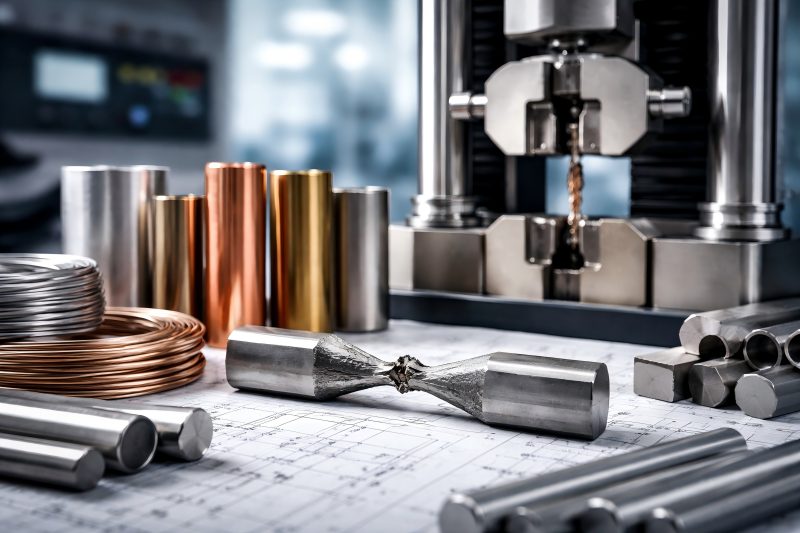
These measurements are often obtained through tensile testing, which is standard in quality control and materials testing laboratories.
Importance of Ductility in Manufacturing
Ductility is more than just a laboratory metric—it plays a critical role in various manufacturing processes:
Forming and Shaping
High ductility allows metals to be cold-worked, rolled, or drawn into wires without cracking. For example:
- Aluminum, with high ductility, is used in automotive body panels, aerospace structures, and packaging.
- Copper is drawn into wires for electrical applications due to its excellent ductility.
Absorption of Stress
Materials with good ductility can absorb energy and deform under stress, which prevents sudden failure. This property is essential in:
- Automotive crash components
- Bridges and structural beams
- Pressure vessels
Safety and Reliability
Brittle materials fracture abruptly without warning, while ductile materials undergo visible deformation before failure. In manufacturing, predictable deformation ensures safety and reduces catastrophic failures.
Weldability and Machinability
Ductile materials often have better weldability and machinability, making them easier to process in modern manufacturing facilities. For instance, steel with moderate ductility is preferred in welded pipelines.
Factors Affecting Ductility
Several factors influence the ductility of a material. Understanding these can help engineers and manufacturers optimize material selection and processing methods.
Material Composition
- Alloying elements: Adding elements like carbon, nickel, or chromium can strengthen materials but may reduce ductility.
- Impurities: Impurities and non-metallic inclusions can reduce ductility by acting as stress concentrators.
Effect of Carbon on Steel Ductility
| Carbon Content (%) | Ductility (Approx. %Elongation) | Comment |
| 0.1 | 35–40 | Highly ductile, easy to form |
| 0.3 | 20–25 | Balanced strength and ductility |
| 0.6 | 10–15 | Less ductile, more brittle |
| 1.0 | 5–8 | Very brittle, difficult to form |
Temperature
Materials generally become more ductile at higher temperatures and more brittle at low temperatures. For example:
- Metals like steel and aluminum are easier to form when heated.
- Brittle fracture can occur in low-temperature environments, such as pipelines in arctic conditions.
Grain Size and Microstructure
- Fine grains: Usually increase strength but may slightly reduce ductility.
- Coarse grains: Increase ductility but may reduce tensile strength.
Heat treatment and controlled cooling can manipulate grain size to achieve a balance of ductility and strength.
Strain Rate
The speed at which a material is deformed affects ductility:
- Slow deformation: Allows more plastic deformation; ductility is higher.
- Rapid deformation: Material may fracture prematurely; ductility decreases.
This factor is significant in metal forming operations such as stamping, rolling, and extrusion.
Presence of Defects
Surface cracks, voids, or inclusions reduce ductility.
Good manufacturing practices, including clean casting, controlled rolling, and defect-free welding, enhance ductility.
Ductility vs. Malleability
Although often confused, ductility and malleability are not the same:
- Ductility: Ability to stretch into wires (tensile deformation).
- Malleability: Ability to compress into sheets or plates (compressive deformation).
For instance:
| Material | Ductility | Malleability |
| Copper | High | High |
| Gold | Moderate | Very High |
| Cast Iron | Low | Low |
Understanding both properties is essential for forming processes and material selection.
Measuring Ductility
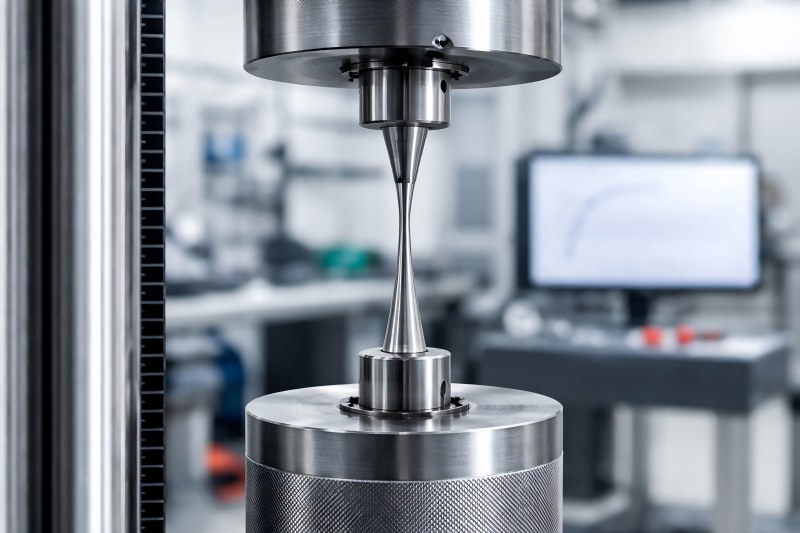
Ductility is quantified through mechanical testing, typically using a tensile test machine:
Tensile Test Procedure
- Prepare a standard specimen (usually a dog-bone shape).
- Apply tensile load gradually until fracture occurs.
- Calculate the cross-sectional area decrease and elongation.
Common Guidelines
- Standard Test Procedures for Tension Testing of Metallic Materials, ASTM E8/E8M
- ISO 6892-1 (Tensile Testing for Metallic Materials)
These standards provide consistent and precise ductility measurements across different materials and production batches.
Examples of Ductile Materials
Materials with high ductility are widely used in manufacturing:
| Material | Typical % Elongation | Applications |
| Copper | 30–50 | Electrical wiring, plumbing, and roofing |
| Aluminum | 20–40 | Aerospace panels, beverage cans |
| Mild Steel | 20–30 | Structural beams, pipelines |
| Nickel Alloys | 10–35 | Turbine blades, high-temperature parts |
Conversely, brittle materials such as cast iron and ceramics exhibit low ductility and fracture with minimal plastic deformation.
Ductility in Manufacturing Processes
Understanding ductility informs several key manufacturing operations:
Metal Forming
High-ductility metals are preferred for:
- Cold rolling: Produces sheets and strips.
- Wire drawing: Copper and aluminum wires.
- Deep drawing: Beverage cans and automotive panels.
Welding and Joining
Ductile materials reduce the risk of cracks during welding. Welding brittle metals requires preheating or post-weld heat treatment to improve ductility.
Machining
Ductile materials tend to form continuous chips, making machining smoother and easier, reducing tool wear.
Casting and Forging
Ductility ensures that materials absorb internal stresses during cooling or forging, reducing the risk of cracks and failures.
Factors Leading to Reduced Ductility in Manufacturing
Several manufacturing conditions can reduce ductility:
- Excessive cold work without annealing.
- Impurities or inclusions introduced during casting.
- Improper heat treatment results in brittle phases.
- High strain rates in stamping or extrusion.
Mitigation strategies include proper heat treatment, alloy selection, and controlled deformation rates.
Applications of Ductility Knowledge
Ductility plays a crucial role in designing components that must resist fracture while deforming:
- Automotive Industry: Crash zones, bumpers, and structural frames rely on ductile steel to absorb impact.
- Aerospace: Aluminum and titanium alloys with high ductility prevent catastrophic fracture in fuselage components.
- Construction: Steel reinforcement bars in concrete must bend without breaking.
- Electronics: Copper wiring requires ductility for insulation and bending during assembly.
Ductility Factors
| Factor | Effect on Ductility |
| Material composition | Higher carbon reduces ductility |
| Temperature | Higher temp increases ductility |
| Grain size | Fine grains: higher strength, lower ductility |
| Strain rate | Fast deformation reduces ductility |
| Impurities/defects | Decrease ductility |
| Heat treatment | Can improve or reduce depending on the process |
Ductility is crucial in material selection and manufacturing, affecting how metals deform, absorb stress, and resist fracture. Engineers use measurements like percent elongation and reduction in area to ensure safe, cost-effective products. Factors such as composition, temperature, strain rate, and microstructure influence ductility. Understanding it helps manufacturers design materials that withstand forming, welding, machining, and loads while reducing failure risks. Considering ductility in design improves performance, safety, and efficiency across automotive, aerospace, construction, and electronics industries.