
3D printing is fast, low-cost, and flexible, making it suitable for concept models, complex shapes, and early design testing.
CNC machining offers stronger materials, tighter tolerances, smoother surfaces, and better real-world performance. Many projects use 3D printing for early prototypes and CNC machining for final functional validation.
What Are Functional Prototypes?
A functional prototype is a physical sample used to test how a part or product works in real conditions. Unlike simple appearance models, functional prototypes must usually meet certain performance requirements.
They may be used to test:
- Mechanical strength
- Assembly fit
- Dimensional accuracy
- Heat resistance
- Load-bearing ability
- Product movement
- Sealing performance
- User operation
- Material behavior
- Design feasibility
Functional prototypes are widely used in automotive parts, consumer electronics, medical devices, industrial equipment, robotics, machinery components, aerospace parts, and custom product development.
| Prototype Type | Main Purpose | Common Process |
| Concept prototype | Check shape and basic design idea | 3D printing |
| Appearance prototype | Review product’s look and structure | 3D printing or CNC machining |
| Functional prototype | Test real use and performance | CNC machining or high-strength 3D printing |
| Engineering prototype | Validate design before tooling | CNC machining |
| Pre-production sample | Confirm quality before mass production | CNC machining |
For functional prototypes, the part must often be strong, accurate, and close to the final production material. This is why the process choice is very important.
What Is 3D Printing?
Additive manufacturing, another name for 3D printing, uses layer-by-layer material addition to construct parts. The process starts with a 3D CAD file. The machine reads the digital design and builds the part according to the model geometry.
Common 3D printing technologies include:
| 3D Printing Method | Common Materials | Typical Use |
| FDM | PLA, ABS, PETG, nylon, carbon fiber-filled plastics | Low-cost prototypes, basic functional testing |
| SLA | Photopolymer resin | High-detail appearance models |
| SLS | Nylon powder | Strong plastic functional prototypes |
| MJF | Nylon powder | Durable functional plastic parts |
| DMLS / SLM | Stainless steel, aluminum, titanium | Metal prototype parts |
3D printing is popular because it can create complex shapes quickly without special tooling. It is especially useful in the early phases of product development, when designs may change frequently.
CNC Machining: What Is It?
One subtractive manufacturing technique is CNC machining. It removes material from a solid block, bar, or plate using computer-controlled cutting instruments. CNC milling, CNC turning, drilling, tapping, boring, grinding, and occasionally EDM or wire cutting are examples of common CNC machining techniques.
CNC machining can produce parts from real engineering materials, such as aluminum, stainless steel, carbon steel, brass, copper, titanium, POM, nylon, ABS, PC, PTFE, and other plastics.
| CNC Machining Process | Common Applications |
| CNC milling | Housings, brackets, plates, molds, blocks, complex parts |
| CNC turning | Shafts, pins, bushings, sleeves, round parts |
| Drilling and tapping | Holes, threads, fastener features |
| Grinding | High-precision surfaces |
| EDM | Complex shapes or hard materials |
| Surface finishing | Anodizing, plating, polishing, and passivation |
CNC machining is often selected for functional prototypes that require strong materials, tight tolerances, smooth surfaces, and performance close to final production parts.
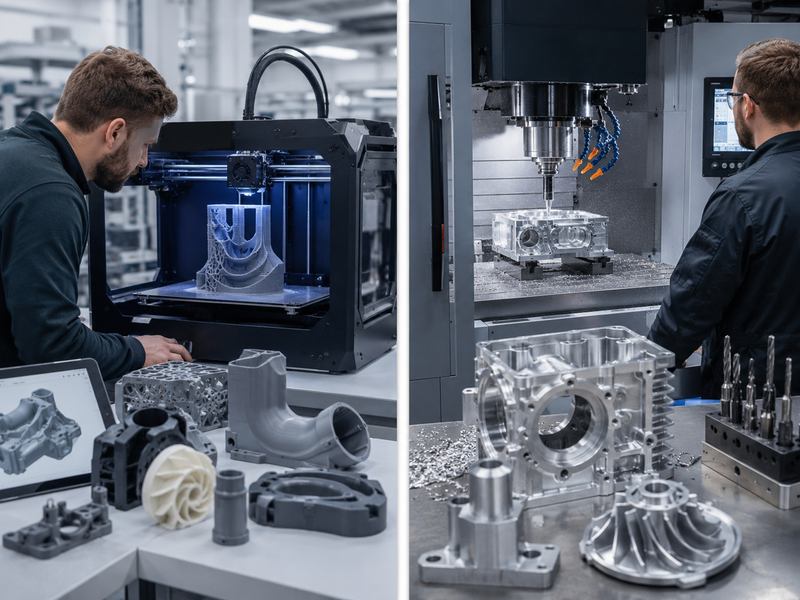
Basic Comparison: 3D Printing vs CNC Machining
| Comparison Item | 3D Printing | CNC Machining |
| Manufacturing method | Adds material layer by layer | Removes material from solid stock |
| Best for | Complex shapes, fast design iteration | Strong, accurate, production-like prototypes |
| Material strength | Depends on the printing method and material | Usually closer to the final material strength |
| Tolerance | Moderate to good | High precision |
| Surface finish | Layer lines may be visible | Smooth machined surface |
| Setup cost | Low | Higher than 3D printing |
| Unit cost for simple parts | Low for small parts | Higher for a complex setup |
| Design freedom | Very high | Limited by tool access |
| Lead time | Very fast for simple parts | Fast, but depends on complexity |
| Best development stage | Early concept and design testing | Engineering validation and functional testing |
Both processes are valuable. Complex geometry and early-stage design are typically better suited for 3D printing. For final design verification and performance testing, CNC machining is typically preferable.
Complexity and Geometry in Design
Design freedom is one of the main benefits of 3D printing. Since the part is built layer by layer, 3D printing can produce complex internal channels, lattice structures, lightweight designs, organic shapes, and features that are difficult or impossible to machine.
For example, 3D printing may be better for:
- Internal cooling channels
- Lightweight lattice structures
- Complex curved surfaces
- Integrated snap-fit features
- One-piece assemblies
- Hollow structures
- Fast concept models
CNC machining has more geometry limitations because cutting tools must physically reach the machining area. Deep pockets, sharp internal corners, undercuts, very thin walls, and internal cavities may be difficult or expensive to machine.
However, CNC machining is excellent for many functional mechanical parts, especially when the design has clear surfaces, holes, threads, slots, and standard mechanical features.
| Geometry Feature | Better Process | Reason |
| Internal channels | 3D printing | Easier to build inside the part |
| Sharp external edges | CNC machining | Cutting tools can create clean edges |
| Complex organic shape | 3D printing | No tool access limitation |
| Flat precision surfaces | CNC machining | Better accuracy and finish |
| Deep threaded holes | CNC machining | Stronger and more reliable threads |
| Lightweight lattice | 3D printing | Can produce complex internal structures |
| Tight-fitting assembly parts | CNC machining | Better dimensional control |
If the prototype is mainly used to check complex shapes or concept designs, 3D printing may be faster. If the prototype must fit accurately with other mechanical components, CNC machining is often more reliable.
Material Strength and Functional Performance
For functional prototypes, material performance is often more important than appearance. A prototype may need to support load, resist wear, handle heat, or survive repeated assembly testing.
CNC machining usually has an advantage because it uses solid engineering materials. A CNC-machined aluminum prototype, for example, can perform much closer to a final aluminum production part than a plastic 3D-printed model.
3D printing can produce strong parts, especially with SLS, MJF, carbon fiber-filled materials, or metal 3D printing. However, some printed parts may have weaker strength between layers. This is called anisotropy, meaning the part’s strength may vary depending on print direction.
| Performance Factor | 3D Printing | CNC Machining |
| Strength consistency | May vary by print direction | More consistent |
| Heat resistance | Depends on material | Strong with proper material |
| Wear resistance | Moderate to good | Excellent with suitable material |
| Load-bearing ability | Good for some methods | Usually better |
| Impact resistance | Depends on printed material | Strong with metal or engineering plastics |
| Final material simulation | Sometimes limited | Very close to final material |
For prototypes that need real mechanical performance, CNC machining is usually the safer choice. For early testing or lightweight structures, 3D printing may be enough.
Tolerance and Dimensional Accuracy
Tolerance is another major difference. In general, CNC machining outperforms 3D printing in terms of dimensional precision. This is important for parts with bearings, shafts, screw holes, sealing surfaces, mating features, precision slots, or tight assembly requirements.
3D printing accuracy depends on the printing technology, material shrinkage, machine quality, build direction, and post-processing. Some technologies can produce detailed parts, but the final dimensions may still need adjustment.
Tight tolerances can be achieved by CNC machining due to the highly regulated cutting process. It is often used when the prototype must match engineering drawings closely.
| Accuracy Requirement | Better Process |
| General shape testing | 3D printing |
| Basic assembly check | 3D printing or CNC machining |
| Tight tolerance holes | CNC machining |
| Precision flatness | CNC machining |
| Bearing seats | CNC machining |
| Threaded features | CNC machining |
| Cosmetic concept model | 3D printing |
| Production-like sample | CNC machining |
If the prototype needs to fit with other parts accurately, CNC machining is usually better.
Surface Finish and Appearance
3D-printed parts often show layer lines, especially with FDM printing. SLA can produce smoother surfaces, while SLS and MJF have a slightly grainy texture. Post-processing such as sanding, painting, polishing, vapor smoothing, or coating, can improve appearance, but it adds time and cost.
CNC machining can create a smooth and professional surface directly from the machine. Additional finishing options include anodizing, polishing, brushing, bead blasting, powder coating, electroplating, passivation, and painting.
| Surface Requirement | 3D Printing | CNC Machining |
| Quick rough prototype | Good | Good |
| Smooth metal surface | Limited | Excellent |
| Transparent part | Possible with SLA resin | Possible with acrylic or PC machining |
| Painted appearance model | Good after finishing | Very good |
| Visible functional metal part | Not ideal unless metal printed | Excellent |
| Premium surface finish | Needs post-processing | Easier to achieve |
For products where appearance and function both matter, CNC machining often provides a more professional result.
Lead Time and Design Iteration
3D printing is often faster for early design iteration.A designer can swiftly update the CAD file and print a fresh version. Simple parts don’t require complicated programming, fixtures, or tools.
Because of this, 3D printing is perfect for early product development, particularly when the concept is still evolving.
CNC machining also supports fast prototyping, but it usually requires toolpath programming, material preparation, machine setup, and sometimes fixtures. For simple parts, CNC machining can still be very fast. For complex parts, lead time may be longer.
| Development Stage | Recommended Process | Reason |
| Early concept design | 3D printing | Fast and low-cost iteration |
| Shape and size review | 3D printing | Quick physical model |
| Fit testing | 3D printing or CNC machining | Depends on tolerance |
| Functional testing | CNC machining | Better strength and accuracy |
| Engineering validation | CNC machining | Closer to final product |
| Pre-production review | CNC machining | More production-like result |
Many companies use both processes: 3D printing for early design changes and CNC machining for final prototype validation.
Cost Comparison
The cost of 3D printing and CNC machining depends on part size, material, complexity, quantity, tolerance, finishing, and lead time.
For little, intricate plastic items and small numbers, 3D printing is frequently more economical. It does not require cutting tools or fixtures, and setup time is relatively low.
CNC machining may cost more for complex prototypes because machining time, programming, setup, and material waste affect price. However, CNC machining may be more cost-effective for simple shapes, strong materials, and prototypes that require real performance.
| Cost Factor | 3D Printing | CNC Machining |
| Setup cost | Low | Medium |
| Material waste | Low | Higher |
| Labor and programming | Lower for simple prints | Higher for complex parts |
| Cost for complex geometry | Often lower | May be higher |
| Cost for simple metal parts | Higher if metal printed | Often reasonable |
| Cost for tight tolerance | May increase after finishing | More suitable |
| Cost for final testing | May need redesign or reprint | Better value for functional validation |
The cheapest prototype is not always the best choice. If a low-cost 3D-printed prototype cannot pass real testing, CNC machining may save time and reduce risk.
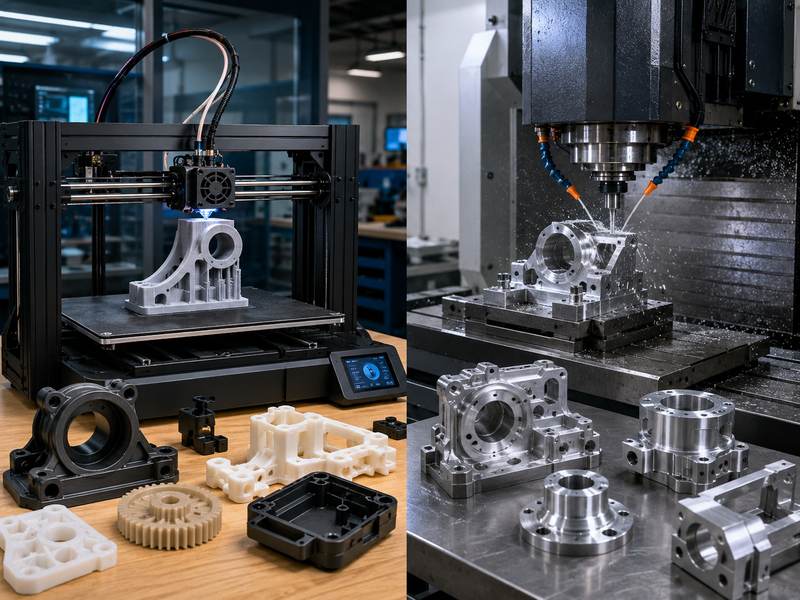
Quantity and Batch Prototypes
For one or two early design samples, 3D printing is often convenient. The optimal option for several functioning prototypes is determined by the material and performance requirements.
CNC machining may be better for small-batch prototypes when all parts must have consistent dimensions and material properties. It is also useful when the prototype will be tested by customers, investors, or engineering teams.
| Quantity | 3D Printing | CNC Machining |
| 1 piece | Very suitable | Suitable |
| 2–10 pieces | Suitable | Very suitable for functional parts |
| 10–100 pieces | Suitable for plastic parts | Good for consistent prototypes |
| Large prototype batch | Depends on method | Good for repeatable production |
| Production transition | Limited | Easier to move toward manufacturing |
If a prototype project is close to production, CNC machining gives better preparation for manufacturing.
When to Choose 3D Printing
Choose 3D printing when the project needs fast design iteration, complex shapes, low-cost concept models, or early physical samples.
3D printing is suitable for:
- Early product design
- Concept verification
- Complex geometry
- Ergonomic testing
- Plastic appearance models
- Lightweight structures
- Internal channels
- Low-volume design experiments
- Fast visual samples
It is especially useful when the design may change several times before the final version.
When to Choose CNC Machining
Choose CNC machining when the prototype must be strong, accurate, and close to the final product.
CNC machining is suitable for:
- Functional mechanical testing
- Metal prototypes
- Engineering plastics
- Tight tolerance parts
- Assembly verification
- Load-bearing components
- Heat-resistant parts
- Wear-resistant parts
- Pre-production samples
- Customer approval samples
For parts that must perform under real working conditions, CNC machining is often the better choice.
Can 3D Printing and CNC Machining Be Used Together?
Yes. Many product development teams use both methods in the same project.
A common workflow may look like this:
| Project Step | Process Used |
| Initial design idea | 3D printing |
| Shape and size review | 3D printing |
| Design improvement | 3D printing |
| Functional testing | CNC machining |
| Final engineering validation | CNC machining |
| Pre-production sample | CNC machining |
This approach reduces development cost while still ensuring final performance. 3D printing helps teams move quickly in the early stage, while CNC machining supports reliable testing before production.
Final Decision Guide
| Project Requirement | Better Choice |
| Fastest concept model | 3D printing |
| Lowest cost for complex plastic shape | 3D printing |
| Best material strength | CNC machining |
| Best dimensional accuracy | CNC machining |
| Smooth metal appearance | CNC machining |
| Complex internal structure | 3D printing |
| Production-like prototype | CNC machining |
| Functional metal part | CNC machining |
| Lightweight experimental design | 3D printing |
| Final customer sample | CNC machining |