
Choosing a reliable CNC machining manufacturer in China requires evaluating more than price. Buyers should check machining capability, quality control, engineering support, material knowledge, surface treatment experience, delivery reliability, communication, and export experience.
A good supplier should understand drawings, offer practical production advice, provide samples and inspection reports, and deliver parts on time. For custom CNC machining services, working with a professional supplier like Anhua Machining can improve part quality, simplify sourcing, and support long-term production.
For buyers who are comparing multiple manufacturers, it is also important to look beyond individual machining capabilities and evaluate the supplier’s overall OEM sourcing capabilities, production scalability, quality control, and communication process. Our CNC Machining Supplier in China: Complete OEM Sourcing Guide provides a more detailed framework for evaluating Chinese CNC machining suppliers, from prototype development and quality management to mass production and RFQ preparation.
Understand Your CNC Machining Requirements First
Before searching for a supplier, you should clearly define your own machining requirements. A reliable manufacturer can provide technical support, but the buyer should still prepare basic project information. This helps the supplier quote accurately and judge whether the part can be manufactured efficiently.
Important information usually includes:
| Requirement | What to Prepare | Why It Matters |
| Drawings | 2D drawings and 3D CAD files | Helps confirm dimensions, tolerances, and machining details |
| Material | Aluminum, steel, stainless steel, brass, copper, plastic, etc. | Affects machining method, cost, and surface finish |
| Quantity | Prototype, small batch, or mass production | Influences the unit price and production planning |
| Tolerance | General tolerance or tight tolerance areas | Determines machining difficulty and inspection needs |
| Surface finish | Anodizing, polishing, plating, powder coating, passivation, etc. | Affects final appearance and function |
| Application | Automotive, medical, electronics, machinery, etc. | Helps the supplier understand performance requirements |
If your project has special requirements, such as high precision, food-grade material, corrosion resistance, wear resistance, or assembly testing, you should explain these details at the beginning. Clear information reduces misunderstanding and helps you identify whether the supplier is professional.
Check the Manufacturer’s CNC Machining Capabilities
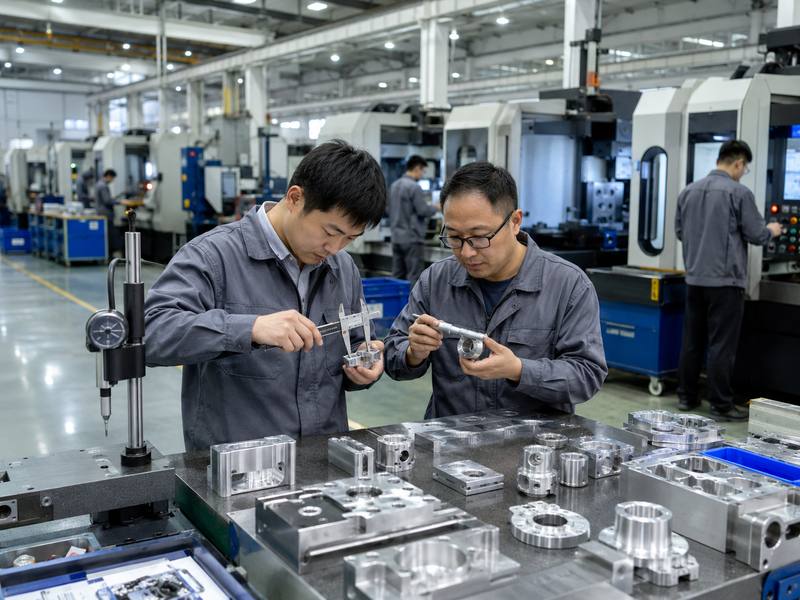
A reliable CNC machining manufacturer should have suitable equipment and technical ability for your project. CNC machining is not one single process. It may include CNC milling, CNC turning, drilling, tapping, grinding, wire cutting, EDM, surface treatment, and assembly.
When reviewing a Chinese CNC machining supplier, check whether they can handle your part size, material, complexity, tolerance, and order volume.
| Capability Area | What to Check |
| CNC milling | 3-axis, 4-axis, or 5-axis machining capability |
| CNC turning | Ability to machine shafts, bushings, sleeves, threaded parts, and round components |
| Material range | Aluminum, stainless steel, carbon steel, brass, copper, titanium, and engineering plastics |
| Part complexity | Thin-wall parts, deep holes, complex surfaces, tight-tolerance features |
| Batch capacity | Prototype, low-volume production, and mass production |
| Secondary processes | Heat treatment, anodizing, plating, painting, polishing, and laser marking |
| Assembly support | Simple assembly, testing, packaging, and logistics support |
For complex components, 5-axis machining may reduce setup times and improve accuracy. For turned parts, the manufacturer should have strong lathe capability. For high-volume orders, stable production planning and repeatability are more important than only having advanced machines.
A supplier such as Anhua Machining can be evaluated based on its ability to support custom CNC machining projects, material selection, production control, and quality inspection for different industrial applications.
Evaluate Quality Control Systems
Quality control is one of the most important factors when choosing a CNC machining manufacturer in China. Low prices are not meaningful if the parts cannot meet drawing requirements. A reliable supplier should have a clear inspection process before, during, and after production.
You can ask the supplier about their quality control process, inspection equipment, and quality documents. For precision CNC machining, inspection should not rely only on visual checking. The factory should use measuring tools and inspection systems suitable for the tolerance level.
Common inspection tools include:
| Inspection Tool | Main Use |
| Calipers | General dimension measurement |
| Micrometers | More accurate thickness and diameter measurement |
| Height gauges | Checking height and step dimensions |
| Coordinate Measuring Machine | Measuring complex and high-precision parts |
| Surface roughness tester | Checking surface finish values |
| Thread gauges | Inspecting internal and external threads |
| Pin gauges | Checking hole size and fit |
| Hardness tester | Testing material hardness after treatment |
A good CNC machining manufacturer should provide inspection reports when needed. For critical parts, you can request First Article Inspection, material certificates, surface treatment reports, and dimensional inspection reports.
You should also check whether the supplier understands international quality expectations. Even if you do not require strict certifications, the factory should have a stable quality management process.
Review Industry Experience and Case Examples
Different industries have different machining standards. A manufacturer that mainly produces simple decorative parts may not be suitable for high-precision mechanical components. Before choosing a supplier, check whether they have experience with your industry or similar products.
For example:
| Industry | Common CNC Machined Parts | Key Requirements |
| Automotive | Brackets, housings, shafts, connectors | Strength, repeatability, batch consistency |
| Electronics | Heat sinks, enclosures, and connectors | Appearance, precision, surface finish |
| Medical devices | Stainless steel parts, instrument components | Clean surface, accuracy, and material traceability |
| Machinery | Gears, plates, blocks, fixtures | Durability, dimensional stability |
| Aerospace | Lightweight aluminum and titanium parts | High precision, strict tolerance control |
| Energy equipment | Valve parts, pump parts, fittings | Corrosion resistance and reliability |
Ask the supplier for sample photos, production examples, or similar project experience. A professional supplier may not be able to disclose all customer details, but they should be able to show their general machining capability.
Industry experience helps the manufacturer better understand part function, risk points, and inspection priorities. This can reduce trial-and-error during production.
Compare Communication and Engineering Support
Communication is often overlooked, but it is very important when working with overseas CNC machining manufacturers. A reliable Chinese supplier should respond clearly, understand technical drawings, ask useful questions, and explain production suggestions.
Good communication includes:
| Good Supplier Behavior | What It Shows |
| Responds quickly and clearly | Organized sales and engineering support |
| Reviews drawings carefully | Strong technical understanding |
| Points out manufacturing risks | Responsible engineering attitude |
| Suggests cost-saving improvements | Experience with manufacturability |
| Confirms tolerance and surface finish details | Attention to quality |
| Provides realistic lead times | Better production planning |
If a supplier only gives a low price without asking any technical questions, you should be careful. Complex CNC machining projects often require design review, tolerance discussion, material confirmation, and surface treatment planning.
For example, a reliable manufacturer may suggest changing sharp internal corners to reasonable radii, adjusting unnecessarily tight tolerances, or choosing a more suitable aluminum grade. These suggestions can reduce cost and improve production stability.
Check Pricing Carefully, Not Just the Lowest Quote
Many buyers choose Chinese CNC machining manufacturers because of cost advantages. However, the lowest price is not always the best choice. Extremely low prices may indicate poor material quality, weak quality control, inexperienced workers, or hidden costs.
A CNC machining quotation is usually affected by several factors:
| Cost Factor | How It Affects Price |
| Material type | Stainless steel and titanium are usually more expensive than aluminum |
| Part complexity | More complex geometry requires more machining time |
| Tolerance | Tighter tolerances increase inspection and machining difficulty |
| Surface finish | Anodizing, plating, polishing, and coating add cost |
| Quantity | Larger volumes usually reduce unit cost |
| Setup time | Multiple setups increase production cost |
| Tooling and fixtures | Special fixtures may be required for stable machining |
| Lead time | Urgent orders may require additional production arrangements |
When comparing suppliers, do not only compare the final price. You should compare what is included in the quotation. Does the price include material, machining, surface finish, inspection, packaging, and shipping? Are there extra costs for samples, tooling, or design changes?
A reliable supplier should provide transparent pricing and explain major cost drivers when needed.
Start with Samples or Small Batch Orders
If you are working with a new CNC machining manufacturer in China, it is usually better to start with a prototype or small batch order. This allows you to evaluate the supplier before moving to mass production.
A sample order can help you check:
| Evaluation Point | What to Review |
| Dimension accuracy | Whether the part matches the drawing |
| Surface finish | Whether the appearance and roughness meet expectations |
| Material quality | Whether the correct material is used |
| Communication | Whether the supplier updates progress clearly |
| Lead time | Whether the supplier ships on schedule |
| Packaging | Whether parts are protected during transport |
| Problem-solving | How the supplier handles corrections or feedback |
If the sample quality is stable and the supplier handles communication professionally, you can gradually increase order quantity. For long-term cooperation, this step can reduce risk.
Confirm Lead Time and Production Capacity
Delivery time is another key factor. A reliable CNC machining manufacturer should provide realistic lead times based on material availability, machining workload, surface treatment, inspection, and shipping.
Common lead time factors include:
| Factor | Possible Impact |
| Material procurement | Special materials may take longer |
| Machine availability | Busy production schedules can delay orders |
| Part complexity | Complex parts need longer machining time |
| Surface treatment | Outsourced finishing may add several days |
| Inspection requirements | Full inspection takes more time |
| Quantity | Large orders need stable production planning |
| Shipping method | Express, air freight, and sea freight vary greatly |
You should avoid suppliers who promise unrealistically fast delivery without reviewing the project carefully. Fast delivery is useful, but stable and accurate delivery is more important.
For urgent projects, ask whether the supplier can support priority production, but make sure quality inspection is still included.
Pay Attention to Surface Treatment Ability
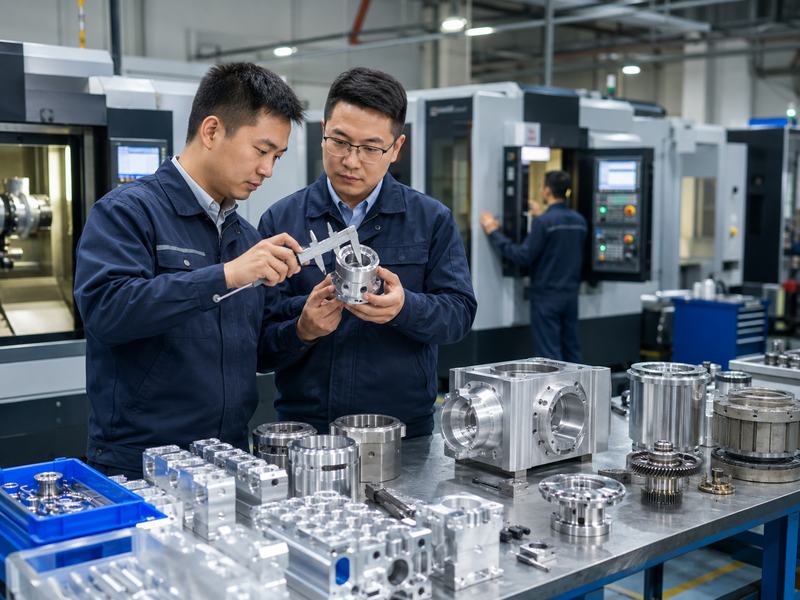
Many CNC-machined parts require surface finishing after machining. Surface treatment can improve appearance, corrosion resistance, wear resistance, electrical performance, or cleaning ability.
Common surface treatments include:
| Surface Treatment | Common Applications |
| Anodizing | Aluminum parts, electronics, automotive components |
| Hard anodizing | Wear-resistant aluminum parts |
| Electroplating | Decorative and corrosion-resistant metal parts |
| Passivation | Stainless steel parts |
| Powder coating | Machinery parts, enclosures, outdoor components |
| Polishing | Decorative or low-friction surfaces |
| Sandblasting | Matte surface appearance |
| Black oxide | Steel parts requiring mild corrosion protection |
| Laser marking | Logos, part numbers, traceability codes |
A reliable CNC machining manufacturer should understand how surface treatment affects final dimensions. For example, anodizing adds a coating layer, polishing may slightly change dimensions, and plating thickness must be considered for tight-tolerance parts.
You should confirm color standards, surface texture, masking areas, and inspection requirements before production.
Review Packaging and Export Experience
For international buyers, packaging and export experience are also important. Precision CNC machined parts can be damaged during transportation if they are not packed properly. Scratches, dents, thread damage, and surface finish defects may happen during shipping.
Good packaging may include foam protection, plastic bags, anti-rust oil, bubble wrap, cartons, wooden boxes, labels, and separated layers. For high-precision or appearance parts, each component may need individual packaging.
You should also check whether the supplier has experience with international shipping documents, customs requirements, and logistics coordination. A manufacturer with export experience can help reduce delivery problems.
Look for Long-Term Cooperation Potential
A reliable CNC machining manufacturer should not only complete one order but also support long-term cooperation. If your business needs repeated orders, product updates, or new part development, the supplier should be able to grow with your needs.
Long-term cooperation depends on stable quality, reasonable pricing, engineering support, confidentiality, delivery performance, and after-sales service. A good supplier should record production data, keep process consistency, and help improve manufacturability over time.
You can evaluate long-term potential by asking:
| Question | Why It Matters |
| Can you keep production records for repeat orders? | Helps maintain consistency |
| Can you support design changes? | Useful for product improvement |
| Can you provide inspection reports regularly? | Supports quality tracking |
| Can you handle increasing order volumes? | Important for business growth |
| Can you protect drawings and confidential information? | Reduces intellectual property risk |
| Can you support assembly or secondary processing? | Simplifies supply chain management |