
Finding a machine shop to cut a few prototype parts is relatively easy. Finding one capable of holding tight tolerances across a 50,000-part run without blowing your budget? That takes serious vetting. B2B procurement teams constantly face the pressure of driving down unit costs while preventing dimensional failures that could stall an entire assembly line.
Partnering with an overseas manufacturer is often the best route to achieve aggressive pricing targets. But transitioning a functional design into a mass-produced component carries operational risk. This guide breaks down exactly how OEM managers should evaluate a CNC machining supplier in China, mitigate supply chain bottlenecks, and move projects efficiently from concept to mass production.
Beyond the Equipment List: Vetting Real Capacity
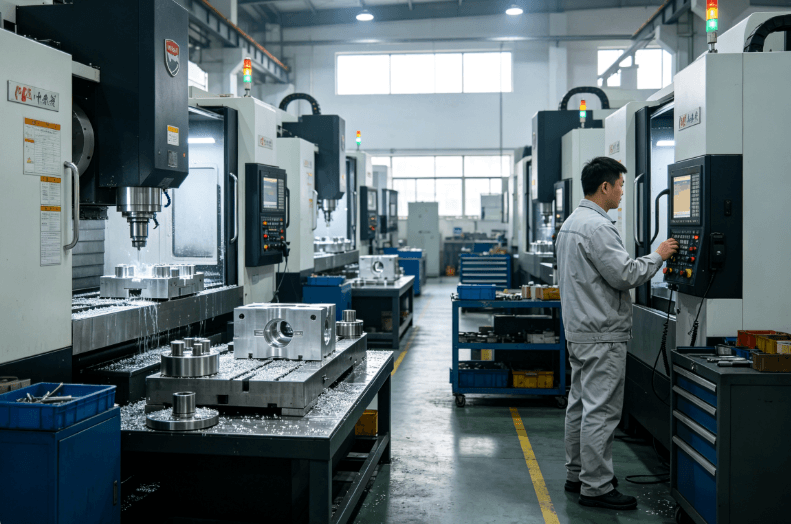
A common trap for procurement teams is relying entirely on a vendor’s equipment list. Having a dozen multi-axis mills on the floor doesn’t automatically equal high-volume capability. True manufacturing scalability depends on workflow integration and production management.
Many prototype shops lack the automated bar feeders, robust coolant systems, and floor space required to run parts 24/7. When evaluating a potential facility, you have to look at how they handle secondary operations.
Managing multiple distinct vendors for milling, heat treatment, and surface finishing introduces severe risks. Every time a batch transfers to an outside subcontractor for anodizing or bead blasting, transit times increase and accountability fractures. Facilities that handle these secondary processes in-house compress lead times and keep quality control under one roof.
The Transition: Prototyping to High-Volume Runs
Moving a custom OEM component into mass production is where most supply chain delays actually happen. You don’t just load a CAD file and immediately hit the start button on a 10,000-unit order. Procurement and engineering teams must validate mechanical properties and establish stable machine cycle times first.
Rushing this transition almost guarantees heavy material scrap and downstream assembly issues. Manufacturing engineers rely on pilot runs to establish baseline capability metrics like Cpk. This proves the machining process is repeatable before committing massive capital to raw material blocks.
When reviewing partners, look for custom CNC machining services from prototype to production that follow a structured scale-up workflow:
-
Rapid Prototyping: 1–10 units strictly for validating physical fit and form.
-
Pilot Run (NPI): 50–500 units to dial in CAM programs, test custom fixturing, and evaluate yield rates.
-
Mass Production: High-volume output focused on automated inspection, cost efficiency, and maximum throughput.
Controlling Tolerances at Scale
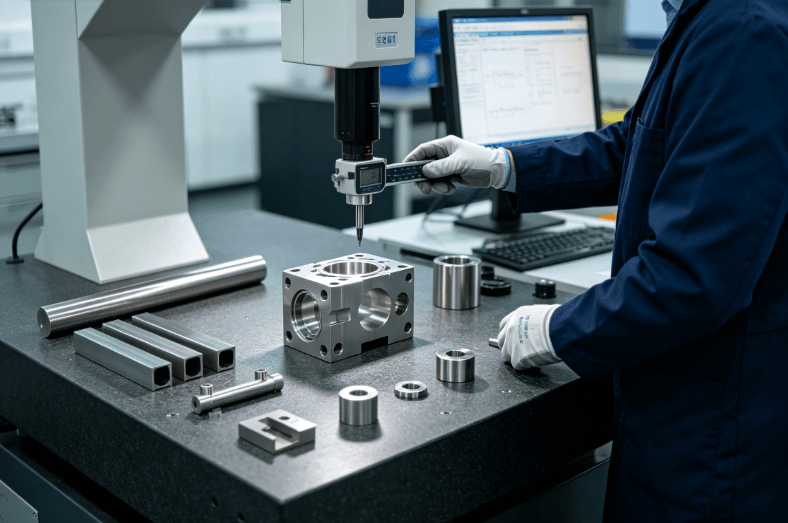
Extreme precision on a single prototype is expected. Maintaining that exact same precision on part number 4,999 requires rigorous, automated quality control. Hand calipers and manual micrometers simply won’t cut it on a multi-shift production run.
Capable suppliers utilize in-process probing to verify critical geometries before the part even comes off the machine. Once parts leave the mill, quality teams should rely on Coordinate Measuring Machines (CMM) to continuously monitor dimensional accuracy against standard AQL sampling plans.
Engineers should also use Design for Manufacturability (DFM) reviews to catch over-toleranced features. Slapping tight ASME Y14.5 tolerances on non-critical geometries forces the shop to slow down spindle speeds and perform extra inspections. A skilled partner will flag these areas early, helping you strip out unnecessary machine time and lower the final unit cost.
How Material Choices Dictate Batch Pricing
Raw material selection directly impacts machine cycle times and consumable tooling expenses—two massive drivers of your final invoice.
Standard Aluminum 6061-T6 machines rapidly and dissipates heat well, which keeps labor and machine-hour costs low. It’s exactly why you see it used so heavily in consumer electronics enclosures and automotive brackets.
On the flip side, specialized industrial alloys drag out production times. Machining 316L stainless steel for medical housings requires slower feed rates to manage heat generation. Titanium Grade 5 causes rapid tool wear. If the shop has to swap out custom carbide end mills halfway through every shift, your part price will inevitably spike.
Experienced high-volume manufacturers offset some of these costs by engineering custom zero-point fixtures. These specialized workholding solutions let operators swap raw material blanks in seconds rather than minutes, maximizing spindle uptime across all shifts.
Building an RFQ That Gets Accurate Pricing
Sending a vague Request for Quote (RFQ) to an overseas vendor is a surefire way to get hit with hidden costs later. Incomplete technical drawings lead to inaccurate pricing models and painful sampling delays.
Before you contact us or any potential manufacturing partner to price out a project, ensure your RFQ package leaves no room for assumptions.
A complete commercial documentation package should always include:
-
3D CAD and 2D Drawings: Provide STEP files, but always include PDF drawings that explicitly call out tight tolerances and threaded holes.
-
Material Specifications: State the exact metal grades required and mandate Material Test Certificates (MTC).
-
Inspection Standards: Define your required AQL sampling plans and ask for full First Article Inspection (FAI) reports on the initial batch.
-
Volume Projections: Share your Estimated Annual Usage (EAU). Knowing the long-term volume helps the supplier amortize custom fixture costs over a larger quantity, lowering your immediate piece price.
Quality Systems and Supplier Integration
Different B2B sectors operate under entirely different regulatory realities. What works for a generic industrial bracket might fail catastrophic quality audits in the automotive sector.
Baseline commercial manufacturing requires standard ISO 9001 certification. However, if you are sourcing medical device components, your partner must adhere to ISO 13485 to ensure total traceability. Automotive OEM projects rely on strict IATF 16949 standards.
Working with an established, vertically integrated manufacturer like Anhua Machining takes the guesswork out of this compliance burden. Having a single point of accountability for everything from initial DFM reviews to final surface treatment ensures better dimensional stability and a much faster path to market.
FAQ
What is the typical MOQ for industrial CNC production in China?
Minimum Order Quantities depend on the facility’s setup. Specialized prototyping shops routinely accept 1-unit orders to help engineers validate designs. Larger, high-volume production facilities typically look for pilot runs of 50 to 100 units to justify the time spent programming CAM software and building custom workholding fixtures.
Can I modify a CAD design between the prototype and mass production phases?
Yes, and it is highly recommended. Manufacturing engineers almost always tweak designs after the functional prototype phase. Opening up internal corner radii, standardizing blind hole depths, or relaxing non-critical tolerances drastically improves manufacturability and drives down volume pricing.
How do secondary surface finishes affect total lead times?
If the machine shop handles surface treatments in-house, it adds very little time to the schedule. Outsourcing processes like hard coat anodizing, powder coating, or passivation to a third party usually adds three to five days due to transit and queue times.
What documentation proves raw material authenticity?
Procurement teams should strictly require Material Test Certificates (MTC) prior to the start of mass production. These documents trace the metal back to the mill, verifying its exact chemical composition and physical properties.
Reference Sources
-
ISO 9001:2015 – Quality management systems — Requirements. International Organization for Standardization.
-
ASME Y14.5-2018 – Dimensioning and Tolerancing. American Society of Mechanical Engineers.
-
ASTM B209 / B209M – Standard Specification for Aluminum and Aluminum-Alloy Sheet and Plate. ASTM International.
-
Machinery’s Handbook, 31st Edition – Erik Oberg et al. Industrial Press.