
Elevators and lifting equipment rely on precision metal parts for safe, stable, and long-term operation. Components such as guide rail brackets, door parts, pulley supports, frames, shafts, housings, and safety parts support load, movement, vibration control, and reliability.
These parts require strong materials, accurate dimensions, durable surfaces, and reliable safety performance. Custom metal parts help solve different installation, load, and design needs while improving assembly, performance, and service life.
What Are Custom Metal Parts for Elevators and Lifting Equipment?
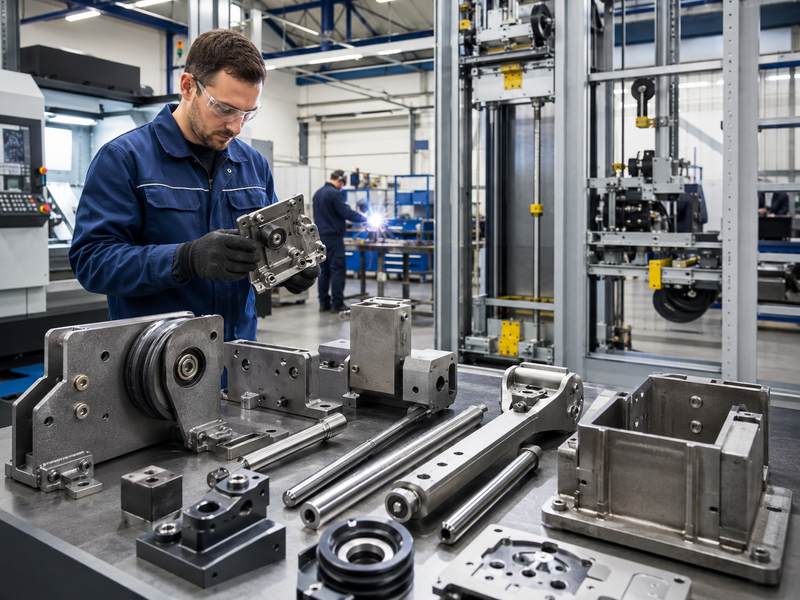
Custom metal parts are components manufactured according to specific drawings, samples, technical requirements, or application needs. They are not restricted to typical catalogue items. Instead, they can be designed and produced for a particular elevator model, lifting platform, hoist, crane system, escalator, construction lift, or industrial lifting machine.
CNC machining, sheet metal fabrication, laser cutting, bending, welding, stamping, casting, forging, or surface finishing are some methods for producing these parts. The best manufacturing method depends on part structure, load requirements, tolerance level, order volume, and cost target.
In elevator and lifting systems, custom metal parts are commonly used for structural support, motion transmission, safety protection, connection, guiding, positioning, and enclosure protection.
Common Applications of Custom Metal Parts
Elevators and lifting equipment include many mechanical and structural systems. Each system requires different metal components.
| Application Area | Common Custom Metal Parts | Main Function |
| Elevator shaft system | Guide rail brackets, support plates, and fixing clips | Rail alignment and structural support |
| Elevator car system | Frames, panels, brackets, reinforcement plates | Cabin support and assembly |
| Door system | Door tracks, rollers, hinges, plates, covers | Smooth opening and closing |
| Lifting platform | Scissor arms, base frames, pins, and shafts | Load lifting and movement support |
| Hoist and crane equipment | Hooks, pulleys, drums, gear housings | Lifting, pulling, and transmission |
| Safety mechanism | Locking parts, brake plates, latch components | Safety control and emergency protection |
| Control cabinet and enclosure | Sheet metal boxes, panels, mounting plates | Electrical protection and installation |
These parts may look simple, but their performance can directly affect equipment safety. For example, a weak bracket may cause guide rail misalignment. A poorly machined shaft may increase vibration. A low-quality pulley part may reduce lifting efficiency or cause early wear.
Why Customization Is Important
Elevator and lifting equipment are often installed in different environments. A residential elevator, cargo elevator, hospital elevator, industrial lifting platform, warehouse hoist, and construction lifting system all have different design requirements.
Standard parts may not always match the project. Customization allows manufacturers to adjust the part size, material, hole position, thickness, surface treatment, tolerance, and structure according to actual use.
Better Fit for Equipment Design
Custom metal parts can be manufactured according to exact drawings. This helps reduce installation gaps, misalignment, drilling adjustments, and assembly delays. For elevator projects, accurate parts are especially important because even small dimensional errors can affect door movement, guide rail positioning, or cabin stability.
Stronger Load-Bearing Performance
Lifting equipment often works under repeated load conditions. Custom parts can be designed with proper thickness, reinforcement ribs, stronger materials, or optimized structures to handle specific loads. This is important for cargo elevators, hydraulic lifts, scissor lifts, cranes, and industrial hoists.
Improved Safety and Reliability
Safety is the most important requirement in elevator and lifting equipment. Custom metal parts can be produced with controlled materials, precise machining, reliable welding, and strict inspection. This reduces the risk of deformation, cracking, loosening, or premature failure.
Easier Maintenance and Replacement
For older elevator systems or special lifting machines, original parts may no longer be available. Custom manufacturing can produce replacement parts based on samples or drawings, helping maintenance teams restore equipment without redesigning the whole system.
Common Materials Used for Elevator and Lifting Parts
Material selection affects strength, corrosion resistance, weight, machinability, and cost. Different components require different materials.
| Material | Advantages | Typical Applications |
| Carbon steel | High strength, cost-effective, easy to weld | Frames, brackets, supports, base plates |
| Stainless steel | Corrosion-resistant, clean appearance, durable | Elevator panels, covers, exposed parts |
| Aluminum alloy | Lightweight, easy to machine, good appearance | Covers, housings, lightweight parts |
| Alloy steel | High strength, wear resistance, fatigue resistance | Shafts, pins, gears, load-bearing parts |
| Galvanized steel | Good corrosion protection, economical | Outdoor brackets, mounting plates, sheet parts |
| Cast iron/cast steel | Good rigidity and vibration resistance | Housings, pulley parts, heavy components |
For indoor elevator parts, carbon steel with powder coating or zinc plating is commonly used. For exposed or decorative parts, stainless steel is often preferred. For moving parts where weight reduction matters, aluminum alloy may be selected. For high-load lifting components, alloy steel is usually a better choice.
Main Manufacturing Processes
Custom metal parts for elevators and lifting equipment can be manufactured through several processes. Each process has different advantages.
CNC Machining
CNC machining is suitable for precision parts such as shafts, pins, bushings, rollers, housings, connecting blocks, and threaded components. It provides high-dimensional accuracy and stable repeatability.
Machining is often used when parts require tight tolerances, smooth surfaces, accurate holes, or complex shapes. For lifting equipment, CNC-machined pins and shafts must be strong and precise to support safe movement.
Fabrication of Sheet Metal
Laser cutting, punching, bending, welding, and assembly are all part of sheet metal fabrication. It is widely used for elevator panels, control cabinet enclosures, covers, mounting plates, guards, and brackets.
Both small and medium production runs can benefit from this adaptable approach. It also allows many surface finishing options, such as powder coating, brushing, polishing, and galvanizing.
Welding Fabrication
Welding is used for large structural parts, frames, support bases, lifting platforms, brackets, and reinforced assemblies. Strong weld quality is critical because lifting equipment often carries heavy and repeated loads.
Welded parts may require inspection for weld strength, deformation, and dimensional accuracy. After welding, additional machining or surface treatment may be needed.
Stamping
Stamping is suitable for high-volume production of metal plates, clips, covers, washers, small brackets, and standardized parts. After tooling is finished, stamping can produce goods quickly and at a reduced cost per unit.
However, stamping requires mold investment, so it is usually more suitable for stable designs and large order quantities.
Casting and Forging
Casting is used for complex metal parts such as housings, pulley bodies, and heavy structural components. Forging is suitable for high-strength parts such as hooks, links, shafts, and load-bearing components.
Forged parts usually offer better strength and fatigue resistance than cast parts, but they may have higher tooling and processing costs.
| Process | Best For | Key Benefit |
| CNC machining | Shafts, pins, precision blocks, housings | High accuracy |
| Sheet metal fabrication | Panels, covers, brackets, enclosures | Flexible customization |
| Welding fabrication | Frames, bases, support structures | Strong assemblies |
| Stamping | Clips, plates, small brackets | Efficient mass production |
| Casting | Complex housings, pulley parts | Complex shapes |
| Forging | Hooks, shafts, high-load parts | High strength |
Key Design Considerations
Custom metal parts should be designed not only for shape, but also for safety, manufacturability, assembly, and long-term operation.
Load Capacity
Parts used in lifting systems must withstand static load, dynamic load, impact load, and repeated stress. Designers should consider the actual working environment, safety factor, and possible overload conditions.
Dimensional Accuracy
Elevator and lifting equipment often requires precise alignment. Hole positions, flatness, perpendicularity, and surface accuracy can affect installation and movement. For example, inaccurate guide rail brackets may cause vibration or abnormal wear.
Fatigue Resistance
Lifting equipment moves repeatedly. Parts such as pins, shafts, arms, and brackets may experience thousands or millions of cycles. Proper material selection, heat treatment, surface finish, and structural design can improve fatigue resistance.
Corrosion Protection
Elevator and lifting equipment may operate indoors, outdoors, in humid environments, or in industrial plants. The surroundings should be taken into consideration while choosing a surface treatment. Common options include zinc plating, powder coating, anodizing, polishing, black oxide, and hot-dip galvanizing.
Assembly Efficiency
A good custom part design should make installation easier. This may include accurate mounting holes, chamfered edges, positioning slots, welded nuts, modular structures, and clear assembly interfaces.
Surface Treatment Options
Surface treatment improves appearance, corrosion resistance, wear resistance, and service life. For elevator components, surface quality is also important because some parts are visible to users.
| Surface Treatment | Main Purpose | Suitable Parts |
| Powder coating | Corrosion protection and color finish | Brackets, frames, covers |
| Zinc plating | Rust prevention | Fasteners, plates, brackets |
| Hot-dip galvanizing | Strong outdoor corrosion resistance | Outdoor supports, heavy frames |
| Anodizing | Aluminum protection and appearance | Aluminum covers, housings |
| Polishing | Smooth and bright surface | Stainless steel elevator panels |
| Brushing | Decorative linear texture | Elevator doors, panels, trims |
| Black oxide | Mild corrosion protection, dark finish | Shafts, small machined parts |
The correct surface treatment depends on both function and environment. A hidden internal bracket may only need zinc plating, while a visible stainless steel panel may require brushing or polishing.
Quality Control Requirements
Because elevator and lifting equipment are safety-related applications, quality control must be strict. Manufacturers should inspect materials, dimensions, welding quality, surface treatment, and mechanical performance.
Common inspection items include material certificates, dimensional reports, hardness testing, surface roughness inspection, weld inspection, coating thickness testing, load testing, and visual inspection.
For critical lifting components, non-destructive testing may also be required. Depending on the component and use, this may involve X-ray, magnetic particle, or ultrasonic testing.
A reliable custom metal parts supplier should have stable production processes and documented inspection standards. Quality control shouldn’t be limited to the last phase. It should start from raw material selection and continue through cutting, machining, welding, finishing, and packaging.
Benefits of Working with a Custom Metal Parts Manufacturer
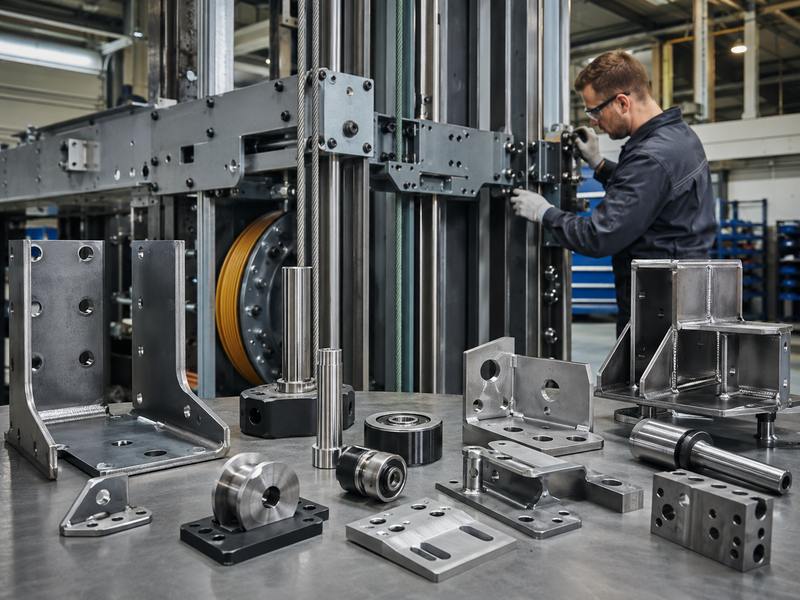
A professional manufacturer can support the full process from drawing review to production and inspection. This is especially helpful for elevator and lifting equipment projects where parts need to match both mechanical and safety requirements.
A good supplier can help optimize material selection, reduce unnecessary cost, improve part manufacturability, and suggest better surface treatment. For example, a thick machined part may be redesigned as a welded structure to reduce material waste. A complicated sheet metal part may be simplified to improve bending accuracy and reduce production cost.
Custom manufacturing also helps companies manage small-batch orders, replacement parts, prototype testing, and mass production. This flexibility is useful for elevator modernization projects, lifting equipment upgrades, and new product development.
How to Choose the Right Supplier
Choosing the right supplier is important for quality and delivery stability. The supplier’s experience with lifts, lifting, machinery, and structural metal parts should be verified by buyers. They should also review equipment capacity, material options, tolerance control, welding ability, surface finishing resources, and inspection process.
The supplier should be able to understand technical drawings and communicate clearly about tolerances, materials, finishing, packaging, and delivery time. For complex or safety-related parts, sample approval is recommended before mass production.
| Supplier Factor | Why It Matters |
| Industry experience | Helps understand load, safety, and assembly requirements |
| Manufacturing capability | Supports different part types and production volumes |
| Quality inspection | Reduces defects and improves consistency |
| Material control | Ensures strength and durability |
| Surface finishing options | Improves corrosion resistance and appearance |
| Engineering support | Helps optimize design and reduce cost |
| Delivery stability | Keeps elevator and lifting projects on schedule |
A low price is not always the best choice. Poor-quality parts may cause assembly problems, equipment downtime, safety risks, and higher long-term costs.
Custom metal parts are vital for elevator and lifting equipment, supporting safety, strength, movement, installation, and long-term performance. Common parts include brackets, frames, shafts, pins, panels, pulley supports, door components, enclosures, and safety mechanism parts.
Reliable production requires suitable materials, proper processes, accurate dimensions, surface treatment, and strict inspection. Working with an experienced custom metal parts manufacturer helps improve fit, performance, reliability, and project delivery.