
For businesses seeking reliable custom sheet metal fabrication China remains a highly competitive and capable manufacturing hub. However, identifying a dependable supply chain partner goes far beyond comparing unit prices. Sourcing industrial components overseas carries inherent risks regarding quality consistency. A reliable partner ensures tight tolerances, verifiable material properties, and predictable lead times.
In large-volume production, even minor deviations in bend deductions or welding parameters can derail assembly lines. OEM project managers and B2B procurement teams must look past polished marketing materials. Selecting the right facility requires a systematic evaluation of engineering support, equipment capabilities, and quality management systems. This guide provides an actionable framework for auditing and selecting a high-tier manufacturing partner.
Core Criteria for Evaluating Manufacturing Capability
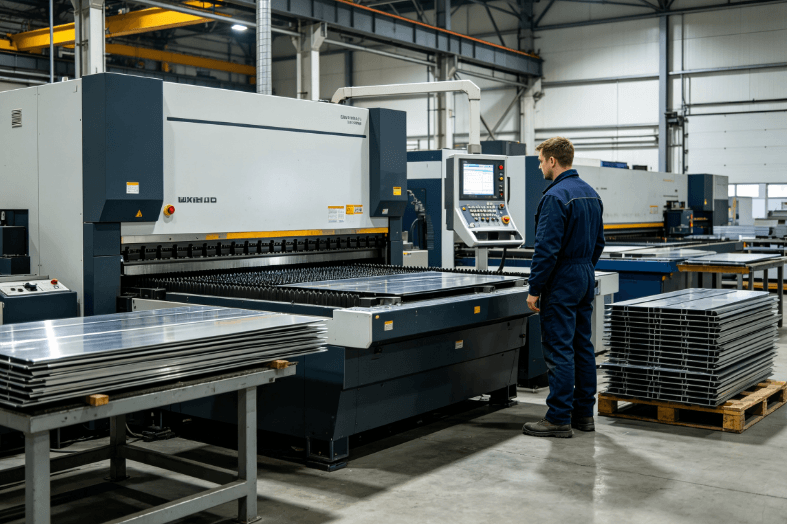
A factory’s equipment list offers insight into its raw production potential. Reliable manufacturers maintain modern in-house capabilities for core processes like laser cutting, CNC punching, and bending. Heavy reliance on outsourced secondary operations often introduces severe scheduling bottlenecks.
Evaluate the tonnage and precision of their press brakes. Automated press brakes ensure consistent bend angles across large production batches. You must also assess their welding capabilities. Robotic welding stations provide superior weld penetration and consistency compared to manual operations, particularly for complex structural frames.
Engineering support is equally critical during supplier evaluation. The best partners proactively review CAD models for manufacturability before production begins. They will suggest design modifications to reduce material waste or simplify the bending process. This level of technical engagement prevents costly revisions later.
Navigating the RFQ Workflow for B2B Procurement
Submitting a vague Request for Quote (RFQ) guarantees inaccurate pricing and extended lead times. A structured procurement workflow ensures apples-to-apples comparisons across different vendors. Clear documentation establishes the foundation for a successful manufacturing relationship.
Follow this systematic RFQ workflow to streamline vendor evaluation:
-
Provide complete file packages: Always submit native 3D CAD files (STEP/IGES) alongside fully dimensioned 2D PDF drawings.
-
Specify exact materials: Never just state “aluminum.” Clearly call out specific grades like 5052-H32 Aluminum or 304L Stainless Steel.
-
Define critical tolerances: Highlight critical dimensions on the 2D drawings. Specify standard tolerances according to ISO 2768-m or similar frameworks.
-
Detail finishing requirements: Clearly outline surface preparation, powder coating thickness, or anodizing specifications.
-
Request transparent pricing: Ask for itemized quotes separating tooling, setup fees, and raw material costs.
Quality Control and International Compliance Standards
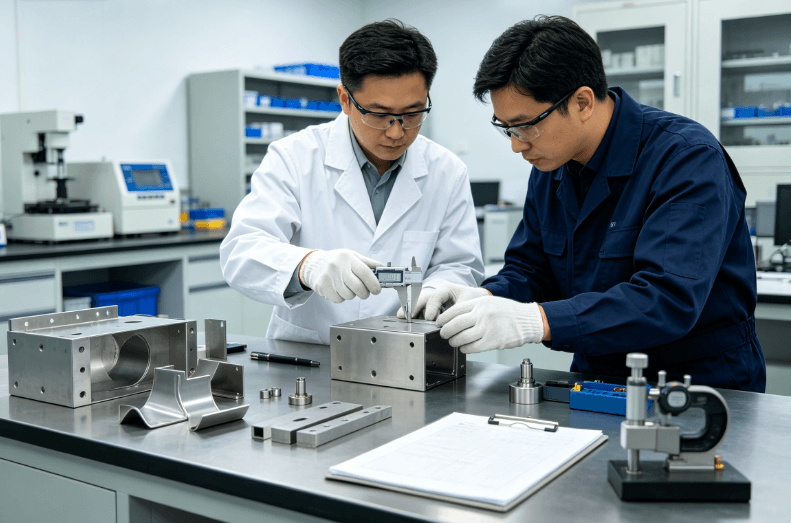
A robust Quality Management System (QMS) is non-negotiable for industrial, automotive, or medical applications. You should verify that the facility holds a valid ISO 9001 certification at a minimum [1]. Ask for examples of their standard inspection documentation.
First Article Inspection (FAI) reports are vital before authorizing mass production. An FAI confirms that all tooling and processes yield parts matching your precise specifications. For critical structural components, raw material traceability is also mandatory. Reliable suppliers will readily provide Material Test Reports (MTR) upon request.
Pay attention to how the supplier handles non-conformance. A mature manufacturing partner will utilize frameworks like the Production Part Approval Process (PPAP). They maintain dedicated quarantine areas for defective parts. This prevents out-of-spec materials from accidentally entering your final shipment.
Direct Factory vs. Trading Company: Which Fits Your Project?
Buyers often struggle to differentiate between direct manufacturers and trading companies. Both entities serve distinct purposes in the global supply chain. Understanding these differences helps align your procurement strategy with your project constraints.
| Evaluation Metric | Direct Manufacturing Factory | Sourcing/Trading Company |
| Cost Structure | Lower per-unit cost for medium to high volume. | Higher unit cost due to intermediary markups. |
| Communication | Direct access to engineers; slower response times. | Excellent English; faster general communication. |
| Quality Control | Direct oversight of factory floor and processes. | Reliant on third-party audits and factory trust. |
| MOQ Flexibility | Higher Minimum Order Quantities usually required. | Often flexible by aggregating multiple small orders. |
For long-term OEM contracts, partnering with a direct factory provides better control over intellectual property and production scaling.
Assessing Production Scalability and Lead Times
A supplier capable of delivering five pristine prototypes may struggle to produce five thousand units. You must evaluate their capacity to scale production efficiently. Ask about their shift structures and current machine utilization rates.
Sampling delays may occur when intricate tooling adjustments are required. A reliable partner will communicate these potential delays transparently rather than making unrealistic guarantees. Understand their standard lead times for both prototypes and full production runs.
Packaging is another frequently overlooked aspect of scalable production. Improper packaging leads to surface scratching or deformation during transit. Ensure the factory utilizes custom dunnage, edge protectors, and moisture-resistant wrapping for overseas shipping.
Seamless Supply Chain Integration with Anhua Machining
Finding a partner that balances technical expertise with scalable capacity is critical. Based in Liyang City, Jiangsu Province, Anhua Machining has established itself as a premier destination for one-stop manufacturing. Their operations support projects ranging from fast-turn prototypes to high-volume commercial production [2].
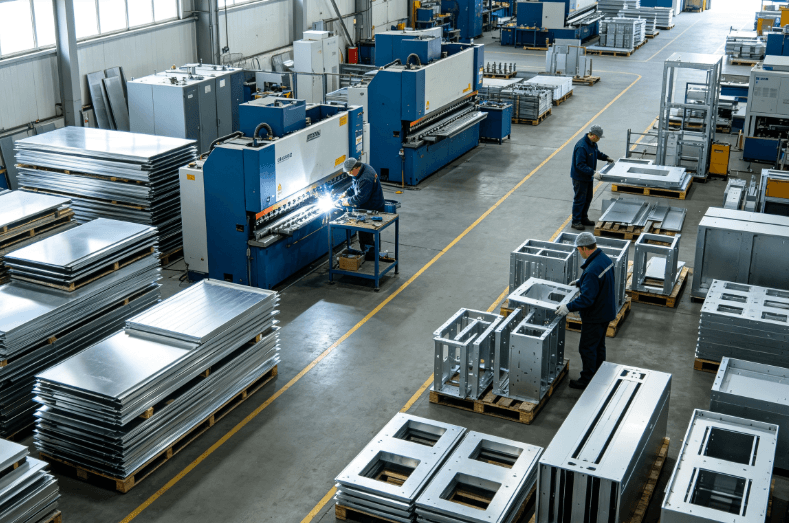
Anhua Machining excels in delivering comprehensive sheet metal fabrication solutions. They manage the entire lifecycle in-house, encompassing precision laser cutting, CNC bending, stamping, and welding. This vertical integration allows them to produce complex enclosures, heavy-duty brackets, and precision equipment panels while strictly controlling lead times.
By eliminating the need to coordinate between multiple sub-tier vendors, OEM project managers can drastically simplify supplier management. If you are preparing a new technical RFQ or evaluating vendor consolidation, you can directly contact their engineering team to review your prints. Their proactive design-for-manufacturing (DFM) support ensures smooth transitions into mass production.
Frequently Asked Questions
What is a standard Minimum Order Quantity (MOQ) for Chinese sheet metal factories?
MOQs vary significantly based on factory size and setup complexity. Direct factories typically require minimums ranging from 100 to 500 units for production runs. However, many specialized partners offer flexible low-volume prototyping before committing to mass production.
How do I protect my intellectual property during the RFQ phase?
Always execute a Non-Disclosure Agreement (NDA) before sharing proprietary CAD files. For high-risk projects, consider utilizing NNN (Non-Disclosure, Non-Use, Non-Circumvention) agreements drafted specifically under Chinese jurisdiction for better enforceability.
What is the expected lead time for First Article Inspection (FAI) samples?
For standard sheet metal components without complex custom tooling, FAI samples typically take 10 to 15 business days. If custom stamping dies or specific extrusion profiles are required, lead times can extend to 30 days.
Can sheet metal suppliers handle surface finishing in-house?
Top-tier facilities generally handle standard finishing like deburring, sanding, and sandblasting in-house. Specialized finishes like electroplating, anodizing, or specialized powder coating are often managed through heavily audited local sub-contractors.
Reference Sources
-
International Organization for Standardization. (2015). ISO 9001:2015 Quality management systems — Requirements. ISO.
-
Anhua Machining Engineering. (2026). Custom Manufacturing and Sheet Metal Processing Capabilities.
-
ASTM International. (2024). ASTM A480 / A480M Standard Specification for General Requirements for Flat-Rolled Stainless and Heat-Resisting Steel Plate, Sheet, and Strip.