
The medical device industry requires extreme precision and reliability, where even minor deviations can impact patient safety. To meet these demands, manufacturers rely on Swiss machining—a specialized CNC method capable of producing highly precise, complex, small parts. Originating from watchmaking, it now plays a vital role in medical manufacturing due to its micron-level accuracy and ability to handle biocompatible materials.
What Does Swiss Machining Mean?
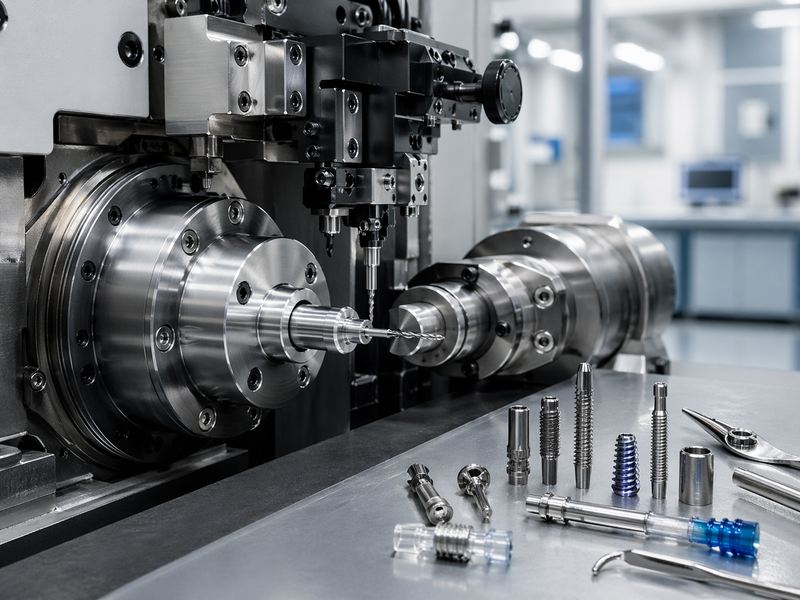
CNC Swiss machining is a precision manufacturing technique that produces small, complex components with remarkable accuracy using Swiss-type CNC lathes. Swiss machines, in contrast to conventional CNC lathes, use a sliding headstock and guiding bushing to support the workpiece near the cutting tool, minimizing vibration and increasing accuracy.
In this process, bar stock material is continuously fed through the machine while multiple tools perform operations such as turning, milling, drilling, and threading simultaneously. This allows for high efficiency and minimal repositioning.
Key Features of Swiss Machining
- Guide bushing for enhanced stability
- Multi-axis, multi-tool operations
- Continuous bar feeding system
- High repeatability for mass production
- Capability for micro-machining
Swiss machines can achieve extremely tight tolerances—often within microns—making them ideal for medical applications where precision is critical.
Swiss Machining’s Advantages for Medical Devices
Components for medical equipment must be accurate, reliable, long-lasting, and compatible with stringent regulations. Swiss machining excels in these areas.
Core Advantages
- Ultra-High Precision
Swiss machines can produce parts with tolerances as tight as ±0.001 mm or better, ensuring accuracy in critical applications. - Consistency and Repeatability
CNC automation ensures that every part in a batch meets identical specifications, which is vital for medical safety and reliability. - Complex Geometry Capability
Swiss machining can create intricate features such as micro-holes, threads, and internal channels that are difficult to achieve with other methods. - High Efficiency in Production
A single configuration can carry out several tasks, cutting cycle times and increasing production. - Miniaturization Support
The technology is ideal for producing extremely small components, sometimes less than 1 mm in diameter.
Applications in Medical Device Manufacturing
Swiss machining is widely used across various segments of the medical industry due to its precision and flexibility.
Common Medical Applications
| Application Category | Typical Components | Key Requirements |
| Surgical Instruments | Scalpels, forceps, clamps | Sharp edges, durability |
| Orthopedic Implants | Bone screws, joint components | Biocompatibility, strength |
| Cardiovascular Devices | Stents, catheter parts | Micro-scale precision |
| Dental Devices | Implants, crowns, abutments | Accuracy, surface finish |
| Diagnostic Equipment | Sensor housings, connectors | Tight tolerances |
| Minimally Invasive Tools | Endoscopic components | Small size, complexity |
Swiss machining is particularly valuable in producing implants, surgical tools, and catheter components, where both precision and surface quality directly impact patient outcomes.
Materials Used in Medical Device Machining in Switzerland
Material selection is critical in medical manufacturing due to requirements for strength, corrosion resistance, and biocompatibility.
Common Materials
| Material Type | Examples | Advantages | Typical Use |
| Stainless Steel | 316L, 17-4 PH | კორrosion resistance, strength | Surgical tools, implants |
| Titanium | Ti-6Al-4V | Lightweight, biocompatible | Orthopedic implants |
| Cobalt-Chrome | CoCr alloys | High wear resistance | Joint replacements |
| Plastics | PEEK, PTFE | Lightweight, non-reactive | Medical housings |
| Aluminum | Various alloys | Easy machining, lightweight | Non-implant devices |
Swiss machining systems can handle both metals and high-performance plastics, enabling manufacturers to produce a wide range of medical components.
Swiss Machining Process Workflow
Understanding the workflow helps highlight why Swiss machining is so efficient and precise.
Methodical Procedure
- CAD modeling and design
The component is meticulously modeled in three dimensions by engineers. - CAM Programming
Software translates the design into machine instructions. - Material Loading
Bar stock is fed into the Swiss machine. - Machining Operations
Multiple tools perform turning, milling, drilling, and threading simultaneously. - In-Process Inspection
Sensors and measurement systems ensure dimensional accuracy. - Finishing & Deburring
Surface treatments improve performance and safety. - Final Quality Inspection
Components undergo rigorous testing and validation.
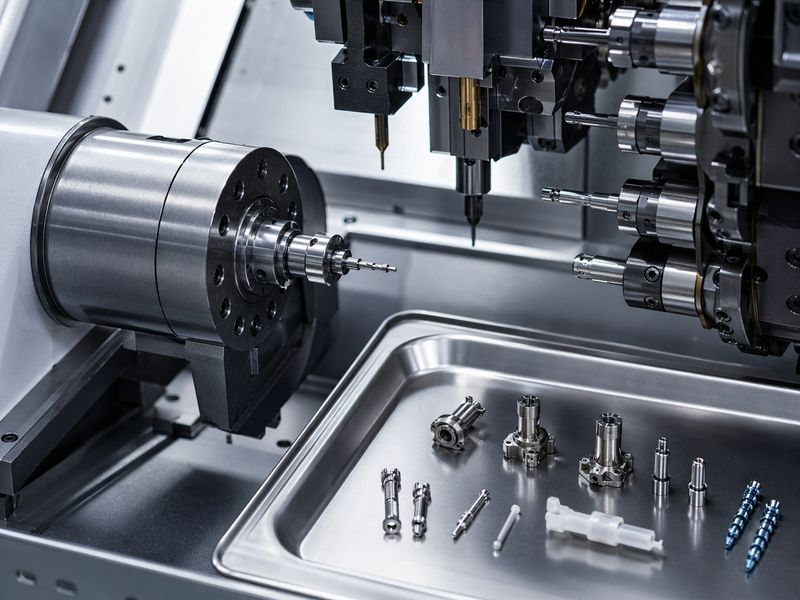
Swiss machines often complete complex parts in a single cycle, reducing errors and improving efficiency.
Quality Standards and Compliance
Medical device manufacturing is heavily regulated, and Swiss machining service providers must adhere to strict standards.
Key Certifications
- ISO 13485 (Medical Device Quality Management)
- ISO 9001 (Quality Management Systems)
- FDA compliance (U.S. market)
- CE marking (European market)
Quality Control Measures
| Quality Aspect | Method | Purpose |
| Dimensional Accuracy | CMM inspection | Ensure tolerance compliance |
| Surface Finish | Profilometers | Improve performance |
| Material Integrity | Testing & certification | Verify biocompatibility |
| Traceability | Batch tracking | Regulatory compliance |
Precision machining ensures that components meet strict safety and performance requirements, which are essential for medical applications.
Comparison: Swiss Machining vs Conventional CNC
| Feature | Swiss Machining | Conventional CNC |
| Precision | Extremely high | High |
| Part Size | Very small, micro parts | Small to large |
| Efficiency | High for complex parts | Moderate |
| Setup Time | Low (single setup) | Higher |
| Production Volume | Ideal for high volume | Flexible |
| Complexity | Excellent for intricate designs | Limited for micro parts |
Swiss machining stands out for small, high-precision, high-volume production, making it the preferred choice for many medical applications.
Advantages for Medical Device Manufacturers
1. Faster Time-to-Market
Swiss machining supports rapid prototyping and iteration, allowing manufacturers to bring products to market faster.
2. Reduced Manufacturing Costs
Although the initial setup may be complex, the ability to complete multiple operations in one cycle reduces labor and production costs.
3. Enhanced Product Performance
Precision components improve device reliability, contributing to better clinical outcomes.
4. Scalability
Swiss machining is perfect for large-scale production as well as prototypes.
Challenges and Considerations
Despite its advantages, Swiss machining also presents some challenges:
Key Challenges
- High initial investment in specialized equipment
- Complex programming requirements
- Limited suitability for large parts
- Need for skilled operators
Manufacturers must carefully evaluate project requirements to determine whether Swiss machining is the best solution.
Choosing the Right Swiss Machining Service Provider
Selecting a reliable partner is essential for success in medical device manufacturing.
Key Selection Criteria
- Experience in medical applications
- Certification (ISO 13485)
- Advanced equipment and technology
- Material expertise
- Quality control capabilities
- Ability to scale production
A qualified provider ensures compliance, quality, and efficiency throughout the manufacturing process.
Swiss machining is essential in modern medical device manufacturing, enabling the production of precise, complex, and consistent components. Its tight tolerances, efficiency, and support for miniaturization help meet strict industry demands and improve product quality. It will continue to be a major technological force behind precision medical device innovation as healthcare develops.