
Sheet metal fabrication is used for automotive parts, enclosures, brackets, cabinets, HVAC components, and custom assemblies. Welding quality affects strength, appearance, accuracy, and performance.
TIG welding offers clean welds and precise control, while MIG welding provides faster speed and higher efficiency. Material, thickness, look, volume, cost, and application all influence the best decision.
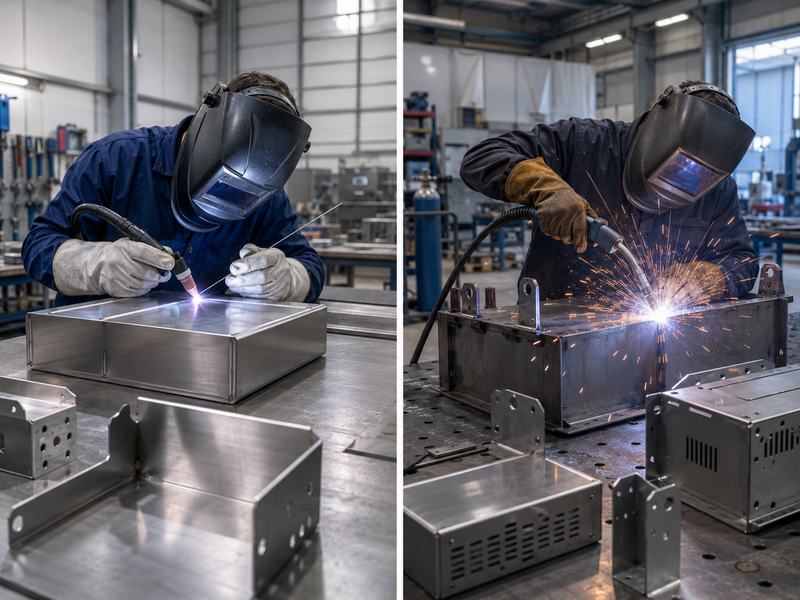
TIG Welding vs MIG Welding: Basic Comparison
| Comparison Item | TIG Welding | MIG Welding |
| Welding process | Uses a tungsten electrode and an optional filler rod | Uses a continuous wire electrode |
| Welding speed | Slower | Faster |
| Weld appearance | Cleaner and more refined | Good, but may need cleanup |
| Skill requirement | Higher | Lower |
| Heat control | Excellent | Moderate to good |
| Best for thin sheet metal | Very suitable | Suitable with proper settings |
| Production efficiency | Lower | Higher |
| Cost per part | Usually higher | Usually lower |
| Common use | Precision parts, visible welds, stainless steel, aluminum | Batch production, structural parts, general fabrication |
Both TIG and MIG welding can produce strong results. However, their advantages are different. For precision control and aesthetics, TIG welding works better. MIG welding is better for speed and production efficiency.
Sheet Metal Thickness and Welding Method Selection
Sheet metal is usually thinner than plate metal, so heat control is very important. For precision control and aesthetics, TIG welding works better. Overheating can result in deformation, warping, burn-through, or an unsightly surface.
TIG welding offers better control when working with very thin materials. The operator can carefully control the arc, heat input, and filler addition. This makes TIG welding a good choice for thin stainless steel panels, aluminum covers, decorative parts, and high-precision assemblies.
Thin sheet metal can also be welded with MIG, but the welding parameters need to be carefully controlled. Wire diameter, voltage, travel speed, gas flow, and welding technique all affect the final result. For high-volume sheet metal production, MIG welding can be very efficient when the process is well controlled.
| Sheet Thickness | Recommended Process | Reason |
| Very thin sheet metal | TIG welding | Better heat control and lower burn-through risk |
| Thin to medium sheet metal | TIG or MIG welding | Depends on appearance, quantity, and cost |
| Medium sheet metal parts | MIG welding | Faster and more efficient |
| Thick welded assemblies | MIG welding | Better deposition rate and production speed |
| Visible decorative welds | TIG welding | Cleaner weld bead and better appearance |
Weld Quality and Appearance
Appearance is one of the biggest differences between TIG and MIG welding.
TIG welding usually creates smooth, neat, and visually appealing welds. It produces less spatter and often requires less post-weld cleanup. For products where the weld is visible, such as stainless steel enclosures, food-grade equipment, decorative panels, display fixtures, and premium custom parts, TIG welding is often preferred.
MIG welding can also create good welds, but it usually produces more spatter than TIG welding. Depending on the product requirements, MIG welds may need grinding, polishing, or surface finishing after welding. For hidden welds or structural joints where appearance is less critical, MIG welding is often a practical choice.
| Quality Factor | TIG Welding | MIG Welding |
| Weld bead appearance | Excellent | Good |
| Spatter level | Very low | Higher than TIG |
| Post-weld cleanup | Usually less | May require more |
| Precision control | High | Moderate |
| Risk of distortion | Lower with proper control | Higher if heat input is not controlled |
| Suitable for visible welds | Very suitable | Suitable after finishing |
Welding Speed and Production Efficiency
MIG welding is usually much faster than TIG welding. The continuous wire feeding system allows operators to weld longer seams quickly. This makes MIG welding a strong choice for high-volume sheet metal fabrication.
For example, if a manufacturer needs to produce hundreds or thousands of welded brackets, frames, boxes, or cabinet structures, MIG welding can reduce labor time and improve production output.
Because the operator frequently utilises two hands—one for the flame and one for the filler rod—TIG welding is slower. It also requires more attention to heat input and weld pool control. However, the slower speed can be worthwhile when the part requires high precision or excellent appearance.
| Production Factor | TIG Welding | MIG Welding |
| Welding speed | Slow | Fast |
| Labor time | Higher | Lower |
| Suitable for mass production | Limited | Very suitable |
| Suitable for custom precision work | Very suitable | Suitable |
| Operator fatigue | Higher for long welds | Lower for long welds |
| Productivity | Lower | Higher |
For production-focused sheet metal fabrication, MIG welding often offers better efficiency. For quality-focused or appearance-focused fabrication, TIG welding may be worth the extra time.
Material Compatibility
Both TIG and MIG welding can be used on many metals, but the best choice depends on material type and project requirements.
Because TIG welding offers excellent control and smooth welds, it is frequently used for aluminium and stainless steel. It is also suitable for copper, titanium, and specialty metals when high-quality welding is required.
Aluminium, stainless steel, and carbon steel are common materials for MIG welding. It is especially well-liked in general industrial fabrication since it offers a great combination of strength, speed, and cost.
| Material | TIG Welding | MIG Welding |
| Carbon steel | Good for precision work | Very common and efficient |
| Stainless steel | Excellent appearance and control | Good for production welding |
| Aluminum | Excellent for thin and clean welds | Good for faster production |
| Galvanized steel | Possible, but coating must be considered | Common, but fumes and coating issues must be controlled |
| Copper | Suitable with skill and control | More difficult |
| Titanium | Very suitable for high-quality welding | Less common |
For stainless steel sheet metal products that require clean appearance, TIG welding is often preferred. For carbon steel sheet metal frames or enclosures, MIG welding is usually more cost-effective.
Distortion and Heat Control
Heat Control and Distortion Sheet metal is heat-sensitive. If too much heat is applied, the material can warp, shrink, or deform. This is especially important for large flat panels, thin enclosures, precision covers, and visible surfaces.
The operator has more control over heat input when using TIG welding. This helps reduce burn-through and distortion when welding thin parts. However, because TIG welding is slower, heat can still build up if the process is not managed properly.
MIG welding is faster, but it can introduce more heat if the settings are not correct. Poor technique may cause excessive penetration, burn-through, spatter, or warping. To control distortion, manufacturers may use fixtures, tack welding, staggered welding, back-step welding, and proper cooling control.
| Distortion Control Method | Purpose |
| Proper fixture design | Holds sheet metal in the correct position |
| Tack welding | Prevents movement before final welding |
| Controlled heat input | Reduces warping and burn-through |
| Balanced welding sequence | Distributes heat more evenly |
| Short weld sections | Prevents excessive heat buildup |
| Post-weld inspection | Checks dimensional accuracy |
A reliable sheet metal fabrication manufacturer should understand how to control distortion, not just complete the weld.
Cost Differences Between TIG and MIG Welding
Cost is another important factor when choosing between TIG and MIG welding. In most cases, TIG welding costs more than MIG welding because it is slower and requires more skilled labor.
MIG welding usually has a lower cost per part, especially for medium and large production runs. It is faster, easier to automate, and more efficient for long welds.
However, the lowest welding cost is not always the best choice. If MIG welding creates more spatter, distortion, or surface defects, additional grinding and finishing may increase the total cost. For visible stainless steel or aluminum parts, TIG welding may reduce finishing work and improve final product quality.
| Cost Factor | TIG Welding | MIG Welding |
| Labor cost | Higher | Lower |
| Equipment cost | Moderate | Moderate |
| Production speed | Lower | Higher |
| Finishing cost | Usually lower | May be higher |
| Best for small precision orders | Yes | Sometimes |
| Best for high-volume production | Less suitable | Very suitable |
The best choice should be based on total project cost, not welding cost alone.
Power and Efficiency
When done properly, both TIG and MIG welding can result in strong welds. Weld strength depends on material preparation, joint design, welding parameters, filler material, shielding gas, penetration, and operator skill.
Strong, clean, and superior welds can be produced by TIG welding, especially on thin materials and precision components. MIG welding can also produce strong welds and is often used in structural sheet metal assemblies.
For load-bearing parts, the manufacturer should consider joint type, weld size, penetration depth, material thickness, and inspection standards. A good-looking weld is not always a strong weld, and a strong weld is not always the cleanest-looking weld. Engineering requirements should guide the welding process.
Common Applications in Sheet Metal Fabrication
TIG welding and MIG welding are used in different sheet metal products depending on function and appearance.
| Application | Preferred Welding Method | Reason |
| Stainless steel food equipment | TIG welding | Clean welds and easy finishing |
| Electrical enclosures | MIG or TIG welding | Depends on appearance and quantity |
| Automotive brackets | MIG welding | Fast and cost-effective |
| Aluminum covers | TIG welding | Better control on thin aluminum |
| Machinery guards | MIG welding | Efficient for industrial production |
| Decorative metal products | TIG welding | Better weld appearance |
| Sheet metal frames | MIG welding | Strong and efficient |
| Prototype sheet metal parts | TIG welding | Flexible and precise |
For custom sheet metal fabrication, many manufacturers use both TIG and MIG welding in the same factory. The right process is selected according to each part.
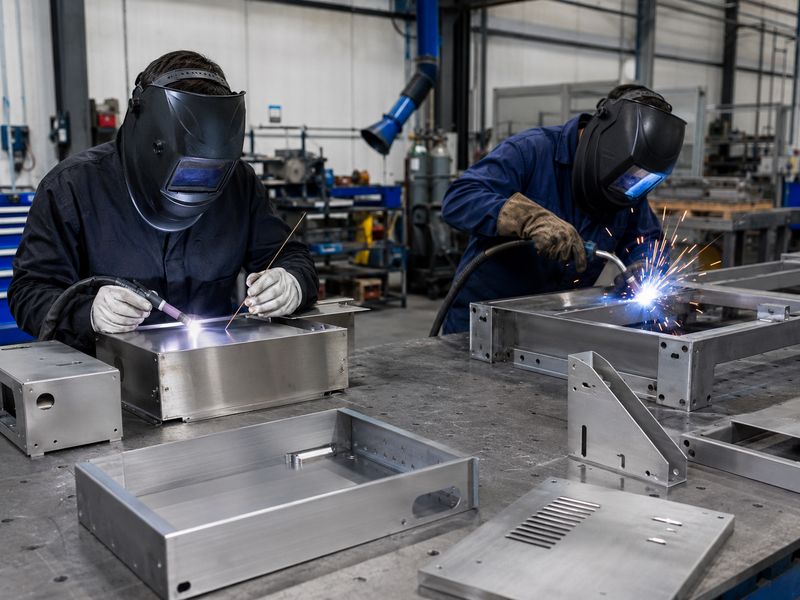
How to Choose Between TIG and MIG Welding
When choosing between TIG and MIG welding for sheet metal fabrication, buyers should not make the decision only based on price. The better method depends on the product’s actual needs.
Choose TIG welding when:
- The sheet metal is very thin.
- The weld is visible.
- Appearance quality is important.
- The material is stainless steel or aluminum.
- The project requires high precision.
- The order quantity is small or customized.
- Lower spatter and cleaner welds are required.
Choose MIG welding when:
- Production speed is important.
- The order quantity is large.
- Weld appearance is not the top priority.
- The material is carbon steel or medium-thickness sheet metal.
- The project requires cost-effective welding.
- Long weld seams are needed.
- Parts need strong and efficient assembly.
| Decision Point | Better Choice |
| Best appearance | TIG welding |
| Fastest production | MIG welding |
| Lowest labor cost | MIG welding |
| Thin stainless steel | TIG welding |
| High-volume carbon steel parts | MIG welding |
| Precision custom parts | TIG welding |
| Industrial welded frames | MIG welding |
| Reduced spatter | TIG welding |
Importance of a Reliable Fabrication Manufacturer
The welding method is important, but the manufacturer’s experience is even more important. Poor TIG welding can still cause defects. Poor MIG welding can lead to spatter, weak joints, and distortion. A professional sheet metal fabrication manufacturer should understand both processes and recommend the right one based on your drawings, material, tolerance, and final application.
Before choosing a supplier, check whether they can provide:
- Welding process recommendations
- Material and thickness analysis
- Fixture design support
- Sample production
- Dimensional inspection
- Surface finishing
- Batch production control
- Packaging and delivery support
For custom sheet metal fabrication, the best supplier is not always the one that only follows instructions. A good manufacturer should review your design and help improve manufacturability, cost efficiency, and final product quality.
Conclusion
TIG and MIG welding are both widely used in sheet metal fabrication. TIG welding offers better heat control, cleaner welds, less spatter, and a finer appearance, making it suitable for thin metal, stainless steel, aluminum, visible welds, and precision parts. MIG welding is faster, easier to operate, and more cost-effective, making it ideal for batch production, carbon steel parts, frames, brackets, and structural assemblies.
The best choice depends on material, thickness, appearance, strength, volume, budget, and delivery time. Many projects use TIG for visible or precision areas and MIG for structural or hidden joints. Customers can select the best welding solution and lower production risks by being aware of these variations.