
Forging is a strong manufacturing method that improves metal grain structure, strength, impact resistance, fatigue performance, and durability. Closed die forging suits high-volume, accurate, complex parts, while open die forging is better for large, simple, heavy-duty, or low-volume custom parts. This guide compares both methods to help you choose the right process for cost, quality, machining, and production efficiency.
What Is Closed Die Forging?
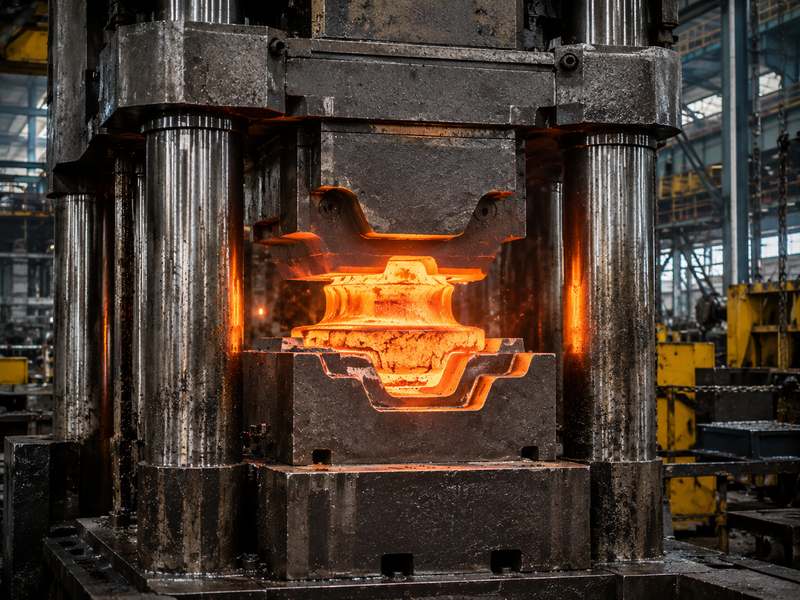
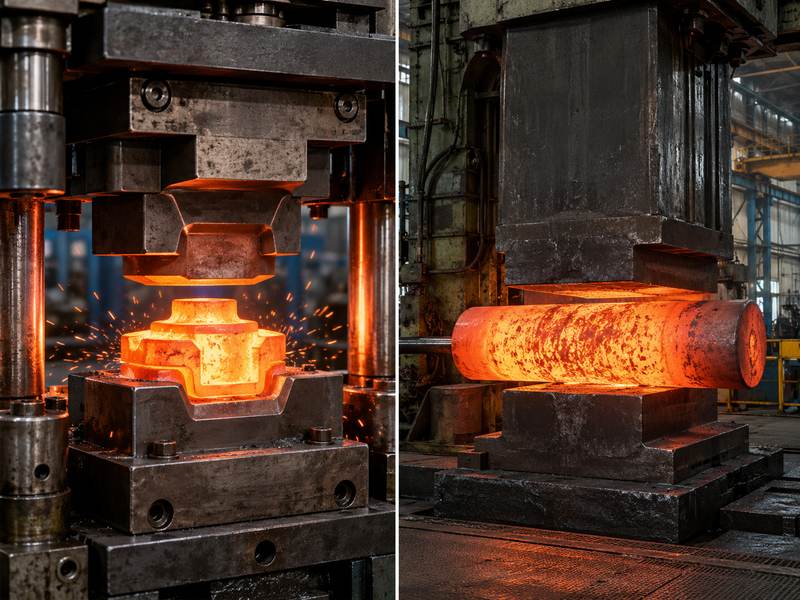
Closed die forging, also called impression die forging, creates a certain part geometry by heating metal and using shaped dies. The metal billet is sandwiched between two or more dies. When pressure is applied, the metal flows into the die cavity and takes on the required shape.
Because the die cavity controls the final shape, closed die forging can produce parts with more complex details, better dimensional accuracy, and more consistent repeatability.
You may choose closed die forging for parts such as:
- Automotive connecting rods
- Gear blanks
- Crankshafts
- Flanges
- Valve bodies
- Hand tools
- Agricultural machinery parts
- Aerospace brackets
- Industrial hardware
- Precision mechanical components
Closed die forging is especially useful when you need many identical parts with stable quality.
What Does Open Die Forging Mean?
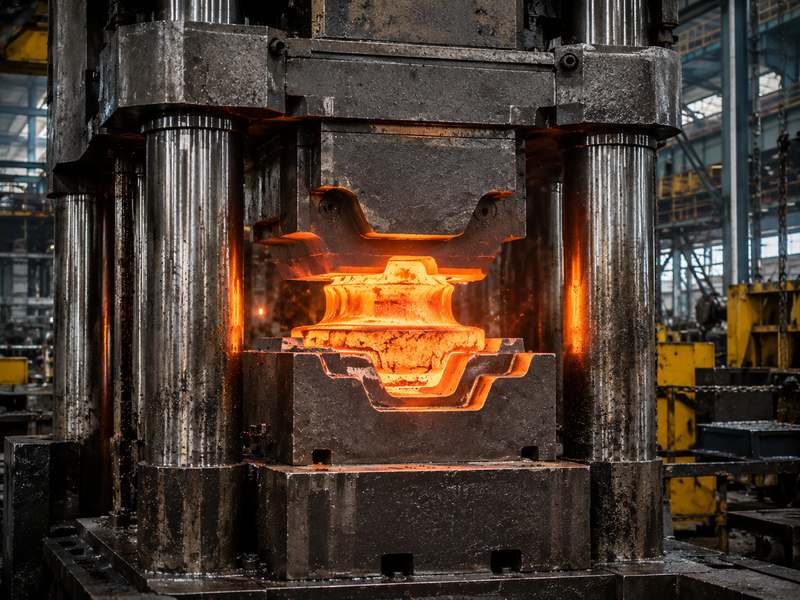
In open die forging, metal is compressed and shaped using flat or basic dies. The metal is not completely contained within a formed chamber, unlike closed die forging. Instead, the workpiece is gradually formed through repeated pressing, hammering, rotating, and repositioning.
The operator or forging machine controls the shape by moving the material between the dies. Because the dies are open, this process can handle very large parts and flexible custom shapes.
You may choose open die forging for parts such as:
- Large shafts
- Rings
- Discs
- Bars
- Blocks
- Cylinders
- Pressure vessel parts
- Heavy equipment components
- Marine shafts
- Power generation components
- Oil and gas parts
Open die forging is common when your part is too large for closed die tooling or when your production volume is low.
Closed Die Forging vs Open Die Forging: Basic Comparison
| Factor | Closed Die Forging | Open Die Forging |
| Die Type | Shaped die cavity | Flat or simple dies |
| Part Complexity | Better for complex shapes | Better for simple shapes |
| Size Range | Small to medium parts | Medium to very large parts |
| Production Volume | Better for medium to high volume | Better for low volume or custom parts |
| Tooling Cost | Higher | Lower |
| Dimensional Accuracy | Better | Lower |
| Material Waste | Moderate, often with flash | Lower in some simple parts |
| Machining Requirement | Usually less machining | Often more machining |
| Repeatability | High | Depends more on process control |
| Typical Use | Precision forged components | Large heavy-duty forged parts |
Key Difference 1: Die Design and Tooling Cost
The biggest difference between closed die forging and open die forging is the die design.
In closed die forging, your supplier needs to create custom dies with cavities that match your part shape. These dies require engineering, machining, heat treatment, and testing. Because of this, the initial tooling cost is usually higher.
However, once the die is made, it can produce many parts with a consistent shape and quality. If your order quantity is large enough, the tooling cost can be spread across many pieces, reducing the unit cost.
When it comes to open die forging, the dies are typically flat, V-shaped, round, or possess a simple design. You do not need a dedicated die cavity for every part design. This makes open die forging more flexible and usually reduces upfront tooling cost.
If your project requires only a few large components, open die forging may be more economical. If your project requires thousands of similar parts, closed die forging may give you better long-term cost efficiency.
Key Difference 2: Part Shape and Complexity
Closed die forging is better when your part has a defined shape, complex contour, ribs, bosses, holes, steps, or special geometry. Since the metal flows into the die cavity, the part can be formed closer to the final shape.
This near-net-shape capability can reduce machining time and material removal.
Open die forging is better for simpler shapes, such as shafts, rings, discs, blocks, bars, and cylinders. It gives you more flexibility for large dimensions, but it usually cannot create detailed shapes directly. If your final part has complex features, you may need more CNC machining after forging.
For example, if you need a small automotive suspension part with complex geometry, closed die forging is usually better. If you need a large turbine shaft or heavy industrial ring, open die forging is often the better choice.
Key Difference 3: Size and Weight Capacity
Open die forging has a major advantage when you need large or heavy parts. Since the metal is not restricted inside a closed cavity, open die forging can handle large workpieces that may weigh hundreds, thousands, or even tens of thousands of kilograms.
This makes open die forging suitable for heavy industries such as:
- Power generation
- Oil and gas
- Shipbuilding
- Mining equipment
- Heavy machinery
- Pressure vessels
- Large transmission systems
Closed die forging is usually better for small to medium-sized parts. Large closed dies are expensive, difficult to manufacture, and require powerful forging equipment. For very large parts, closed die forging may become impractical or too costly.
If your component is very large, open die forging is usually the more realistic choice.
Key Difference 4: Dimensional Accuracy
Closed die forging generally provides better dimensional accuracy because the die cavity controls the final shape. This makes it easier to achieve consistent size, geometry, and part-to-part repeatability.
However, forged parts may still require machining after forging, especially for precision surfaces, holes, threads, and assembly areas.
Open die forging has lower dimensional accuracy because the final shape depends more on the forming process, operator skill, machine control, and repeated deformation steps. The forged blank is often intentionally made larger than the final size, then machined to the required dimensions.
If your project needs tighter dimensional control with less machining, closed die forging is usually better.
Key Difference 5: Material Flow and Mechanical Properties
By fine-tuning the metal’s grain structure, both open die forging and closed die forging can increase mechanical strength. However, the grain flow is controlled differently.
In closed die forging, the material flows into the shape of the die cavity. This can create favorable grain flow that follows the part geometry, improving strength in critical areas. This is one of the reasons why closed die forged parts are extensively utilized in the automotive and aerospace industries.
Through repeated deformation, the material is crushed and extended during open die forging. This can dismantle internal defects, fine-tune grain structure, and enhance toughness. It is especially useful for large components where internal soundness is important.
Both methods can produce strong parts, but your choice should depend on the part geometry, load direction, material, and performance requirements.
Key Difference 6: Production Volume
Production volume is one of the most important decision factors.
Closed die forging is usually more suitable when you need medium to high production volume. At first, the cost of the tooling is higher, but as you make more pieces, the procedure gets more economical.
Open die forging is often better when you need low-volume production, prototype forging, custom heavy parts, or one-off components. Since dedicated shaped dies are not required, you can start production with lower tooling investment.
| Production Requirement | Better Choice | Reason |
| 1–10 custom heavy parts | Open die forging | Lower tooling cost and flexible shaping |
| Small batch industrial parts | Open die forging or closed die forging | Depends on complexity and tolerance |
| Medium-volume parts | Closed die forging | Better repeatability and lower unit cost |
| High-volume parts | Closed die forging | Tooling cost is spread across many parts |
| Very large components | Open die forging | Better size capacity |
Key Difference 7: Machining Allowance
Closed die forging usually produces parts closer to the final shape. This means you may need less machining after forging. Less machining can reduce material waste, shorten production time, and lower total cost.
Open die forging usually requires a larger machining allowance. The forged shape is often a rough blank that needs CNC machining to reach final dimensions and surface finish.
However, open die forging can still be cost-effective for large parts because creating closed dies for such parts would be too expensive.
When comparing costs, you should not only look at the forging price. You should also consider:
- Tooling cost
- Forging cost
- Material waste
- Heat treatment
- CNC machining cost
- Inspection cost
- Lead time
- Scrap risk
- Final part performance
The cheapest forging process is not always the lowest-cost complete solution.
Advantages of Closed Die Forging
Closed die forging offers several clear advantages when your part design and production quantity match the process.
Main advantages include:
- Better shape accuracy
- High repeatability
- Suitable for complex geometries
- Good surface consistency
- Less machining required
- Strong grain flow around part shape
- Good for medium and high-volume production
- Lower unit cost at larger quantities
- Suitable for precision mechanical parts
Closed die forging is a strong choice when you need consistent forged parts with controlled geometry.
Limitations of Closed Die Forging
Closed die forging also has some limitations that you should consider.
Possible limitations include:
- Higher initial tooling cost
- Longer tooling development time
- Less flexible for design changes
- Not ideal for very large parts
- Die wear must be controlled
- Flash trimming may be required
- Not cost-effective for very low quantities
If your design is still changing, you may want to test the part by machining or open die forging before investing in closed die tooling.
Advantages of Open Die Forging
Open die forging is highly valuable for large, simple, or custom components.
Main advantages include:
- Lower tooling cost
- Suitable for very large parts
- Flexible for custom sizes
- Good internal grain refinement
- Suitable for low-volume production
- Useful for shafts, rings, discs, and bars
- Good for heavy-duty industrial applications
- Easier to adjust dimensions during forging
Open die forging is often the practical choice when your part is too large or too low-volume for closed die forging.
Limitations of Open Die Forging
Open die forging may not be suitable for every project.
Possible limitations include:
- Lower dimensional accuracy
- More machining required
- Not ideal for complex shapes
- Lower repeatability than closed die forging
- More dependent on process control
- Rougher forged shape
- Longer finishing work for precision parts
If your final component needs a detailed shape, tight tolerance, and high repeatability, open die forging may increase downstream machining costs.
Which Forging Method Should You Choose?
You should choose closed die forging if your part has a defined shape, medium to high production volume, tighter dimensional requirements, and complex geometry. It is usually better when you want repeatable parts with less machining.
You should choose open die forging if your part is large, simple, low-volume, or custom-sized. It is also better when the upfront tooling cost is low or when the part is too large for closed die tooling.
| Your Requirement | Recommended Process |
| Complex shape | Closed die forging |
| Simple shaft, ring, disc, or block | Open die forging |
| High production volume | Closed die forging |
| Low production volume | Open die forging |
| Very large component | Open die forging |
| Tight repeatability | Closed die forging |
| Lower tooling investment | Open die forging |
| Less machining after forging | Closed die forging |
| Heavy-duty custom blank | Open die forging |
Questions You Should Ask Your Forging Supplier
Before you place an order, you should discuss your part requirements with your forging supplier. A professional supplier can help you decide which process gives you the best balance of strength, cost, and manufacturability.
Useful questions include:
- Is my part more suitable for closed die forging or open die forging?
- What material grade do you recommend?
- What forging tolerance can you achieve?
- How much machining allowance should I reserve?
- Do I need heat treatment after forging?
- What is the expected tooling cost?
- What is the minimum order quantity?
- Can you provide prototype samples?
- What inspection reports can you provide?
- Can you support CNC machining after forging?
These questions help you avoid wrong process selection and unexpected production costs.
Common Buyer Mistakes to Avoid
When you compare closed die forging and open die forging, avoid choosing only based on unit forging price. The total cost of your finished part is more important.
Common mistakes include:
- Choosing closed die forging for very low-volume parts
- Choosing open die forging for complex high-volume parts
- Ignoring machining allowance
- Not considering tooling cost
- Underestimating the lead time for die development
- Not defining tolerance requirements
- Forgetting heat treatment needs
- Ignoring grain flow and load direction
- Providing incomplete drawings
- Comparing quotes without checking the process scope
A clear drawing, material specification, quantity estimate, and application description can help your supplier recommend the right forging method.
Conclusion
Closed die forging is ideal for complex shapes, higher accuracy, repeatability, and medium to high volumes. Open die forging suits large parts, simple shapes, flexible sizes, lower tooling costs, and low-volume custom production. The best choice depends on part size, shape, quantity, tolerance, material, performance needs, machining plan, and total process cost.